

Most B2B email campaigns fail because they treat the email inbox like a website, overwhelming recipients with lengthy content. SaaS marketing managers spend hours crafting what they believe are perfect emails, only to watch open rates plateau and replies dwindle. The problem isn’t effort or intent. It’s a fundamental misunderstanding of how busy decision makers interact with their inboxes versus browsing websites. This article reveals the core pitfalls sabotaging your campaigns and offers a research-driven framework to transform generic outreach into strategically sequenced messages that generate real engagement.
Table of Contents
- Understanding Why Generic Email Campaigns Fail In B2B SaaS
- Common Pitfalls: Poor Segmentation, Targeting, And Homogenization
- Misconceptions About Email Personalization In B2B Outreach
- Framework For Designing Contextualized, High-Impact Email Campaigns
- Practical Steps For B2B SaaS Marketing Managers To Fix Failing Email Campaigns
- Summary: Transforming Email Campaigns From Failures To Drivers Of Growth
- Enhance Your B2B SaaS Email Outreach With Mailly AI Platform
Key takeaways
| Point | Details |
|---|---|
| Inbox behavior differs from website engagement | Recipients scan emails in seconds, not minutes, requiring concise, curiosity-driven messages instead of mini landing pages. |
| Generic targeting causes fatigue and low response | Mass emailing broad lists with templated AI content homogenizes messaging, reducing novelty and harming sender reputation. |
| Superficial personalization backfires | Context-free token replacements create recipient fatigue, while meaningful personalization requires deep research into buyer priorities. |
| Contextual research boosts reply rates dramatically | Targeted, multi-touch campaigns achieve response rates 7 to 9 times higher than generic blasts by aligning offers with actual business needs. |
| Psychological sequencing drives sustained engagement | Mapping email sequences to buyer decision stages increases replies to 15 to 25 percent compared to random send patterns. |
Understanding why generic email campaigns fail in B2B SaaS
The inbox operates on completely different rules than a website. When someone visits your site, they’re actively seeking information and willing to scroll through detailed copy. In an inbox, that same person is triaging dozens of messages in minutes, deciding within seconds whether to engage or delete.
Yet emails often written as mini landing pages overwhelm recipients, leading to plateaued open rates and stalled click-throughs. Marketing managers pack initial emails with product features, case studies, testimonials, and multiple CTAs, believing more information equals more value. The opposite is true.
Consider these behavioral realities that doom generic approaches:
- Decision makers scan subject lines and preview text in under three seconds before deciding to open
- Opened emails get skimmed in another five to ten seconds unless something immediately relevant catches attention
- Dense paragraphs and multiple asks trigger deletion, not action
- Generic value propositions like “increase efficiency” or “reduce costs” blend into the noise of identical competitor messages
Short, curiosity-driven emails that acknowledge a specific business context perform dramatically better. The goal of your first email isn’t to close a deal or even book a meeting. It’s to spark enough curiosity that the recipient reads your next message. By optimizing outreach relevance through contextual hooks rather than feature dumps, you respect inbox behavior and increase engagement.
Pro Tip: Test your emails by reading only the first two sentences. If they don’t immediately signal relevance to a specific recipient challenge, rewrite them. Generic openings like “Hope this finds you well” or “I wanted to reach out” waste precious attention.
Understand B2B email marketing failure reasons stem from treating reactive triage behavior like proactive browsing. Once you shift your mindset from information delivery to conversation initiation, campaign performance transforms.
Common pitfalls: poor segmentation, targeting, and homogenization
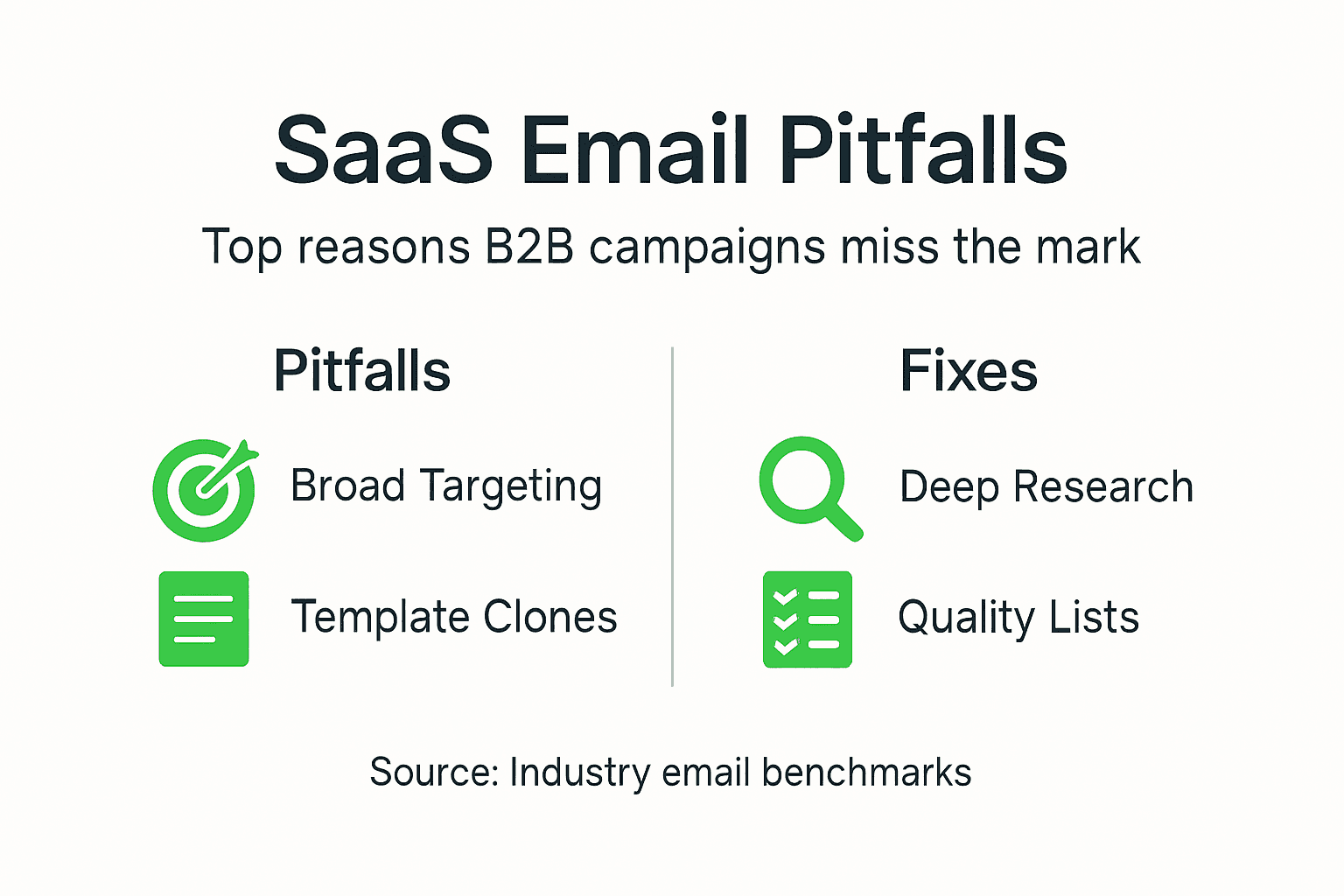
Broad targeting sabotages even well-written emails. When you email thousands of loosely qualified contacts, open rates drop, unsubscribe rates climb, and sender reputation degrades. Email service providers notice these signals and route future messages to spam folders, creating a vicious cycle.

The rise of AI tools promised to solve personalization at scale, but mass template usage homogenizes emails, causing reduced engagement as recipients receive many identical messages daily. Marketing managers use the same AI prompts, generating nearly identical subject lines and opening hooks across competing vendors. Recipients quickly recognize the pattern and tune out.
Here’s how poor segmentation and homogenization compound to kill campaigns:
- Purchasing broad contact lists without qualifying ICP fit leads to irrelevant outreach that damages brand perception
- Sending high volumes of templated emails floods inboxes, triggering recipient fatigue even if individual messages seem personalized
- Generic segmentation by job title alone ignores critical context like company stage, recent funding, technology stack, or strategic priorities
- Overusing popular AI tools without customization creates messages indistinguishable from dozens of competitors
Recipient fatigue manifests quickly. A prospect who receives three similar “AI-personalized” emails in one week from different vendors stops reading any of them. Your carefully crafted fourth message gets lumped into the same mental category and deleted unread.
Pro Tip: Before launching any campaign, manually review a sample of target accounts. Can you identify at least two specific business triggers or contextual factors that make your offer timely and relevant? If not, your segmentation is too broad.
Effective cold outreach tips for SaaS teams emphasize quality over quantity. Rigorous list qualification, where you research each account’s strategic priorities before inclusion, dramatically improves response rates while reducing list size. Smaller, deeply researched lists outperform large, superficially segmented ones every time.
Avoid email template homogenization issues by treating AI as a research assistant, not a copywriter. Use it to analyze company data and suggest angles, then craft unique messages that reflect genuine understanding of each prospect’s situation.
Misconceptions about email personalization in B2B outreach
Marketing managers often believe personalization means inserting first names, company names, and recent LinkedIn posts into templates. This surface-level approach fails because it lacks meaningful context. Recipients immediately recognize these tactics and mentally categorize messages as automated outreach, not genuine communication.
Overuse of AI-generated personalization templates leads to message fatigue and reduced replies despite surface-level customization. The problem isn’t personalization itself. It’s the mismatch between effort signaled and value delivered. When an email mentions a prospect’s recent LinkedIn post but then pitches an irrelevant product, the personalization feels manipulative rather than helpful.
Common faulty beliefs that sabotage campaigns include:
- More personalization tokens automatically increase reply rates, regardless of relevance
- Mentioning any recent company news demonstrates research and builds credibility
- Volume compensates for shallow personalization, allowing spray-and-pray tactics with name insertions
- AI tools can replicate deep account research and strategic positioning at scale without human oversight
These misconceptions lead to diminishing returns. Early adopters of AI personalization saw initial boosts in engagement. As the tactic became widespread, recipients grew numb to it. Now, generic personalization often performs worse than honest, direct outreach that acknowledges its automated nature.
Meaningful personalization requires understanding a prospect’s specific business bottlenecks, strategic priorities, and decision-making context. This means researching product architecture, monetization models, competitive positioning, and hiring signals to identify real problems your solution addresses. Surface-level observations about company size or industry don’t qualify.
Pro Tip: If you can’t explain in one sentence why your offer is uniquely timely for this specific prospect right now, your personalization isn’t deep enough. Timely relevance beats generic customization every time.
The benefits of true personalization emerge when messages demonstrate genuine understanding of recipient challenges and position solutions as responses to their current priorities. This level of insight can’t be automated with simple data enrichment. It requires strategic analysis that connects dots between company context and offer positioning.
Address misconceptions about personalization by shifting from token replacement to contextual framing. Your goal isn’t proving you know details about the recipient. It’s demonstrating you understand their business well enough to offer something genuinely useful at this moment.
Framework for designing contextualized, high-impact email campaigns
Traditional volume-based campaigns and contextual sequencing campaigns produce radically different results. Understanding these differences helps you design outreach that actually works.
| Approach | Volume-Based Campaigns | Contextual Sequencing Campaigns |
|---|---|---|
| List Size | Thousands of loosely qualified contacts | Hundreds of rigorously researched accounts |
| Research Depth | Job title and industry only | Product architecture, monetization, competitive positioning, hiring signals |
| Personalization | Token replacement in templates | Strategic offer reframing based on business priorities |
| Sequence Design | Random timing or arbitrary intervals | Psychologically mapped to buyer decision stages |
| Response Rate | 0.5% to 2% typical | 15% to 25% achievable |
Targeted, multi-touch campaigns achieve 6.8% to 9.2% response rates, 7 to 9 times higher than generic blasts. These results stem from a framework that prioritizes relevance over reach.
Follow this stepwise approach to transform your campaigns:
- Conduct deep ICP analysis to identify companies facing specific problems your solution addresses, not just those matching demographic criteria
- Research each target account’s strategic context including recent funding, product launches, competitive threats, and organizational changes
- Segment prospects by business trigger and priority alignment, not just firmographic data
- Design email sequences that map to psychological buying stages, starting with problem awareness and building toward solution evaluation
- Craft initial messages that demonstrate contextual understanding without pitching, sparking curiosity rather than requesting meetings
- Apply measured personalization focused on strategic relevance, not superficial details
Psychological sequencing means your second email acknowledges the first without being pushy. Your third email introduces social proof only after establishing relevance. Each message builds on previous ones, creating momentum rather than repeating the same ask.
Relevance-driven outreach improves engagement by over 50% compared to generic offers. This improvement stems from treating each prospect as a unique business facing specific challenges, not as a demographic segment to be targeted with one-size-fits-all messaging.
The email campaign psychology framework emphasizes matching message intensity and ask complexity to recipient readiness. Early emails plant seeds. Middle sequence messages nurture interest. Late sequence messages convert engagement into conversations. This gradual escalation respects buyer psychology and dramatically outperforms aggressive early asks.
Implement this cold email relevance guide by starting small. Test the framework on 50 deeply researched accounts before scaling. Measure not just open and reply rates, but conversation quality and meeting conversion. High-quality conversations from smaller lists generate more pipeline than high-volume campaigns with low engagement.
Review B2B multi-touch campaign response data to understand how properly sequenced outreach compounds engagement over time. Each relevant touchpoint increases the probability that your next message gets read and considered seriously.
Explore the engagement impact of contextual research through A/B testing. Run parallel campaigns with identical list sizes but different research depths. The deeply researched cohort will consistently outperform the superficially segmented one, often by multiples rather than percentages.
Practical steps for B2B SaaS marketing managers to fix failing email campaigns
Transforming underperforming campaigns requires concrete action, not just conceptual understanding. Start with these prioritized steps to implement the contextual framework effectively.
First, audit your current prospect list ruthlessly. Remove any contact who doesn’t clearly fit your ICP based on deep analysis of their company’s strategic priorities, technology stack, and business model. A smaller, highly qualified list outperforms a large, loosely targeted one. Aim for quality thresholds where you can articulate specific business triggers for at least 80% of your targets.
Second, redesign your research process to gather strategic intelligence, not just demographic data. Investigate target companies’ product architecture, monetization approaches, recent organizational changes, competitive pressures, and hiring patterns. This contextual information enables you to position your offer as a response to their specific situation rather than a generic solution.
Third, use AI tools to augment human insight, not replace it. Let AI analyze company data and suggest positioning angles, but write final copy yourself to ensure uniqueness and strategic alignment. Avoid the temptation to generate entire email sequences with AI prompts. The resulting homogenization will undermine your efforts.
Fourth, map your email sequences to buyer psychology stages rather than arbitrary time intervals:
- Message one establishes relevance by acknowledging a specific business context or challenge
- Message two builds credibility by sharing a relevant insight, case study, or industry observation
- Message three introduces social proof from similar companies facing comparable challenges
- Message four makes a soft ask to continue the conversation, framed as offering value rather than requesting time
Fifth, track metrics beyond open and reply rates. Monitor conversation quality, meeting conversion rates, and pipeline contribution. These downstream metrics reveal whether your improved relevance translates into actual business results. Many essential outreach metrics focus too heavily on top-of-funnel vanity numbers that don’t correlate with revenue.
Sixth, implement continuous testing with controlled cohorts. Maintain a baseline campaign while testing variations in research depth, sequence timing, and message positioning. This disciplined approach identifies what actually drives improvement versus what feels intuitively better but doesn’t move metrics.
Seventh, review these cold emailing steps for SaaS to ensure your execution aligns with strategic intent. Small tactical mistakes like poor subject lines or unclear CTAs can undermine otherwise strong campaigns.
Finally, commit to ongoing refinement. Email campaign effectiveness isn’t a one-time fix but a continuous optimization process. Regularly refresh your ICP criteria, update your research approach as new data sources emerge, and refine your psychological sequencing based on response patterns.
Summary: transforming email campaigns from failures to drivers of growth
Generic, poorly targeted email campaigns fail because they ignore fundamental differences between inbox behavior and website engagement. When you treat busy decision makers’ inboxes like landing pages to be filled with dense content, you guarantee low engagement and high unsubscribe rates.
The path forward requires shifting from volume-based spray-and-pray tactics to contextual, research-driven outreach. Deep ICP analysis, strategic positioning based on business priorities, and psychologically sequenced messaging transform cold emails from interruptive noise into valuable conversations. Targeted campaigns achieve response rates 7 to 9 times higher than generic blasts precisely because they respect recipient time and demonstrate genuine understanding.
Superficial personalization using AI-generated templates creates homogenization and fatigue. Meaningful personalization requires investigating product architecture, competitive positioning, and organizational challenges to position offers as timely responses to specific needs. This level of insight can’t be automated with simple data enrichment but demands strategic human analysis.
Commit to sustained adoption of these best practices. Start with smaller, deeply researched lists. Test rigorously. Measure downstream conversion, not just open rates. Refine continuously based on response patterns. The marketing managers who embrace this contextual approach will transform their email campaigns from persistent failures into reliable growth drivers.
Enhance your B2B SaaS email outreach with Mailly AI platform
Implementing deep contextual research and psychological sequencing at scale requires sophisticated tools designed specifically for this approach. The Mailly AI cold email platform transforms how B2B SaaS companies approach outbound by starting with strategic analysis rather than email copy.
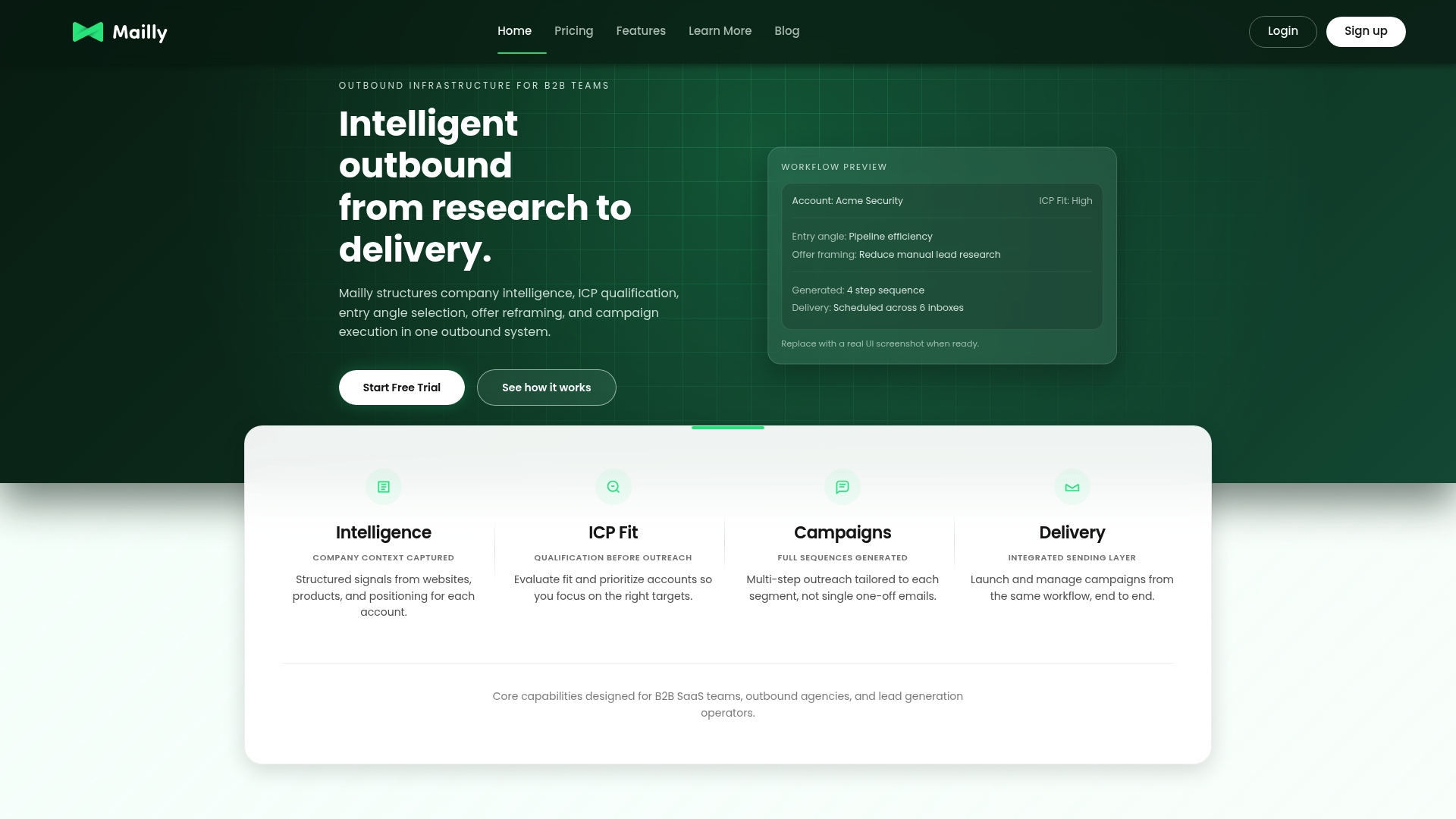
Mailly analyzes target companies’ positioning, product architecture, monetization models, hiring signals, and competitive landscapes to evaluate ICP fit and identify real business bottlenecks. This research foundation enables psychologically sequenced campaigns designed for relevance, not volume. By using AI to boost cold outreach thoughtfully, Mailly helps you avoid the homogenization trap while maintaining efficiency. The platform supports the entire cold outreach workflow guide from ICP analysis through sequence design, ensuring your campaigns reflect strategic intent rather than templated automation.
Frequently asked questions
Why do most B2B SaaS email campaigns fail?
Most campaigns fail because they treat inboxes like websites, overwhelming recipients with lengthy content that gets deleted unread. Generic value propositions blend into competitor noise, while poor segmentation leads to irrelevant outreach that damages sender reputation. Superficial AI-generated personalization creates fatigue as recipients receive dozens of nearly identical messages daily.
How can I improve response rates in B2B SaaS email campaigns?
Improve response rates by rigorously qualifying your prospect list to ensure strong ICP fit based on strategic priorities, not just demographics. Conduct deep contextual research into each target company’s product architecture, monetization model, and competitive challenges. Design psychologically sequenced multi-touch campaigns that build relevance progressively rather than making aggressive early asks.
Is AI-powered personalization effective in cold email outreach?
AI is effective when used to augment human strategic insight, not replace it. The tool should analyze company data and suggest positioning angles while you craft unique messages ensuring contextual relevance. Overusing AI to generate entire sequences creates templated repetition that recipients quickly recognize and ignore, leading to message fatigue and diminished reply rates.
What are common mistakes to avoid in email sequencing?
Avoid sending messages at random intervals or with excessive frequency that overwhelms recipients. Don’t repeat the same ask in every email or introduce complex requests before establishing relevance. Map your sequence to buyer psychology stages, using early messages to build awareness and credibility before making conversation requests in later touches.
What metrics should I track beyond open and reply rates?
Track conversation quality by reviewing actual email exchanges to assess whether replies indicate genuine interest or polite deflection. Monitor meeting conversion rates to understand how many engaged prospects schedule calls. Measure pipeline contribution and deal velocity from email-sourced opportunities to connect outreach effectiveness with revenue outcomes rather than vanity metrics.
