

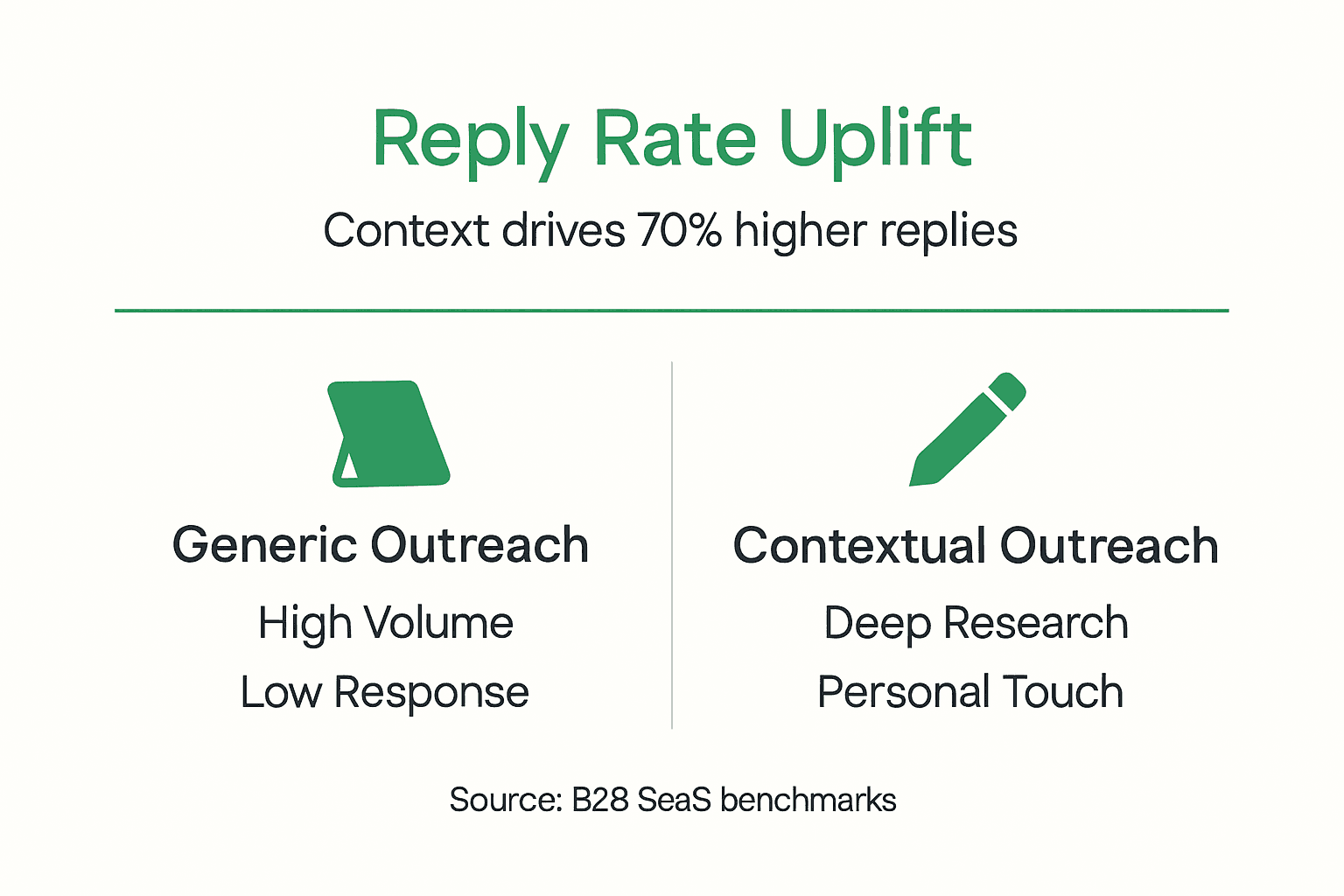
Cold outreach emails without personalization get replied to less than 5% of the time. That abysmal number reflects a broken approach: generic templates sent en masse to strangers who delete them instantly. But what if you flipped the script? Instead of volume, imagine targeting fewer prospects with deep contextual research that boosts reply rates by 70%. That shift from spray and pray to strategic, personalized engagement defines modern cold outreach success.
Table of Contents
- Understanding Cold Outreach In B2B SaaS
- The Role Of Deep Contextual Research In Cold Outreach Success
- Aligning Messaging With Recipient Priorities
- Psychological Sequencing And Behavioral Principles In Cold Outreach
- Debunking Common Misconceptions About Cold Outreach
- Case Studies And Quantitative Impact Of Contextual Cold Outreach
- Practical Steps To Implement Contextual Cold Outreach In B2B SaaS
- Boost Your Cold Outreach With Mailly’s AI-Powered Platform
- Frequently Asked Questions About Cold Outreach
Key Takeaways
| Point | Details |
|---|---|
| Contextual research boosts replies by 70% | Deep analysis of company positioning and priorities drives engagement far beyond templates. |
| Psychological sequencing lifts conversions 30% | Strategic timing and narrative flow in follow-ups optimize decision-maker behavior. |
| Templates cut response rates by 70% | Generic outreach without personalization drastically underperforms targeted messaging. |
| Hiring signals improve receptivity by 20% | Timing outreach around funding or executive hires significantly increases openness. |
| Real results show 3% to 18% reply jumps | B2B SaaS companies using contextual strategies see dramatic response improvements. |
Understanding Cold Outreach in B2B SaaS
Cold outreach means contacting prospects who have no prior relationship with your company, typically via email. For B2B SaaS teams, it’s the frontline tactic to fill pipelines and start conversations with potential customers. Unlike warm leads from inbound marketing or referrals, cold contacts have never heard of you.
The challenge? Typical cold outreach response rates range from 1 to 5% and continue declining as inboxes grow more saturated. Decision-makers receive dozens of generic pitches daily, training them to delete anything that feels templated or irrelevant. The common practice of sending mass emails with minimal personalization has created inbox blindness.
Most outreach campaigns follow a familiar pattern:
- Send identical emails to large lists
- Focus on product features instead of recipient needs
- Use vague subject lines and generic opening sentences
- Follow up once or twice without strategic sequencing
This volume-over-quality approach backfires because it ignores context. When every message looks like spam, even legitimate offers get ignored. Understanding these baseline metrics reveals why change is urgent. To escape the 1 to 5% trap, you need to rethink cold outreach from the ground up, starting with a cold outreach workflow guide that prioritizes research and relevance.
The Role of Deep Contextual Research in Cold Outreach Success
Contextual research transforms cold outreach from guesswork into strategic targeting. Instead of blasting emails to anyone with a job title, you investigate each prospect’s company positioning, product architecture, recent business developments, and competitive landscape. This deep dive reveals whether they fit your Ideal Customer Profile and what business bottlenecks they likely face.
Why does this matter? Hiring signals like recent funding or executive hires increase receptivity by 20% when you time outreach correctly. A SaaS company that just raised Series B is primed to invest in growth tools. A VP of Sales hired three months ago is actively building their tech stack. These signals tell you when prospects are most open to solutions.
Effective contextual research includes:
- Analyzing company websites and positioning statements
- Reviewing product pages to understand architecture and pricing models
- Tracking LinkedIn for hiring announcements and role expansions
- Monitoring press releases for funding rounds or partnerships
- Studying competitor mentions and market positioning
This groundwork enables precise personalization. Instead of saying “I saw you work in SaaS,” you reference their recent expansion into enterprise markets and frame your offer around that shift. The difference between generic and contextual outreach is night and day.
Pro Tip: Combine multiple data sources like LinkedIn, Crunchbase, and company blogs to build a complete picture before writing a single word of your email.
By personalizing cold emails with real insights, you signal that you’ve done your homework. Recipients notice when outreach feels intentional rather than random. This respect for their time and priorities sets the stage for meaningful conversations. Advanced teams use this research to build a robust cold email strategy with research at its core, ensuring every message lands with relevance.
Aligning Messaging With Recipient Priorities
Once you understand a prospect’s context, the next step is reframing your offer to align with their actual priorities. Most cold emails fail because they lead with product features: “Our tool has X integration and Y dashboard.” Decision-makers don’t care about features in isolation. They care about solving specific business problems.

Messaging aligned with recipient priorities boosts open rates by 50% and reply rates by 70%. That dramatic improvement comes from speaking directly to what keeps prospects awake at night. If a company is scaling rapidly, they worry about process bottlenecks and team efficiency. If they’re entering a new market, they need positioning and competitive intelligence. Your message should address those concerns, not your feature list.
Consider the timing as well. Using hiring and funding signals to time outreach improves receptivity because you’re catching prospects in moments of change. A newly funded company is allocating budget. A team that just hired for sales ops is evaluating tools. Reaching out during these windows positions your solution as timely and relevant.
Follow these steps to craft aligned messaging:
- Identify the recipient’s top business priorities through research
- Reframe your offer to directly address one of those priorities
- Tailor your value proposition using their language and pain points
- Include proof points or case studies from similar companies
Priority-based messaging shifts the conversation from “Here’s what we do” to “Here’s how we solve your specific challenge.” This approach respects the recipient’s intelligence and time. They see immediately whether your solution fits their situation.
Pro Tip: Monitor competitor moves and macroeconomic trends in your prospect’s industry to adjust messaging dynamically and stay ahead of shifting priorities.
By learning to align messaging with priorities, you turn cold outreach into a consultative conversation. Instead of pitching blindly, you demonstrate understanding and offer real value upfront. That relevance is what drives replies.
Psychological Sequencing and Behavioral Principles in Cold Outreach
Sending a single cold email rarely works. Decision-makers are busy, distracted, or simply not ready to engage on first contact. This is where psychological sequencing comes in: a strategic series of touchpoints designed to build familiarity, trust, and urgency over time.
Proper psychological sequencing in cold outreach can improve conversion rates by 30%. The key is varying your message type, timing follow-ups during optimal windows, and creating a narrative flow across emails. Each touchpoint should add new value rather than repeating the same pitch.
Effective sequencing leverages behavioral principles. The mere exposure effect means prospects become more comfortable with your name after multiple relevant interactions. Scarcity and urgency can motivate action when used authentically. Social proof in later emails reinforces credibility.
Common sequencing tactics include:
- Staggered intervals: Wait 3 to 5 days between touches to avoid annoyance
- Value-added follow-ups: Share a relevant article, case study, or insight in each email
- Multi-format approaches: Mix short check-ins with longer, informative messages
- Personalized callbacks: Reference previous emails to create continuity
The narrative arc matters. Your first email might highlight a pain point, the second shares a success story, the third offers a specific next step. This progression feels natural rather than pushy. Recipients appreciate the cadence when each message respects their time and offers something new.
Incorporating behavioral insights helps you optimize timing and messaging cadence. For example, emails sent Tuesday through Thursday mornings often see higher open rates. Follow-ups that acknowledge silence (“I know you’re busy”) can re-engage prospects who meant to respond but forgot.
By mastering cold outreach sequencing best practices, you turn a single ignored email into a multi-touch campaign that builds momentum. Sequencing reduces fatigue, increases trust, and positions you as persistent but not annoying. When done right, prospects reply because they’ve seen consistent value over time.
Debunking Common Misconceptions About Cold Outreach
Cold outreach suffers from widespread myths that sabotage results. Let’s correct the most damaging false beliefs with evidence.
Myth 1: Sending large volumes of generic emails drives success. Many teams believe more sends equal more replies. Reality check: Template cold emails have up to 70% lower response rates compared to personalized outreach. Quantity without quality tanks your sender reputation and wastes time.
Myth 2: Templates without context are sufficient. Cookie-cutter emails feel impersonal and get deleted instantly. Recipients can spot a mass email from the first line. Without contextual research, you’re gambling that generic messaging will somehow resonate. It won’t.
Myth 3: Product features trump alignment with business needs. Leading with features assumes prospects care about your solution before understanding their problem. Engagement drops 40% when you ignore recipient priorities. People buy solutions to their pain points, not feature lists.
The table below contrasts templated versus contextual outreach outcomes:
| Metric | Templated Outreach | Contextual Outreach |
|---|---|---|
| Reply Rate | 1 to 5% | 10 to 18% |
| Open Rate | 15 to 25% | 40 to 60% |
| Unsubscribe Rate | 3 to 5% | 0.5 to 1% |
| Meetings Booked | 0.5 to 1% | 3 to 5% |
These numbers reveal the cost of outdated tactics. Contextual outreach requires more upfront effort but delivers exponentially better results. You reach fewer people, but those conversations convert at much higher rates.
Another misconception: automation and personalization are mutually exclusive. False. Modern tools let you automate research and sequencing while maintaining personalized messaging. The trick is using automation to scale the right behaviors, not the wrong ones.
By avoiding common cold outreach myths, you focus energy on strategies that actually work. Quality beats quantity. Context beats templates. Alignment beats feature dumps. Keep these truths front and center as you build campaigns.
Case Studies and Quantitative Impact of Contextual Cold Outreach
Numbers tell the story better than theory. Real B2B SaaS companies have transformed their outreach results by adopting contextual strategies.
One mid-stage SaaS platform struggled with 3% reply rates using templated campaigns. After shifting to deep contextual research and priority-aligned messaging, their response rates increased from 3% to 18%. The change involved analyzing each prospect’s recent hiring, funding, and competitive positioning before crafting personalized emails. Follow-up sequences added case studies and insights tailored to recipient industries.
Another example: a sales enablement tool reduced unsubscribe rates by 25% after abandoning generic templates. By focusing on smaller, better-researched lists, they sent fewer emails but booked three times as many discovery calls. Recipients appreciated the relevance and responded positively.
Long-term benefits extend beyond immediate replies. Contextual outreach builds your brand reputation as thoughtful and strategic. Prospects who don’t convert today remember you favorably when their needs change. Contrast this with mass email blasts that burn your domain reputation and annoy potential customers.
The table below illustrates before and after statistics from a B2B SaaS cold outreach transformation:
| Metric | Before (Templated) | After (Contextual) | Improvement |
|---|---|---|---|
| Reply Rate | 3% | 18% | +500% |
| Open Rate | 22% | 55% | +150% |
| Unsubscribe Rate | 4% | 1% | -75% |
| Meetings Booked | 8 per 1000 | 45 per 1000 | +462% |
These results weren’t overnight miracles. They required consistent measurement, iteration, and commitment to quality over volume. Teams tracked cold outreach success metrics like open rates, reply rates, and time to response. They A/B tested subject lines, message framing, and follow-up cadences.
The takeaway: contextual cold outreach delivers measurable, repeatable improvements. When you invest in research and personalization, prospects respond. The data proves it.
Practical Steps to Implement Contextual Cold Outreach in B2B SaaS
Ready to apply these concepts? Follow this actionable framework to launch effective cold outreach campaigns.
Conduct thorough contextual research. Start by identifying target companies that match your ICP. Dive into their websites, LinkedIn pages, press releases, and product documentation. Look for hiring signals, funding announcements, and competitive positioning. Build a profile of each prospect’s business priorities and pain points.
Build personalized messaging frameworks focused on buyer priorities. Use your research to craft email templates that speak directly to recipient challenges. Avoid feature lists. Instead, frame your solution as the answer to a specific problem they’re facing. Reference their context naturally to demonstrate you’ve done your homework.
Design a sequenced multi-touch campaign with timed follow-ups. Plan 4 to 6 touchpoints over 2 to 3 weeks. Vary the message type: initial outreach, value-added follow-up, social proof, direct ask. Space emails 3 to 5 days apart to avoid overwhelming prospects. Each message should build on the previous one, creating narrative continuity.
Measure key metrics and iterate for continuous improvement. Track open rates, reply rates, unsubscribe rates, and meetings booked. Identify what’s working and what’s not. A/B test subject lines, opening hooks, and calls to action. Use data to refine your approach over time.
Pro Tip: Use automation tools to streamline research and sequencing, but always combine them with manual research to ensure quality and relevance.
If advanced analytics feel out of reach, start simple. Use LinkedIn and Google to research prospects. Write personalized opening lines by hand. Send follow-ups manually at first to learn what resonates. As you see results, invest in tools to scale your process.
For a detailed walkthrough, check out this guide on step-by-step cold emailing. You’ll find templates, timelines, and examples to accelerate your learning curve. Pair that with a robust cold outreach workflow to systematize your efforts.
The key is starting small, learning fast, and scaling what works. Contextual cold outreach isn’t a one-size-fits-all formula. It’s a discipline you refine through practice and iteration.
Boost Your Cold Outreach with Mailly’s AI-Powered Platform
Implementing contextual cold outreach manually takes serious time and effort. That’s where Mailly steps in to transform your process. Mailly is an AI-powered outbound strategy engine built specifically for B2B SaaS sales teams who want better results without burning out their reps.
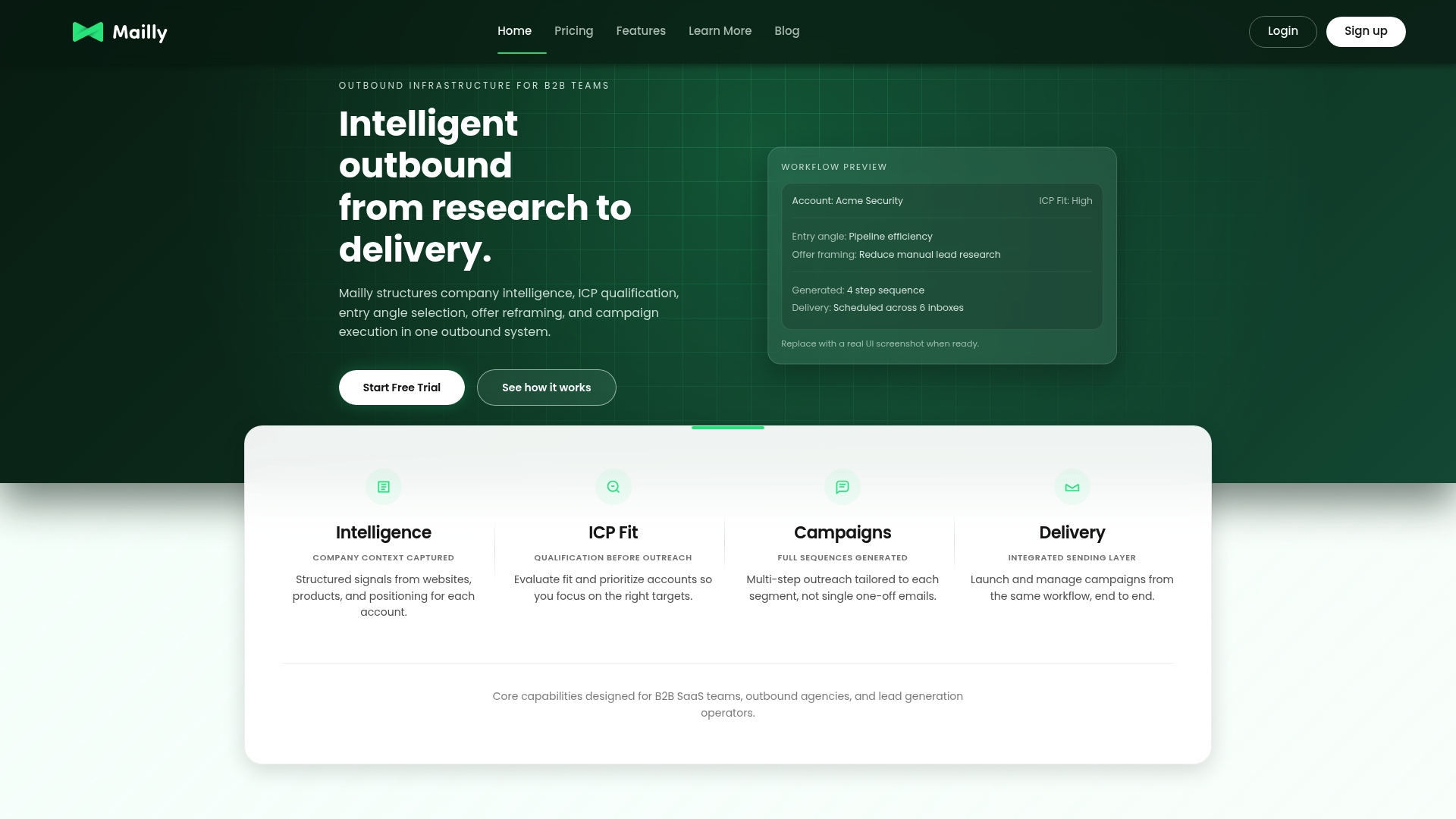
Instead of starting with email copy, Mailly begins with deep contextual research. It analyzes a company’s positioning, product architecture, monetization model, hiring signals, and competitive landscape to evaluate ICP fit and identify real business bottlenecks. Based on this analysis, Mailly reframes your offer to align with recipient priorities and builds psychologically sequenced email campaigns designed for relevance, not volume.
The platform automates the heavy lifting: research, personalization frameworks, and sequencing. You get outreach that feels intentional, contextual, and strategically positioned without spending hours per prospect. This is how modern growth teams scale quality while maintaining the human touch that drives replies.
Ready to see how Mailly powers a smarter cold outreach workflow guide? Explore resources on optimizing outreach relevance and discover how AI can amplify your team’s impact.
Frequently Asked Questions about Cold Outreach
What is the ideal number of follow-ups in a cold outreach sequence?
Most successful sequences include 4 to 6 follow-ups spaced 3 to 5 days apart over 2 to 3 weeks. Each message should add new value or perspective rather than repeating the same pitch. This cadence balances persistence with respect for the recipient’s time.
How can I quickly identify the key priorities of a SaaS prospect?
Start with LinkedIn to review recent hires, promotions, and company updates. Check their website for positioning statements and product pages. Monitor press releases for funding, partnerships, or market expansions. These signals reveal where they’re investing attention and resources.
What tools can help automate contextual research?
Platforms like Mailly, LinkedIn Sales Navigator, Crunchbase, and ZoomInfo provide data on company signals, funding, and hiring. Combine these with manual review of blogs and press releases for a complete picture. Automation saves time but always validate key insights manually.
Is it better to focus on one channel or multiple in cold outreach?
Email remains the primary channel for B2B cold outreach due to its scalability and measurability. However, layering in LinkedIn InMail or connection requests can reinforce your message. Multi-channel sequences work best when each touchpoint feels coordinated, not spammy.
How do I measure the success of my cold outreach campaigns?
Track open rates, reply rates, unsubscribe rates, and meetings booked as your core metrics. Benchmark against industry averages: aim for 40%+ opens and 10%+ replies with contextual outreach. Also monitor time-to-response and conversion from meeting to opportunity for deeper insights.
Can contextual cold outreach work for smaller teams with limited resources?
Absolutely. Start by targeting a smaller, highly-researched list instead of mass sends. Even manually personalizing 20 emails per week will outperform 500 generic ones. Use free tools like LinkedIn and Google for research. As results improve, reinvest in automation to scale efficiently.
