

Most B2B SaaS teams think adding a first name and company detail solves personalization. It doesn’t. Generic volume outreach is dying, with reply rates plummeting as buyers ignore templated messages. Cold outreach transformation uses AI and deep contextual research to replace outdated tactics with relevance-driven strategies that actually work. This guide shows you how to implement smart cold outreach tips for B2B SaaS growth teams that boost engagement and pipeline quality.
Table of Contents
- Key Takeaways
- Introduction To Cold Outreach Transformation
- Challenges Of Traditional Cold Outreach Approaches
- How Ai And Contextual Research Transform Cold Outreach
- Common Misconceptions About Cold Outreach Transformation
- Framework For Executing Cold Outreach Transformation
- Measuring Engagement Impact And Roi Of Transformed Outreach
- Strategic Integration And Multichannel Approaches
- Conclusion And Practical Takeaways
- Unlock Your SaaS Growth With Ai-Powered Cold Outreach
- FAQ
Key Takeaways
| Point | Details |
|---|---|
| Traditional volume tactics fail | Reply rates dropped 15% from 2023 to 2024 as generic outreach saturates inboxes. |
| AI enables scalable personalization | Deep contextual research across thousands of prospects improves reply rates by analyzing 60+ data points per lead. |
| Multi-phase framework drives results | Successful transformation requires ICP definition, AI-powered research, offer reframing, sequenced campaigns, and continuous optimization. |
| Metrics reveal transformation success | Target 8-15% reply rates and 1-3% meeting bookings while monitoring domain health to sustain deliverability. |
| Multichannel integration amplifies impact | Combining email, phone, and LinkedIn with AI orchestration increases close rates by 20% and shortens sales cycles by 25%. |
Introduction to Cold Outreach Transformation
Cold outreach transformation replaces volume-driven spray-and-pray tactics with AI-powered contextual targeting. Traditional methods flood inboxes with generic messages, leading to buyer fatigue and declining engagement. When every prospect receives the same templated pitch with minor name swaps, response rates crater.
Buyers now demand relevance. They ignore messages that fail to address their specific business challenges or priorities. Generic personalization leads to open rates below 20%, while contextual personalization boosts open rates by 10-15 percentage points. This gap reveals why transformation matters.
Transformation shifts focus from quantity to quality. AI analyzes company positioning, product architecture, hiring signals, and competitive landscape to evaluate ICP fit. This depth enables messaging that resonates with real business needs rather than surface-level demographics.
The transformation framework includes:
- Deep contextual research replacing manual prospecting
- AI-powered offer reframing aligned with buyer priorities
- Psychologically sequenced campaigns optimized for engagement
- Multi-channel orchestration across email, phone, and LinkedIn
- Continuous optimization driven by performance metrics
Personalization beyond name insertion becomes scalable through AI. You maintain message quality while reaching thousands of prospects, eliminating the old quality versus quantity tradeoff. This approach delivers the relevance buyers expect and the efficiency growth teams need.
Challenges of Traditional Cold Outreach Approaches
Outdated cold outreach methods create mounting problems for B2B SaaS teams. Understanding these challenges clarifies why transformation is essential, not optional.
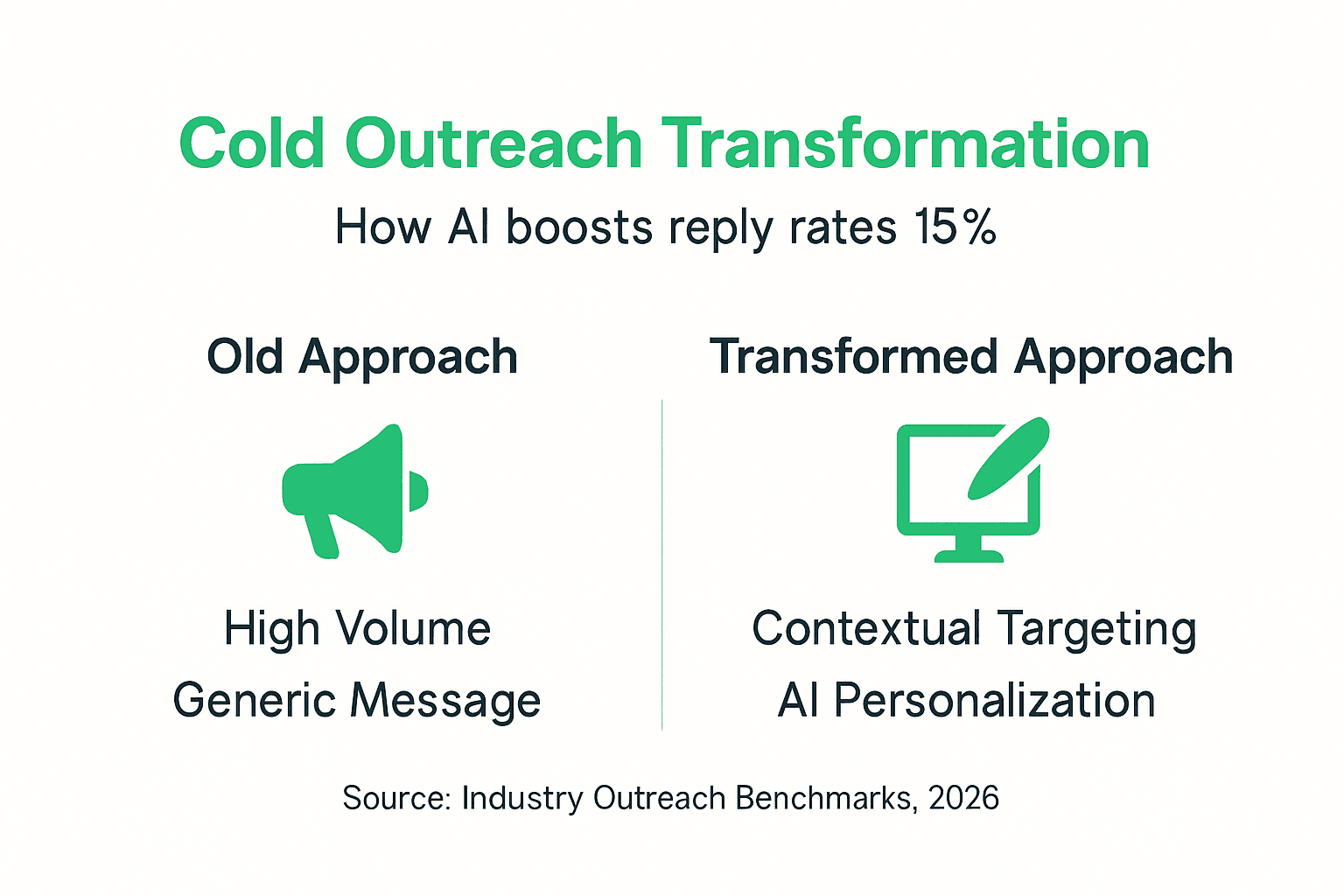
Reply rates declined by 15% from 2023 to 2024 as message overload overwhelms buyers. Inboxes overflow with generic pitches that all sound identical. Decision-makers develop banner blindness to obvious templates.
High volume outreach damages your sending domain. Email providers penalize senders who blast messages without proper engagement signals. Poor deliverability means your emails never reach intended recipients, wasting resources and opportunities.
Manual research doesn’t scale. Spending 15-20 minutes researching each prospect limits daily outreach to dozens, not hundreds. Quality suffers when reps rush research to hit volume targets. This creates a false choice between depth and scale.
Traditional targeting misses actual business needs. Surface-level firmographics (company size, industry, revenue) don’t reveal current priorities or pain points. Messages feel random because they lack connection to what prospects actually care about today.
“When outreach feels templated rather than thoughtful, prospects delete without reading. Generic messages signal you haven’t invested time understanding their business, so why should they invest time responding?”
Poor targeting wastes budget and harms brand reputation. Irrelevant outreach positions your company as another vendor spamming inboxes. This reputation damage persists long after individual campaigns end. You need a better approach that respects prospects’ time while achieving your growth goals.
Implementing an effective cold outreach workflow addresses these challenges systematically.
How AI and Contextual Research Transform Cold Outreach
AI and deep contextual research solve the core problems plaguing traditional outreach. They enable relevance at scale, the holy grail B2B teams have pursued for years.
AI uses machine learning to score leads based on fit and intent signals. It crafts personalized messages by analyzing prospect context, not just filling name fields. Automated sequencing adjusts timing and content based on engagement patterns, optimizing when and how you reach out.
AI platforms perform deep research on 60+ data points, drastically improving targeting accuracy. This includes company positioning, product features, monetization models, hiring trends, technology stack, competitive positioning, and recent business events. Manual research can’t match this depth across thousands of prospects.

AI-powered platforms improve open rates by 10% and shorten deal cycles by 20%. Better targeting and personalization drive these gains. When messages address real business bottlenecks uncovered through research, prospects respond.
Implementing AI transformation follows these steps:
- Define precise ICP criteria including firmographics, technographics, and behavioral signals
- Deploy AI tools to enrich prospect data with contextual business intelligence
- Analyze research to identify genuine pain points and strategic priorities
- Reframe your offer to align with discovered challenges and opportunities
- Build psychologically sequenced campaigns that nurture engagement progressively
- Monitor performance and iterate based on AI-generated insights
Pro Tip: Maintain human oversight throughout AI workflows. Review AI-generated insights and messages to ensure empathy and accuracy. AI handles scale; humans ensure relevance and tone stay on target.
The table below contrasts traditional versus AI-powered outreach:
| Aspect | Traditional Outreach | AI-Powered Transformation |
|---|---|---|
| Research Depth | Surface firmographics | 60+ contextual data points |
| Personalization | Name and company | Business priorities and pain points |
| Scale | Dozens per day manually | Thousands with maintained quality |
| Message Relevance | Generic templates | Contextually tailored messaging |
| Optimization | Periodic manual review | Continuous AI-driven iteration |
This transformation doesn’t replace human judgment. AI amplifies your team’s ability to identify opportunities and craft compelling narratives. The combination of AI efficiency and human insight creates outreach that feels intentional and strategically positioned.
Explore how AI for cold outreach and proven cold email strategy work together to drive results.
Common Misconceptions About Cold Outreach Transformation
Clearing up misconceptions prevents wasted effort and sets realistic expectations for transformation success.
Personalization is not just inserting names or company details. True personalization references specific business context: recent funding, product launches, hiring patterns, or competitive moves. Surface-level tokens don’t fool buyers. They recognize templates immediately.
Increasing volume without strategy backfires. More messages don’t equal more replies when relevance stays low. High volume damages deliverability as providers flag your domain. Focus on quality targeting first, then scale what works.
AI supports but doesn’t replace human judgment. Tools automate research and drafting, but humans must review for accuracy and tone. AI occasionally misinterprets context or suggests messaging that misses the mark. Your oversight ensures quality.
Pro Tip: Start transformation with a pilot segment of 500-1000 prospects. Test AI research quality, message relevance, and reply rates before scaling. This approach limits risk while proving ROI.
Balanced volume and deep relevance achieve optimal results. The goal isn’t maximum emails sent or hyper-customized one-offs. AI enables the middle path: deeply researched, contextually relevant messages delivered at scale.
Key misconceptions to avoid:
- Thinking AI eliminates need for strategic input
- Believing more touchpoints always improve results
- Assuming automation means set-it-and-forget-it campaigns
- Expecting instant transformation without testing and iteration
- Overlooking deliverability and domain health metrics
Understanding why personalize cold emails correctly helps avoid these traps and focus effort where it matters most.
Framework for Executing Cold Outreach Transformation
A clear framework guides your team from planning through optimization, ensuring systematic transformation.
Phase 1: Define and refine your ideal customer profile. Go beyond basic firmographics to include technographic data, behavioral signals, and strategic indicators. Identify which companies face problems your solution solves right now.
Phase 2: Deploy AI-powered tools for deep contextual research. Enrich prospect data with business intelligence covering positioning, product features, monetization, hiring, technology stack, and competitive landscape. This foundation enables genuinely relevant messaging.
Phase 3: Reframe your offer based on uncovered buyer challenges. Don’t lead with product features. Address specific bottlenecks and priorities revealed through research. Position your solution as the bridge between their current state and desired outcomes.
Phase 4: Build AI-driven, psychologically sequenced multi-touch campaigns. Start with value-forward education, progress to social proof and case studies, then introduce clear calls to action. Sequence timing based on engagement signals.
Phase 5: Integrate multi-channel outreach across email, phone, and LinkedIn. Coordinate touchpoints so channels reinforce rather than conflict. AI orchestration optimizes which channel to use when based on prospect behavior.
Phase 6: Continuously measure and optimize using key metrics. Track reply rates, meeting bookings, pipeline quality, and domain health. A/B test messaging, sequences, and targeting to improve performance iteratively.
The comparison below shows execution differences:
| Execution Element | Traditional Approach | Transformation Framework |
|---|---|---|
| ICP Definition | Basic demographics | Behavioral and strategic signals |
| Research Method | Manual LinkedIn browsing | AI analysis of 60+ data points |
| Offer Positioning | Feature-focused pitches | Pain-point-aligned solutions |
| Campaign Structure | Fixed sequence for all | Psychologically optimized flows |
| Channel Strategy | Email-only typically | Coordinated multi-channel |
| Optimization | Quarterly reviews | Continuous AI-driven iteration |
This framework from a proven cold outreach workflow guide provides the structure needed for successful transformation.
Measuring Engagement Impact and ROI of Transformed Outreach
Metrics reveal whether transformation delivers results or needs adjustment. Focus on indicators that connect directly to pipeline and revenue.
Reply rates of 8-15% and meeting bookings of 1-3% indicate effective outreach. These benchmarks reflect quality targeting and relevant messaging. Rates below 5% signal problems with ICP definition, research depth, or message positioning.
Domain health and deliverability prevent your messages from reaching spam. Monitor bounce rates, spam complaints, and sender reputation scores. High volume without engagement signals tanks deliverability fast. Maintain list hygiene and warm up new domains properly.
A/B testing and AI analytics drive continuous improvement. Test subject lines, message angles, sequence timing, and call-to-action phrasing. AI identifies patterns across thousands of sends, revealing what resonates with different prospect segments.
Pipeline quality matters more than vanity metrics. Track how outreach-sourced leads progress through your funnel compared to other channels. Measure deal size, close rates, and sales cycle length. High-quality outreach generates qualified opportunities, not just opens and clicks.
Key metrics to monitor:
- Reply rate and sentiment of replies received
- Meeting booking rate from positive replies
- Pipeline value generated per 1000 prospects contacted
- Cost per qualified opportunity versus other channels
- Domain sender score and deliverability rates
- Average deal size and close rate for outreach pipeline
Continuous optimization keeps campaigns scalable and relevant. Review performance weekly, adjust targeting and messaging based on data, and iterate sequences to improve engagement. What works today may need refinement next quarter as markets evolve.
Track essential cold outreach metrics consistently to maintain performance and identify optimization opportunities early.
Strategic Integration and Multichannel Approaches
Combining email with phone and LinkedIn amplifies engagement and accelerates deals. Single-channel outreach leaves opportunities on the table.
Multichannel outreach yields 20% higher close rates and shortens sales cycles by 25%. Different prospects prefer different channels. Some respond quickly to email, others need a LinkedIn connection request or phone call to engage. Meeting prospects where they are increases response probability.
AI orchestrates timing and personalization across channels for maximum impact. After an email goes unread, AI triggers a LinkedIn connection request with a personalized note. When a prospect opens but doesn’t reply, AI schedules a phone follow-up. This coordination feels natural, not overwhelming.
Optimized channel mix reduces costs while increasing efficiency. Email scales cheaply for initial outreach. Phone and LinkedIn focus on engaged prospects showing intent signals. You allocate expensive rep time where it drives highest return.
Combining touchpoints nurtures prospects by reinforcing relevance. An email introduces your value proposition. A LinkedIn post they see demonstrates thought leadership. A phone call references the email and addresses questions. Multiple exposures build familiarity and trust.
Strategic benefits of multichannel integration:
- Reach prospects on their preferred communication platform
- Reinforce messaging through complementary channel touchpoints
- Identify high-intent prospects based on cross-channel engagement
- Reduce dependency on any single channel’s deliverability
- Accelerate pipeline velocity with coordinated follow-up
The comparison below illustrates multichannel advantages:
| Metric | Email-Only | Integrated Multichannel |
|---|---|---|
| Response Rate | 5-8% | 12-18% |
| Meeting Booking | 1-2% | 3-5% |
| Average Sales Cycle | 45 days | 30-35 days |
| Close Rate | 15-20% | 25-30% |
| Cost per Opportunity | Baseline | 15-20% lower |
Multichannel approaches enable scalable, coordinated outbound beyond email alone. Learn more about optimizing outreach relevance across channels for B2B SaaS success.
Conclusion and Practical Takeaways
Cold outreach transformation moves B2B SaaS teams from failing volume tactics to relevance-driven strategies that work. AI and deep contextual research enable personalization at scale, solving the core tradeoff that limited traditional approaches.
Your next steps:
- Shift mindset from volume-driven to relevance-driven outreach immediately
- Invest in AI-powered tools for deep contextual research across 60+ data points
- Combine AI automation with human oversight to maintain empathy and accuracy
- Measure reply rates, meeting bookings, and pipeline quality continuously
- Integrate multichannel approaches coordinating email, phone, and LinkedIn touchpoints
Transformation requires commitment but delivers measurable results. Reply rates improve, sales cycles shorten, and pipeline quality increases. Start with a pilot, prove ROI, then scale what works. The buyers you want to reach demand relevance. Transformation enables you to deliver it consistently.
Unlock Your SaaS Growth with AI-Powered Cold Outreach
Ready to transform your cold outreach from generic to genuinely relevant? Mailly’s AI-powered platform begins with deep contextual research, analyzing your prospects’ positioning, product architecture, hiring signals, and competitive landscape to identify real business bottlenecks.
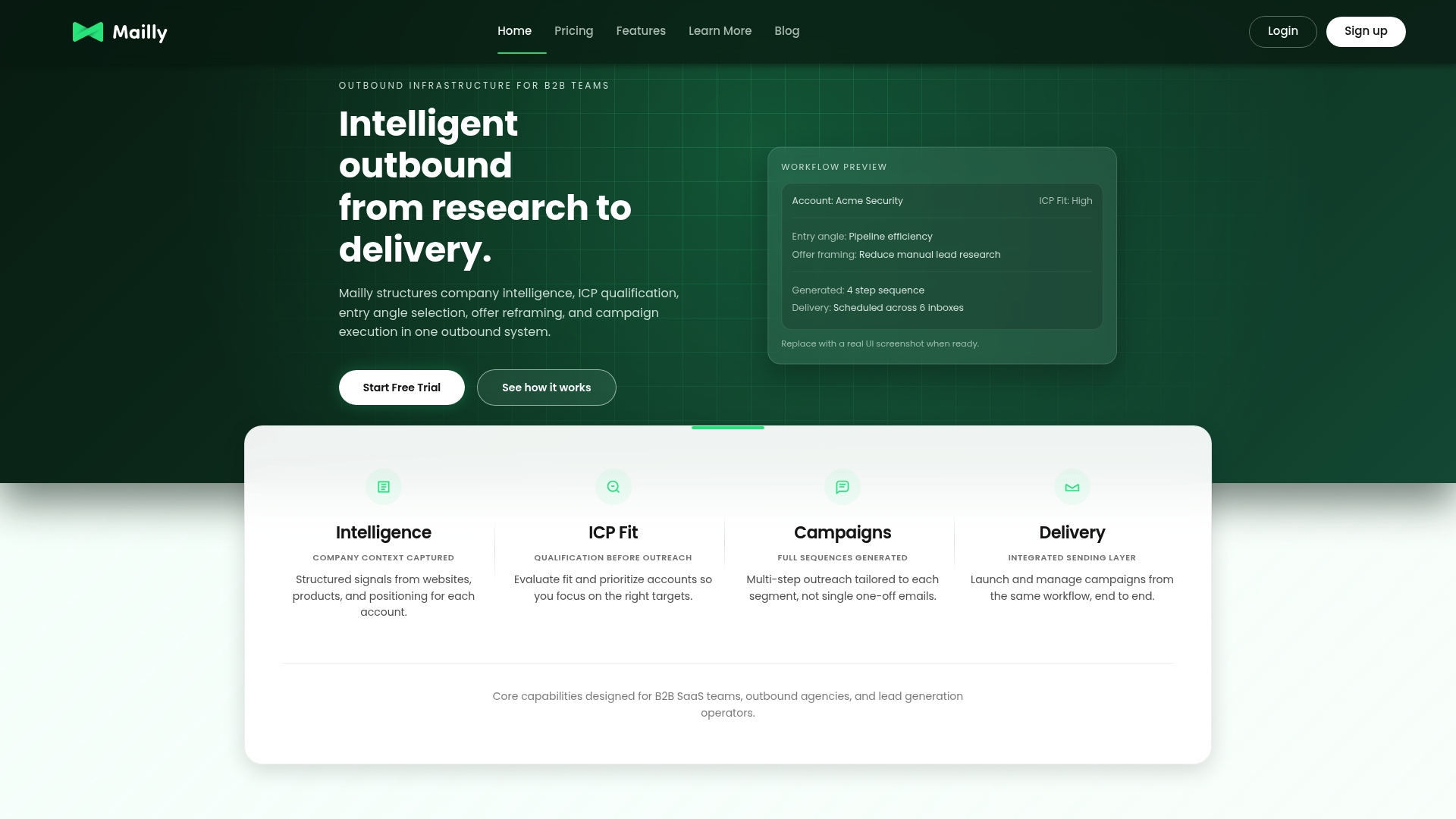
We reframe your offer to align with actual buyer priorities and build psychologically sequenced campaigns designed for engagement, not volume. The result is outreach that feels intentional and strategically positioned. Explore how AI for cold outreach and proven cold outreach workflows combine on the Mailly platform to boost your pipeline quality and reply rates.
FAQ
What is cold outreach transformation?
Cold outreach transformation shifts from generic, volume-based tactics to AI-powered, context-driven engagement strategies. It focuses on understanding buyer priorities through deep research and crafting relevant messaging that addresses specific business challenges rather than blasting templated pitches.
How does AI improve cold outreach effectiveness?
AI automates deep research on prospects’ business context, analyzing 60+ data points including positioning, product features, hiring patterns, and competitive landscape. This enables tailored messaging at scale while optimizing email sequencing and multi-channel timing to boost engagement rates significantly.
Why is traditional volume-based cold outreach failing?
Generic volume outreach overwhelms buyers, leading to declining reply rates as decision-makers ignore templated messages. High volumes without relevance risk domain blacklisting, damage sender reputation, and waste resources on prospects who will never engage with irrelevant pitches.
What are the critical steps to start cold outreach transformation?
Define ideal customer profiles using firmographic, technographic, and behavioral data. Deploy AI tools for deep contextual research to uncover genuine pain points. Reframe offers based on discovered priorities, build psychologically sequenced multi-channel campaigns with human oversight, and continuously measure reply rates, meetings, and pipeline quality to optimize performance.
How can multichannel outreach enhance cold outreach results?
Multichannel approaches combining email, phone, and LinkedIn increase close rates by 20% and shorten sales cycles by 25%. AI coordination ensures timely, personalized touchpoints across channels, meeting prospects on their preferred platforms and reinforcing messaging through complementary exposures that build familiarity and trust.
