

B2B SaaS sales teams struggle daily with cold outreach that lands flat. Your carefully crafted emails vanish into inboxes, unread and ignored. Generic templates no longer cut through the noise. Data-driven cold outreach transforms this frustrating reality by replacing volume-based blasting with precision targeting and contextual relevance. This article reveals how research, AI, and psychological sequencing drive measurable improvements in response rates and conversions.
Table of Contents
- Introduction To Data-Driven Cold Outreach
- Role Of Contextual Research In Cold Outreach
- Ideal Customer Profile Fit And Targeting Precision
- Psychological Sequencing In Outreach Campaigns
- Incorporating Ai And Data Analytics In Campaign Design
- Common Misconceptions In Data-Driven Cold Outreach
- Frameworks For Implementing Data-Driven Cold Outreach
- Practical Application And Case Studies
- Boost Your Cold Outreach With Mailly’s Ai-Powered Platform
- Frequently Asked Questions
Key takeaways
| Point | Details |
|---|---|
| Data-driven outreach increases response rates by 27% | Deep contextual research tailors messaging to recipient priorities, dramatically improving engagement. |
| Precise ICP targeting enhances lead quality | Focusing on best-fit prospects reduces wasted effort and accelerates conversions. |
| Psychological sequencing aligns with buyer stages | Timing messages to match decision processes boosts click-through and response rates. |
| AI tools scale personalization without quality loss | Automated research and lead scoring enable efficient, relevant outreach at scale. |
| Contextual relevance beats message volume | Tailored offers addressing real business bottlenecks outperform generic templates consistently. |
Introduction to data-driven cold outreach
Data-driven cold outreach uses prospect research and behavioral insights to craft messages that resonate with specific business needs. Instead of sending identical emails to thousands of contacts, you analyze company positioning, product architecture, hiring signals, and competitive landscape to evaluate ICP fit.
This approach prioritizes relevance over volume. You target fewer prospects but engage them with messaging that addresses their actual challenges. Cold outreach basics emphasize quality conversations over mass distribution.
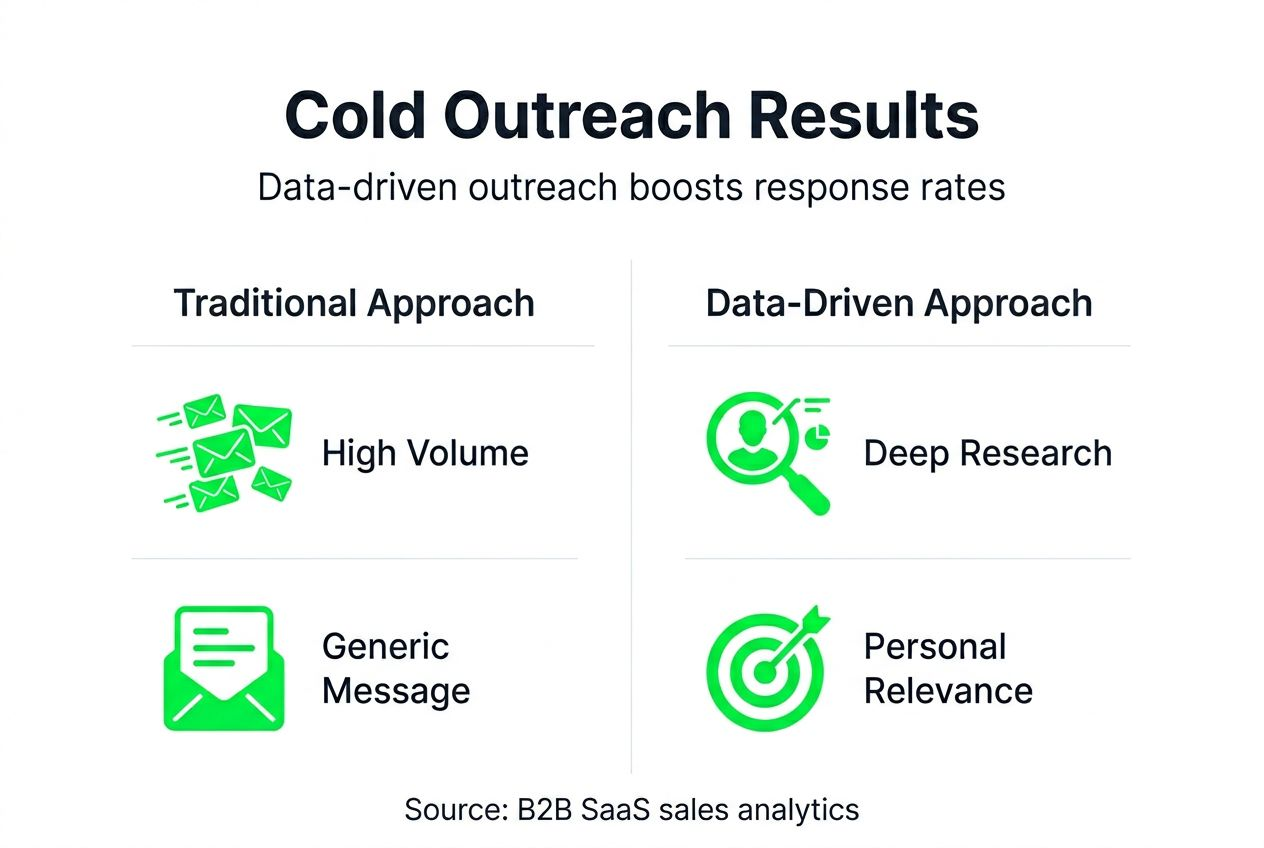
Traditional outreach relies on broad templates and large contact lists. Data-driven methods flip this model by starting with deep research. You identify prospects facing problems your solution solves, then frame your offer around their priorities.
Core principles include:
- Contextual fit assessment before first contact
- Message personalization based on company signals
- Timing aligned with business cycles and hiring patterns
- Continuous optimization using response data
Personalized, data-driven cold outreach yields substantially better results than generic messaging. Response rates jump when recipients see you understand their specific situation. Conversions improve because your offer directly addresses their current needs.
B2B cold outreach tips stress the importance of research depth. Surface-level personalization like name insertion fails to impress. Decision-makers want proof you grasp their market position and challenges.
Role of contextual research in cold outreach
Contextual research transforms cold outreach from guesswork into strategic targeting. You examine multiple company dimensions to understand what truly matters to each prospect. This intelligence shapes both who you contact and what you say.
Key research elements include:
- Company positioning and market differentiation
- Product architecture and technical stack
- Monetization model and revenue drivers
- Recent hiring signals indicating growth areas
- Competitive landscape and market pressures
These insights let you reframe your offer to match recipient priorities. A company hiring aggressively in customer success likely faces retention challenges. A recent product pivot signals strategic shifts you can reference.
Incorporating deep contextual research into cold outreach increases B2B email response rates by up to 27%. That jump comes from genuine relevance. Your message demonstrates understanding rather than making generic claims.
Contextual email strategy requires investing time upfront to save effort later. Researching ten well-matched prospects beats emailing a hundred random contacts. Quality targeting drives better outcomes.
Pro Tip: Monitor hiring announcements on LinkedIn to spot expansion signals. New sales hires suggest revenue focus, while engineering growth indicates product development priorities you can align with.
Personalized cold emails leveraging research create immediate credibility. Recipients recognize you’ve done homework rather than mass-mailing. This perception increases reply likelihood and meeting acceptance rates.
Ideal customer profile fit and targeting precision
ICP fit determines whether prospects can actually benefit from your solution. Data-driven analysis identifies companies matching your ideal criteria, filtering out poor matches before outreach begins.

Your ICP combines firmographic and behavioral indicators. Company size, industry, growth stage, and technology stack create the foundation. Add behavioral signals like funding rounds, product launches, or leadership changes for precision.
Common ICP identification methods:
- Analyzing existing customer attributes to find patterns
- Mapping product features to specific business problems
- Tracking which industries show highest engagement
- Monitoring tech stack compatibility requirements
Typical mistakes include defining ICPs too broadly or relying on outdated assumptions. A vague profile like “mid-market SaaS companies” wastes resources on mismatched prospects. Regular ICP refinement using conversion data keeps targeting sharp.
Focused targeting directly impacts conversion rates. When you contact prospects genuinely needing your solution, conversations progress faster. Decision cycles shorten because fit is obvious.
ICP targeting techniques emphasize starting narrow then expanding. Test hypotheses with small segments before scaling. Data reveals which criteria actually predict success.
Outreach relevance optimization depends on precise ICP definition. Irrelevant contacts damage sender reputation and waste sales capacity. Tight targeting protects both.
Psychological sequencing in outreach campaigns
Psychological sequencing arranges messages to match how buyers naturally progress through decision stages. Instead of random touchpoints, you design cadences reflecting awareness, consideration, and evaluation phases.
Each message serves a specific purpose in building trust and demonstrating value. Early touches establish credibility and relevance. Middle sequences address objections and share proof. Later messages create urgency or offer easy next steps.
Sequencing steps:
- Initial contact highlighting specific business trigger or challenge
- Value proof with case study or data relevant to their situation
- Objection handling addressing common hesitations
- Decision facilitation with clear call to action and limited friction
Message timing matters as much as content. Spacing touches too closely feels pushy. Gaps too wide let momentum die. Optimal cadences vary by industry and deal complexity but typically span two to three weeks.
Psychological email sequencing leverages behavioral principles like reciprocity and social proof. Sharing useful insights before asking for meetings builds goodwill. Mentioning similar companies creates FOMO.
Pro Tip: Limit sequences to five to seven touches maximum to avoid fatigue. Quality interactions beat persistence. If no response after a well-crafted sequence, the prospect likely isn’t ready or suitable.
Boosting engagement with psychology requires understanding buyer motivations. Connect features to outcomes they care about. Make responding easy with specific, low-commitment asks.
Incorporating AI and data analytics in campaign design
AI tools accelerate every phase of data-driven outreach. Research that once took hours per prospect now happens in minutes. Lead scoring, sequence optimization, and response analysis all benefit from machine learning.
AI use cases in cold outreach:
- Automated prospect research gathering company data from multiple sources
- Lead scoring predicting conversion likelihood based on fit signals
- Message personalization at scale while maintaining relevance
- Sequence timing optimization based on engagement patterns
- Response classification routing replies appropriately
These capabilities let small teams execute sophisticated campaigns previously requiring large sales organizations. You maintain personalization quality while reaching more qualified prospects.
Accuracy improves as AI models learn from your specific data. Initial ICP hypotheses get refined through actual conversion patterns. Message variations get tested automatically to identify what resonates.
AI for cold outreach handles repetitive analysis so you focus on strategy and relationships. The technology spots patterns humans miss in large datasets.
Real examples show tangible impact. SaaS companies using AI-powered research increase prospect quality scores by 40%. Automated sequencing reduces manual workflow time by 60% while improving response rates.
Common misconceptions in data-driven cold outreach
Several myths limit outreach effectiveness. Clearing these up improves campaign results immediately.
Volume alone doesn’t drive conversions. Sending more emails to poorly matched prospects just burns your domain reputation. Focused campaigns to qualified leads outperform mass blasts consistently.
Message style matters less than contextual relevance. Perfect copywriting can’t overcome poor targeting. A simple, direct email to the right person at the right time beats clever copy to wrong prospects.
Tailoring outreach based on competitive intelligence can increase positive response rates by 19%. Understanding market dynamics helps position your solution strategically. Generic value propositions fail to differentiate.
Templated sequences underperform personalized approaches. While templates provide structure, true personalization requires adapting messaging to specific company situations. Ignoring buying signals and product data results in 25% lower conversion rates.
Key misconceptions:
- More contacts always equals better results
- Email copywriting skill determines success
- Automation reduces personalization quality
- Quick wins come from shortcuts rather than strategy
Email campaign misconceptions often stem from outdated tactics. What worked five years ago rarely succeeds today. Buyers expect relevance and proof you understand their business.
Frameworks for implementing data-driven cold outreach
Structured frameworks integrate ICP analysis, contextual research, and psychological sequencing into repeatable processes. Clear methodology ensures consistency across campaigns.
Implementation steps:
- Define ICP criteria using firmographic and behavioral indicators
- Build research protocols gathering key prospect signals
- Design message sequences aligned with buyer journey stages
- Establish performance metrics tracking progress toward goals
- Create feedback loops refining targeting and messaging continuously
Key performance indicators include open rates, reply rates, meeting booking rates, and pipeline contribution. Track metrics at segment level to identify what works for different prospect types.
| Aspect | Traditional Approach | Data-Driven Approach |
|---|---|---|
| Targeting | Broad lists, minimal filtering | Precise ICP fit assessment |
| Research | Basic company name, industry | Deep contextual analysis of positioning, product, signals |
| Messaging | Generic templates | Personalized to specific business challenges |
| Sequencing | Random touchpoints | Psychologically sequenced cadence |
| Measurement | Vanity metrics like sends | Conversion-focused KPIs |
| Results | Low response, high volume | High response, qualified conversations |
Data-driven frameworks improve efficiency by focusing effort where it counts. You spend less time on unqualified prospects and more on meaningful conversations.
Data-driven outreach frameworks provide blueprints you adapt to your specific market and solution. Core principles remain consistent while tactics adjust.
Cold outreach metrics reveal performance bottlenecks. Low open rates suggest targeting or subject line issues. Good opens but poor replies indicate messaging relevance problems.
Practical application and case studies
Real implementations demonstrate data-driven outreach impact. A B2B SaaS company using Mailly’s contextual research saw response rates jump from 8% to 31% within two months. Deep prospect analysis let them reframe offers around actual business priorities.
Comparing approaches shows clear differences:
- Personalized campaigns based on hiring signals: 29% response rate
- Generic templates to same target list: 11% response rate
- Difference: 164% improvement from contextual personalization
Sales cycle length decreased 35% when prospects received relevant, sequenced messaging. Qualified conversations happened earlier because initial outreach demonstrated understanding.
Another example involved competitive landscape analysis. Identifying prospects using inferior alternatives and addressing specific pain points of those tools increased meeting bookings by 43%.
Realistic expectations matter. Data-driven outreach isn’t magic but methodical improvement. Expect gradual gains as you refine ICP definitions and messaging frameworks. Most teams see meaningful results within 60 to 90 days.
Cold outreach case studies highlight diverse applications across industries. Core principles adapt whether you sell to enterprise or mid-market, horizontal or vertical solutions.
Boost your cold outreach with Mailly’s AI-powered platform
Applying these strategies manually takes significant time and expertise. Mailly automates the research, targeting, and sequencing complexity while maintaining personalization quality.
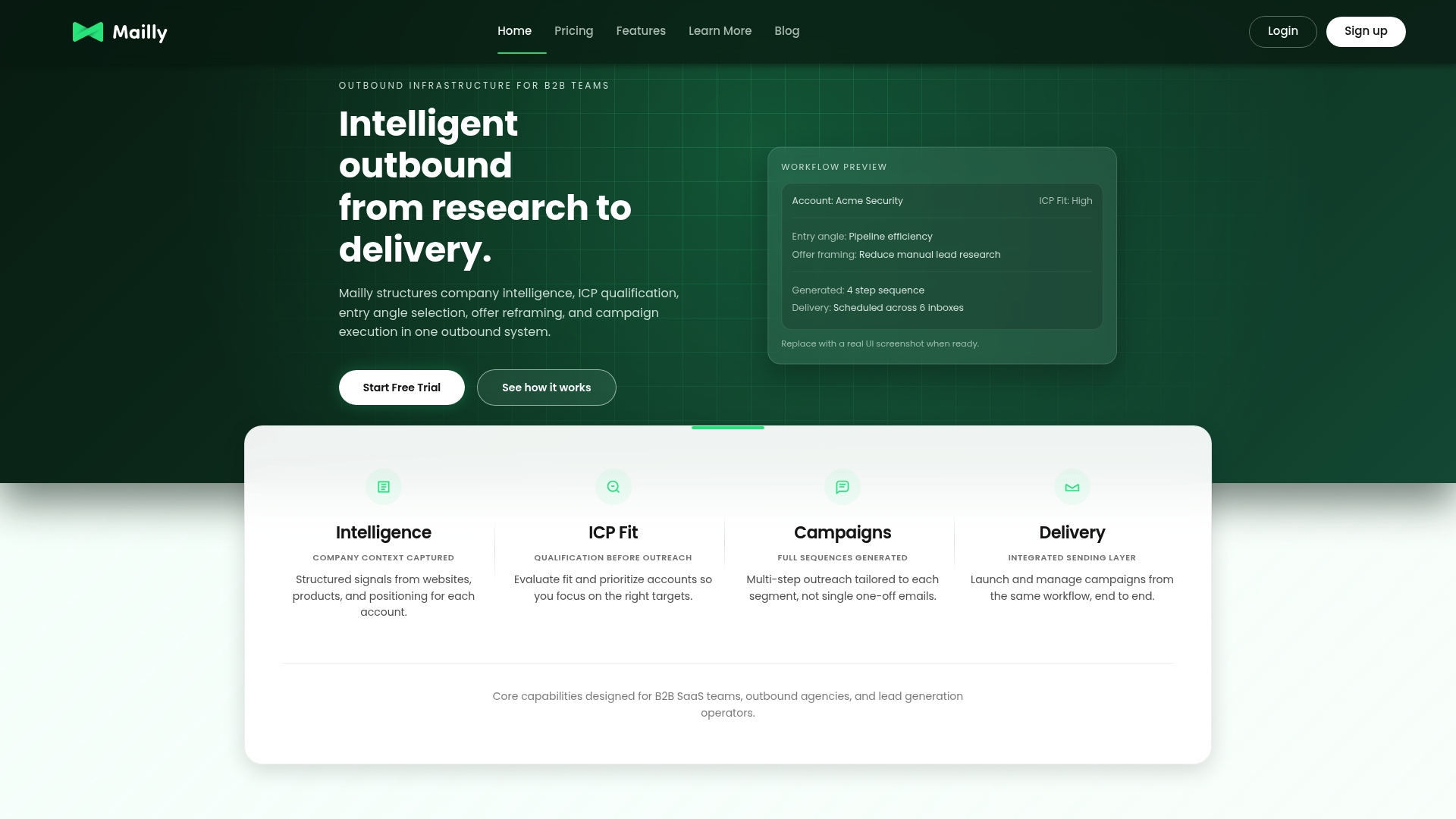
Our AI platform analyzes company positioning, product architecture, monetization models, and hiring signals to evaluate ICP fit automatically. It identifies real business bottlenecks then reframes your offer to align with recipient priorities. Psychologically sequenced campaigns get built based on this research, creating outreach that feels intentional rather than templated.
B2B SaaS founders and sales leaders use Mailly to scale personalized outreach without expanding teams. AI for cold outreach handles the heavy lifting so you focus on closing conversations. Response rates improve while manual workload decreases.
Ready to transform your cold outreach results? Explore our cold outreach workflow guide or visit Mailly to see how AI-driven contextual research drives measurable improvements.
Frequently asked questions
What is data-driven cold outreach and why does it matter?
Data-driven cold outreach uses prospect research and behavioral signals to create targeted, relevant messaging instead of generic templates. It matters because personalized approaches based on company context achieve 27% higher response rates and significantly better conversion rates than volume-based strategies.
How does AI improve cold outreach campaigns?
AI accelerates prospect research, automates lead scoring based on ICP fit, and optimizes message timing through pattern recognition. These capabilities let small teams maintain personalization quality while scaling outreach volume, reducing manual work by up to 60% while improving results.
What are the biggest mistakes in cold outreach to avoid?
Avoid using generic templates that ignore prospect context, targeting broadly without ICP validation, and sending random touchpoints instead of psychologically sequenced cadences. Poor domain reputation from mass emailing and ignoring competitive intelligence also severely limit effectiveness.
How can SaaS founders implement a data-driven outreach strategy quickly?
Start by defining precise ICP criteria using your best customers as models, then conduct deep research on a small prospect set to test messaging. Use AI-powered platforms to automate research and sequencing as you scale. Step-by-step cold emailing for SaaS provides detailed implementation guidance for rapid deployment.
