

Mid-sized B2B tech companies often struggle with cold outreach that generates low response rates. The problem isn’t effort or volume, it’s relevance. Generic, high-volume campaigns fail because they ignore context and personalization. This article explores how cold outreach focused on relevance over volume can dramatically improve engagement, conversions, and brand perception for B2B marketers seeking sustainable growth.
Table of Contents
- How To Choose The Right Cold Outreach Strategy
- Deep Contextual Research For Precise Targeting
- Personalization Strategies In Cold Outreach
- Crafting Contextual And Tailored Offers
- Email Sequencing And Psychological Engagement
- Volume Vs Relevance: Finding The Optimal Balance
- Situational Recommendations: Choosing Your Cold Outreach Approach
- Explore Mailly’s AI-Powered Cold Email Platform
- Frequently Asked Questions
Key takeaways
| Point | Details |
|---|---|
| Deep research drives targeting | Analyzing ICP fit, hiring signals, and competitive landscape ensures outreach reaches prospects with genuine needs. |
| Personalization beats volume | Tailored emails addressing specific pain points generate higher reply rates than generic templates sent at scale. |
| Offer reframing boosts relevance | Aligning your value proposition with prospect priorities and timing increases conversion likelihood. |
| Sequencing maximizes engagement | Multi-step campaigns using psychological triggers sustain interest and drive meetings more effectively than single emails. |
| Balance drives results | Relevance-focused strategies reduce unsubscribes by 50% while maintaining stronger engagement than volume approaches. |
How to choose the right cold outreach strategy
Selecting an effective cold outreach strategy starts with understanding what separates high-performing campaigns from noise. Success depends on personalized, contextually relevant emails rather than sheer message volume. For mid-sized tech companies, this means prioritizing depth over breadth.
The foundation begins with deep recipient research. Before writing a single line of copy, analyze your prospect’s business model, recent hires, product launches, and competitive positioning. This intelligence reveals whether they fit your Ideal Customer Profile and where their actual bottlenecks exist.
Next, design email sequences that follow psychological engagement principles. Start with relevant context, build curiosity, then escalate to clear calls to action. Each touchpoint should feel like a natural progression, not random outreach.
Offer reframing matters enormously. Instead of leading with your product features, connect your solution to the recipient’s current business priorities. If they just raised Series B funding, frame your offer around scaling challenges. If they’re hiring rapidly in engineering, address technical infrastructure pain points.
The critical tradeoff involves volume versus relevance. High-volume generic campaigns reach more inboxes but generate lower engagement and higher unsubscribe rates. Relevance-driven approaches contact fewer people but convert at significantly higher rates while protecting brand reputation.
Pro Tip: Start with a smaller, highly researched list of 50 prospects. Perfect your messaging and sequence. Once you achieve consistent response rates above 15%, scale gradually while maintaining research quality.
Key criteria for evaluation:
- ICP alignment accuracy and fit scoring
- Depth of contextual research per prospect
- Personalization level beyond first name tokens
- Sequence design incorporating psychological triggers
- Balance between outreach scale and message relevance
Understanding a cold outreach contextual strategy transforms how you approach targeting. It shifts focus from contact volume to contact quality, which directly impacts every downstream metric from open rates to pipeline contribution.
Deep contextual research for precise targeting
Contextual research separates effective B2B outreach from spam. It involves analyzing business signals that reveal genuine needs and optimal timing. Leveraging hiring signals and product launches dramatically improves response rates compared to generic demographic targeting.

Start by monitoring hiring activity. A company expanding its sales development team likely faces growth challenges. One adding senior engineers may struggle with technical debt or scaling infrastructure. These signals indicate real problems your solution might address.
Product launches and feature announcements reveal strategic priorities. A SaaS company rolling out enterprise features is moving upmarket. A fintech adding compliance tools faces regulatory pressure. Time your outreach to coincide with these transitions when decision makers actively seek solutions.
Competitive positioning analysis provides differentiation angles. Study who your prospect competes against, their market positioning, and gaps in their offering. Reference these insights to frame your value proposition as uniquely relevant to their situation.
Combine manual research with AI-powered tools for efficiency. Manually reviewing LinkedIn, company blogs, and press releases builds deep understanding. AI tools scale this process by aggregating signals across thousands of prospects while maintaining personalization quality.
Deep context can double response rates versus generic emails. When recipients see you understand their specific challenges, they engage. Superficial personalization like name tokens doesn’t cut it anymore.
Research priorities by importance:
- Recent funding rounds and stated growth plans
- Hiring velocity in specific departments
- Product roadmap signals from release notes
- Competitive landscape and differentiation gaps
- Regulatory changes affecting their industry
Pro Tip: Create a research checklist for each prospect requiring 10 minutes of focused analysis. Document three specific business signals before writing any email copy. This discipline ensures every message starts from genuine insight.
Implementing data-driven cold outreach means treating research as a strategic investment, not a time cost. The precision gained from understanding context outweighs the efficiency of blasting generic templates.
Personalization strategies in cold outreach
Personalization extends far beyond inserting a first name. It requires speaking your prospect’s language, addressing their specific pain points, and sequencing messages based on psychological triggers. Personalized cold emails see reply rates 28% higher than generic templates.
Incorporate industry-specific terminology that demonstrates expertise. A cybersecurity prospect responds better to “zero trust architecture” than “better security.” Use the exact language your recipient uses internally, which you discover through research.
Tailor value propositions to prospect pain points. Don’t lead with all your product features. Identify their top two challenges from research, then position your solution as directly solving those specific problems. Irrelevant features create noise.
Focus on relevance over volume. Sending 1,000 generic emails yields worse results than 100 deeply personalized ones. Quality targeting respects recipient time and builds brand reputation rather than damaging it.
Employ psychographic sequencing to trigger decision-making factors. Start by establishing credibility through shared challenges. Build curiosity with specific insights. Create urgency by connecting to their current initiatives. Close with a frictionless next step.
Personalization creates meaningful increases in replies and conversions. When prospects feel uniquely understood rather than part of a mass blast, they engage. This approach transforms cold outreach from interruption to valuable conversation.
Effective personalization tactics:
- Reference specific products or features from their website
- Mention recent company news or announcements
- Connect their role to business outcomes you improve
- Use case studies from similar companies in their industry
- Align timing with their fiscal calendar or planning cycles
The difference between personalizing cold emails and generic outreach shows immediately in metrics. Open rates improve, but more importantly, reply quality increases. You attract genuinely interested prospects rather than accidental clicks.
Understanding why to personalize B2B outreach for higher conversion rates reveals the fundamental shift in buyer expectations. Modern B2B buyers research extensively before engaging. Generic outreach signals you haven’t done homework, immediately disqualifying you.
Crafting contextual and tailored offers
Offer development determines whether prospects see relevance or just another sales pitch. Effective offers connect directly to current business priorities, leverage timely signals, and communicate value with precision. Aligning offers with hiring signals can increase conversion likelihood by 45%.
Link offers to recent hiring or product announcements. If a company just hired a VP of Sales, offer solutions that help scale revenue teams. If they launched an enterprise tier, position tools that support larger customer implementations.
Time outreach to coincide with significant business events. Funding announcements, leadership changes, and market expansions create windows when decision makers actively seek solutions. Reaching them during these moments dramatically improves receptivity.
Integrate competitive insights for differentiation. Show you understand not just their challenges but how they differ from competitors. Frame your offer as uniquely suited to their specific positioning and strategy.
Communicate value propositions clearly and concisely. Busy executives don’t read long explanations. State the core benefit in one sentence. Use the second sentence to prove it with a relevant metric or customer example.
Real examples illustrate success better than generic claims. Instead of “we help companies grow,” say “we helped a similar Series B SaaS company increase qualified pipeline by 40% in 90 days.” Specificity builds credibility.
Offer crafting principles:
- Start with prospect’s stated goals from research
- Frame your solution around their timeline and urgency
- Quantify expected outcomes with realistic ranges
- Include social proof from comparable companies
- Remove friction from the next step
Contextual offers demonstrate you’ve invested time understanding their situation. This investment signals respect and seriousness, differentiating you from competitors sending templated pitches. The offer becomes a conversation starter rather than a transaction request.
Email sequencing and psychological engagement
Sequencing transforms single touchpoints into strategic campaigns that build momentum over time. Well-designed sequences use psychological principles to maintain interest, address objections, and guide prospects toward meetings. Sequenced cold email campaigns show significantly higher meeting booking and reply rates than single emails.
Design progressive multi-step sequences with clear purposes. Email one establishes relevance. Email two builds credibility with proof. Email three creates urgency. Email four offers an easy out or next step. Each message advances the relationship.
Start with relevance, then escalate calls to action. Never lead with a meeting request. First prove you understand their world. Then demonstrate value. Only after establishing credibility ask for time.
Apply psychological triggers like reciprocity and curiosity. Share a valuable insight in email one without asking anything. This creates reciprocity. Pose a thought-provoking question that teases your solution to build curiosity. Use pattern interrupts to stand out.
Structured sequences improve engagement metrics versus single emails. A five-touch sequence typically achieves 3x the reply rate of a standalone message. Persistence with value beats one-and-done outreach.
Example sequence structure:
- Context email: Demonstrate understanding of their situation with specific research insights
- Value email: Share a relevant case study or data point that addresses their likely challenge
- Curiosity email: Ask a strategic question that reframes how they think about the problem
- Proof email: Provide social proof from a comparable company with quantified results
- Final touch: Offer an easy opt-out or a frictionless next step
Timing matters as much as content. Space emails 3 to 4 days apart for B2B sequences. This maintains presence without overwhelming. Adjust based on recipient seniority and industry norms.
| Sequence Stage | Primary Goal | Psychological Trigger | Timing |
|---|---|---|---|
| Email 1 | Establish relevance | Pattern interrupt | Day 0 |
| Email 2 | Build credibility | Social proof | Day 3 |
| Email 3 | Create curiosity | Open loop | Day 7 |
| Email 4 | Demonstrate value | Reciprocity | Day 11 |
| Email 5 | Request action | Scarcity | Day 15 |
Pro Tip: Track which sequence position generates the most replies. Often email three or four converts best because you’ve built sufficient context. Double down on optimizing those middle touches.
A comprehensive step-by-step cold email guide reveals how sequencing integrates with research and personalization. Each element reinforces the others to create compound effectiveness.
Understanding email campaign psychology for B2B helps you design sequences that feel natural rather than manipulative. The goal is guiding genuine interest, not tricking people into meetings.
Following cold email best practices for 2026 ensures your sequences align with current buyer expectations and deliverability requirements.
Volume vs relevance: finding the optimal balance
The fundamental tension in cold outreach lies between reaching more prospects and making each message count. Volume-based and relevance-driven approaches offer distinct tradeoffs that impact every campaign metric. Relevance-focused cold outreach reduces unsubscribes by 50% while increasing engagement.
Volume-based outreach uses generic templates and high email counts. The strategy bets on quantity to compensate for low individual response rates. It requires minimal research per prospect but demands sophisticated deliverability management.
Relevance-driven outreach uses deep research and tailored messaging. Each email reflects specific prospect context. This approach contacts fewer people but converts at dramatically higher rates while building brand reputation.
Volume approaches risk higher unsubscribes and lower conversion rates. When recipients sense mass outreach, they disengage quickly. Spam complaints can damage sender reputation, affecting deliverability even for legitimate future campaigns.
Relevance approaches improve engagement and brand perception. Prospects who receive contextual outreach often reply positively even when not ready to buy. They remember the quality interaction, creating future opportunities.
| Approach | Pros | Cons | Best For |
|---|---|---|---|
| Volume-based | Reaches more prospects quickly; Lower cost per contact | High unsubscribe rates; Lower conversion rates; Brand reputation risk | Very broad markets; Low-cost products; Less complex sales |
| Relevance-driven | Higher conversion rates; Better brand perception; Lower unsubscribes | Requires more research time; Reaches fewer prospects initially | Complex B2B sales; High-value deals; Relationship-focused selling |
Case data supports improved metrics with relevance over volume. Companies shifting from 1,000 generic emails weekly to 200 researched emails often see reply rates jump from 2% to 15%, with meeting booking rates tripling.
The optimal balance depends on your resources and goals. Most mid-sized tech companies benefit from relevance-focused approaches because:
- Deal values justify research investment
- Complex sales require relationship building
- Brand reputation matters in tight-knit industries
- Limited sales capacity makes each lead quality critical
“We cut our weekly outreach from 800 to 150 emails but increased qualified meetings by 40%. The research investment paid off immediately through better prospect fit and higher close rates.” – VP of Sales, Series B SaaS Company
Balance strategies:
- Segment prospects by fit score and research top tier deeply
- Use AI tools to scale research without sacrificing quality
- Test small batches before scaling any approach
- Monitor unsubscribe rates as a quality signal
- Track cost per qualified meeting, not just cost per email
Exploring relevance versus volume in cold outreach reveals that sustainable growth comes from quality targeting. Short-term volume gains often create long-term deliverability and reputation problems.
Situational recommendations: choosing your cold outreach approach
Selecting the right tactics depends on company resources, campaign type, and sales cycle complexity. No single approach fits all situations. AI-powered outreach tools increase target account penetration by 35% while reducing research time significantly.
Use AI-powered contextual outreach for highest precision and scale. When you need both research depth and volume, AI tools analyze prospect signals automatically while maintaining personalization quality. This suits companies with clear ICPs launching sustained campaigns.
Apply psychographic sequencing for rapid new product campaigns. When introducing something novel, sequences that educate and build curiosity work better than direct pitches. Structure messages to shift prospect thinking before requesting meetings.
Opt for smaller, highly personalized lists when resources are limited. If you lack tools or team capacity, focus on your top 50 dream accounts. Deep manual research on fewer prospects outperforms shallow research on many.
Match tactics to sales cycle complexity and ICP clarity. Simple products with short cycles can use more volume. Complex enterprise solutions with six-month cycles require deep personalization and relationship building throughout.
Manual research versus automation involves tradeoffs based on efficiency needs. Manual research provides deepest insight but doesn’t scale. Automation scales but may miss nuance. Hybrid approaches combining both often work best.
Situational guidance:
- Enterprise deals over $50K: Deep research, executive personalization, relationship sequences
- Product launches: Educational sequences, thought leadership content, curiosity-driven messaging
- Market expansion: Competitor analysis, regional customization, localized case studies
- Limited budget: Focused ICP, manual research on top accounts, quality over quantity
- Scaling proven motions: AI tools, templated personalization, systematic sequencing
Pro Tip: Run parallel tests with different approaches on similar prospect segments. Let data reveal which balance of volume and relevance works for your specific market and offer.
Implementing AI for cold outreach in B2B contexts helps maintain quality while scaling. The technology handles research aggregation, letting humans focus on strategic message crafting and relationship building.
Explore Mailly’s AI-powered cold email platform
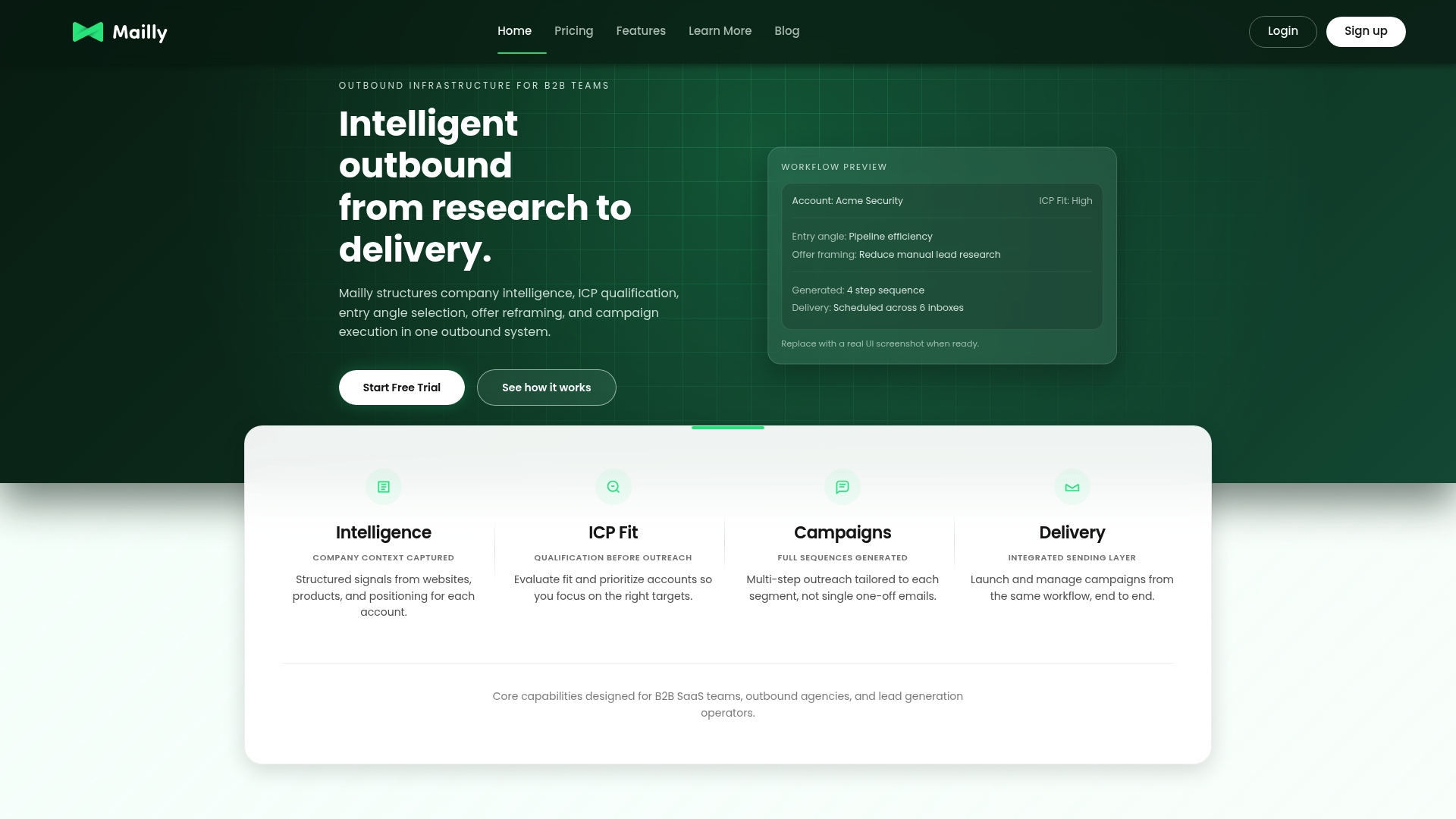
Mailly transforms cold outreach by starting with deep contextual research rather than email templates. The platform analyzes prospect positioning, product architecture, monetization models, hiring signals, and competitive landscapes to evaluate ICP fit and identify real business bottlenecks. Based on this analysis, Mailly reframes your offer to align with recipient priorities and builds psychologically sequenced campaigns designed for relevance, not volume. The result is outreach that feels intentional and strategically positioned. Mailly helps mid-sized B2B tech firms balance personalization with scale, tracking metrics continuously for campaign refinement. Discover how Mailly’s AI cold email platform can elevate your cold outreach strategy.
Frequently asked questions
What metrics should I track to measure cold outreach success?
Focus on reply rate, meeting booking rate, and cost per qualified meeting as primary indicators. Reply rate shows message relevance. Meeting booking rate indicates offer alignment. Track unsubscribe rate as a quality signal, high rates mean poor targeting or messaging. Monitor these cold outreach metrics weekly to identify trends and optimize quickly.
How many emails should be in a cold outreach sequence?
Most effective B2B sequences contain four to six emails spaced three to four days apart. Fewer than four misses opportunities to build context. More than six risks annoying prospects. The exact number depends on deal complexity and sales cycle length. Enterprise deals may warrant longer sequences with educational content between asks.
What’s the ideal cadence for cold email sequences without overwhelming prospects?
Space emails three to four days apart for initial sequences. This maintains presence without feeling pushy. Adjust based on recipient seniority and industry, executives may prefer more spacing. After the initial sequence, wait two weeks before re-engaging with new value or angles. Following a systematic cold outreach workflow guide ensures consistency.
How do I personalize emails when prospect research is limited?
Start with company-level insights like recent funding, product launches, or market positioning available in press releases. Reference industry trends affecting their sector. Use job postings to infer challenges, hiring sales reps suggests growth focus. Even basic personalization outperforms generic templates. Invest more research time as prospects engage.
Should I use AI tools or manual research for cold outreach?
Hybrid approaches work best for most mid-sized companies. Use AI tools to aggregate signals and scale research across many prospects. Apply manual review to your highest-value targets for deepest insight. AI handles efficiency, humans add strategic nuance. Start with AI for initial filtering, then manually research top-scoring accounts before outreach.
What’s the biggest mistake in cold outreach strategies?
Leading with your product instead of prospect context is the most common failure. Recipients don’t care about your features until you prove you understand their situation. Always establish relevance first. Other critical mistakes include poor list targeting, weak subject lines, and asking for meetings too early before building credibility.
