

Generic cold emails waste time and budget. In 2026, B2B SaaS teams need cold email strategies that prioritize relevance over volume to boost reply and conversion rates. This article breaks down actionable best practices for evaluating, personalizing, sequencing, and scaling cold outreach. You’ll learn how contextual research, psychological sequencing, and AI tools transform cold emails into high-converting conversations that drive real meetings and pipeline growth.
Table of Contents
- How To Evaluate And Choose Cold Email Strategies
- Deep Contextual Research And Offer Alignment
- Personalization Strategies That Drive Engagement
- Sequencing And Timing For Maximum Impact
- Technology And Tools To Enhance Cold Email Effectiveness
- Comparing Volume Vs Relevance Approaches
- Situational Recommendations: Choosing The Right Approach
- Boost Your Cold Email Success With Mailly
- Frequently Asked Questions
Key Takeaways
| Point | Details |
|---|---|
| Contextual research | Deep prospect research improves offer alignment and increases conversion rates by 25%. |
| Personalized subject lines | Tailored subject lines can boost open rates by over 22% compared to generic templates. |
| Strategic sequencing | Spacing 4-7 touches 3-5 days apart raises meeting bookings by 30% and replies by 50%. |
| AI-powered efficiency | AI tools improve cold email campaign efficiency by 40%, enabling better targeting and scale. |
| Relevance over volume | Research-driven campaigns achieve 33% reply rates versus 12% for generic volume blasts. |
How to Evaluate and Choose Cold Email Strategies
B2B SaaS teams face a critical decision: chase volume or prioritize relevance. The right cold email strategy depends on your ICP fit, sales cycle complexity, and business goals. Relevance-driven approaches outperform generic blasts when targeting high-value accounts with complex buying processes.
Start by assessing your Ideal Customer Profile fit. Deep contextual research into hiring signals, product architecture, and competitive landscape helps identify prospects who actually need your solution. This cold email strategy for B2B focuses on quality over quantity.
Key evaluation criteria include:
- ICP alignment and business context relevance
- Personalization depth beyond first name tokens
- Psychological sequencing to maintain engagement
- Measurable benchmarks like 25%+ open rates
- AI and automation capabilities for scale
Benchmark your campaigns against industry standards. Aim for open rates above 25% and reply rates over 20%. Offer alignment campaigns convert 35% better than volume-based outreach, making research upfront worthwhile for complex B2B SaaS sales.
Effective strategies balance efficiency with personalization. Volume approaches work for quick list validation, but sustained growth requires contextual relevance. Choose based on your prospect complexity and sales cycle length.
Deep Contextual Research and Offer Alignment
Contextual research transforms cold emails from ignored noise into relevant conversations. Instead of generic pitches, analyze each prospect’s business priorities, pain points, and strategic initiatives. This research-driven approach drives engagement and conversion.

Start by examining hiring signals. Companies hiring for specific roles reveal growth priorities and pain points. A B2B SaaS company expanding its sales team likely needs better lead generation or conversion tools. Use LinkedIn, company career pages, and hiring platforms to identify these signals.
Analyze competitive landscape and product architecture. Understanding where prospects fit in their market helps position your offer as a strategic advantage. Review their website, product documentation, and customer case studies to identify gaps your solution addresses.
Key research areas include:
- Hiring signals indicating growth priorities
- Product architecture revealing technical needs
- Competitive positioning showing differentiation gaps
- Monetization models highlighting revenue challenges
- Recent funding or expansion announcements
75% of prospects prefer relevance over generic pitches, leading to 25% higher conversion. Integrate research insights directly into subject lines and email body. Reference specific initiatives, challenges, or competitive moves to demonstrate understanding.
Avoid generic templates. Instead, craft emails that align your offer with their actual business priorities. If a prospect recently launched in a new market, frame your solution around expansion challenges rather than generic value propositions.
Pro Tip: Use AI-powered tools to automate prospect signal gathering at scale. Manual research works for small lists, but technology enables deep research for SaaS cold emails across hundreds of prospects efficiently. Balance automation with human insight for optimal personalization benefits in cold emails.
Personalization Strategies that Drive Engagement
Personalization goes beyond inserting first names. Effective personalization references specific business challenges, recent company initiatives, or competitive dynamics. This approach signals you’ve done homework and understand their context.
Subject lines make or break open rates. Keep them under 50 characters and include a specific, relevant hook. Reference a prospect’s recent product launch, hiring initiative, or competitive move. Specificity beats generic curiosity every time.
Body copy should connect research insights to value. Instead of listing features, explain how your solution addresses their specific pain point. If they’re expanding internationally, discuss localization challenges and how you solve them.
Craft clear, single-topic CTAs. Multiple asks confuse recipients and reduce response rates. Focus each email on one action: book a call, review a case study, or share feedback. Make the next step obvious and low-friction.
Effective personalization tactics:
- Reference specific business challenges in opening lines
- Connect your solution to their strategic priorities
- Use insights from hiring signals or product updates
- Keep subject lines under 50 characters for mobile
- Include one clear CTA per email
Personalized subject lines raise email opens by 22%; clear CTAs increase conversion by 28%. These improvements compound across sequences, dramatically increasing meeting bookings and pipeline generation.
Segment your prospect list by persona, industry, or pain point. Test different subject line variants for each segment to identify what resonates. A CFO cares about ROI and efficiency, while a VP of Sales focuses on pipeline and conversion rates.
Pro Tip: Create modular email templates with customizable sections for effective personalization tactics. This approach maintains efficiency while enabling deep personalization at scale. Focus customization on the most impactful elements: subject line, opening hook, and value connection. Learn more personalization best practices to maximize engagement.
Sequencing and Timing for Maximum Impact
Cold email sequencing determines whether prospects engage or ignore your outreach. The right sequence length and timing balance persistence with respect, maximizing reply rates without causing fatigue.
Optimal sequences include 4 to 7 touches spaced 3 to 5 days apart. This cadence maintains visibility without overwhelming recipients. Fewer touches leave opportunities on the table, while more creates spam perception.
Psychological sequencing matters as much as timing. Vary your message framing across touches:
- First touch: Introduce value and context
- Second touch: Share social proof or case study
- Third touch: Address potential objections
- Fourth touch: Offer alternative engagement (content, tool, etc.)
- Fifth touch: Final check-in with exit option
- Sixth and seventh: Spaced further apart as low-pressure reminders
Sequences of 4-7 touches spaced 3-5 days apart increase meetings by 30% and replies by up to 50%. This data-backed approach optimizes for engagement without burning lists.
Timing affects deliverability and attention. Send emails Tuesday through Thursday for best open rates. Avoid Mondays (inbox overload) and Fridays (weekend focus). Time sends for 8-10 AM in the prospect’s timezone when they’re checking email but not yet overwhelmed.
Vary message themes across the sequence. Don’t repeat the same pitch five times. Each touch should provide new value, perspective, or insight. This variety maintains interest and demonstrates depth of understanding.
“Strategic sequencing transforms cold outreach from random shots to deliberate conversations. Each touch builds on the previous one, creating momentum toward a meeting.”
Avoid over-contacting. If a prospect doesn’t engage after 7 touches, move them to a nurture list or pause outreach. Persistence becomes harassment when you ignore signals. Respect boundaries to protect sender reputation and brand perception.
Implement effective cold email sequencing strategies and psychological sequencing techniques to maximize campaign performance while maintaining professional boundaries.
Technology and Tools to Enhance Cold Email Effectiveness
Technology transforms cold email from manual grind to scalable system. AI-powered tools automate research, optimize timing, and personalize messages at scale. The key is knowing when and how to leverage these capabilities.
AI assists with prospect data aggregation. Instead of manually researching each company, AI tools scan LinkedIn, company websites, news articles, and funding databases to compile contextual insights. This automation enables research-driven personalization across large prospect lists.
Automated sequencing tools maintain optimal timing and message variation. Set up sequences once, then let the platform handle delivery timing, follow-up scheduling, and bounce management. This consistency improves deliverability and ensures no prospect falls through cracks.
AI suggests personalized message templates based on prospect data. Advanced platforms analyze hiring signals, product updates, and competitive landscape to recommend relevant hooks and value propositions. Human oversight ensures quality while AI handles scale.
| Approach | Research Depth | Personalization | Efficiency | Best For |
|---|---|---|---|---|
| Manual | High | Very High | Low | Small lists, enterprise accounts |
| Semi-Automated | Medium | High | Medium | Growing teams, mid-market focus |
| AI-Enhanced | High | High | Very High | Scale, multiple segments |
| Fully Automated | Low | Low | Very High | Quick testing, high volume |
AI tools improve cold email campaign efficiency by 40%, enabling better scaling. This efficiency gain frees teams to focus on high-value activities like closing deals rather than manual list building.
Pro Tip: Start manual to learn what resonates with your ICP. Once you identify winning patterns, implement AI tools for cold email to scale those insights across larger lists. This hybrid approach combines human insight with machine efficiency for optimal results in scaling cold email campaigns.
Choose tools that integrate with your existing tech stack. CRM integration ensures smooth handoff from cold outreach to sales pipeline. Analytics platforms track performance across sequences, enabling data-driven optimization.
Comparing Volume vs Relevance Approaches
B2B SaaS teams must choose between volume-driven and relevance-driven cold email strategies. Each approach serves different goals with distinct outcomes.
Volume-based outreach prioritizes quantity. Send hundreds or thousands of emails with minimal personalization. This approach works for quick list testing or broad lead generation when you’re still validating ICP fit.
Relevance-driven outreach prioritizes quality. Deep contextual research and personalization target fewer prospects but yield significantly higher engagement. This approach excels for complex B2B SaaS sales with longer cycles and multiple decision makers.
| Factor | Volume Approach | Relevance Approach |
|---|---|---|
| Email quantity | 500-1000+ per week | 50-150 per week |
| Personalization | Minimal (name, company) | Deep (context, pain points) |
| Reply rate | ~12% | ~33% |
| Meeting conversion | ~3-5% | ~15-20% |
| Time per prospect | 2-3 minutes | 10-15 minutes |
| Best for | List testing, broad lead gen | High-value accounts, complex sales |
| Long-term ROI | Lower | Higher |
Personalized campaigns achieve 33% reply rates, while generic volume campaigns only 12%. This dramatic difference compounds across sequences, resulting in 3-5x more qualified meetings from relevance-driven approaches.
Offer alignment drives the conversion gap. Volume campaigns pitch generic value propositions that rarely resonate. Relevance campaigns connect specific prospect challenges to tailored solutions, increasing conversion rates by 35%.
Sequenced, relevance campaigns yield better long-term ROI. Initial time investment pays off through higher-quality conversations, shorter sales cycles, and better customer fit. Volume approaches generate more top-of-funnel activity but often lower-quality leads.
Consider cold email performance benchmarks and cold email method comparison when selecting your approach. Match strategy to business goals and sales complexity.
Situational Recommendations: Choosing the Right Approach
Your ideal cold email strategy depends on prospect type, sales cycle complexity, and business goals. Here’s how to choose:
High-value enterprise accounts: Use research-driven relevance. Deep personalization and strategic sequencing justify the time investment for large contract values.
Mid-market SaaS prospects: Blend approaches. Use AI tools to automate research and enable personalization at scale. This balance delivers relevance efficiently.
List validation and testing: Start with volume to identify responsive segments. Then shift to relevance-driven outreach for validated ICPs.
Long sales cycles with multiple stakeholders: Implement longer sequences (6-7 touches) with educational content. Space touches 4-5 days apart to maintain visibility without pressure.
Quick-close, transactional products: Volume approaches work when sales cycles are short and decision-making is simple. Optimize for speed over deep personalization.
Leverage AI tools to scale personalized campaigns. Modern platforms combine research automation with human oversight, enabling relevance at volume. This hybrid approach delivers 30-40% efficiency gains while maintaining quality.
Match sequence length to sales cycle complexity. Shorter cycles need 3-4 touches over 10-12 days. Longer enterprise cycles benefit from 6-7 touches over 21-28 days with varied content types.
Test and iterate based on performance data. Track open rates, reply rates, and meeting conversion by segment. Double down on what works and cut what doesn’t. Continuous optimization compounds results over time.
Review choosing cold email strategies and cold outreach workflow recommendations to implement the right approach for your situation.
Boost Your Cold Email Success with Mailly
Ready to implement these cold email best practices without manual research bottlenecks? Mailly combines AI-powered contextual research with strategic sequencing to deliver relevance at scale.
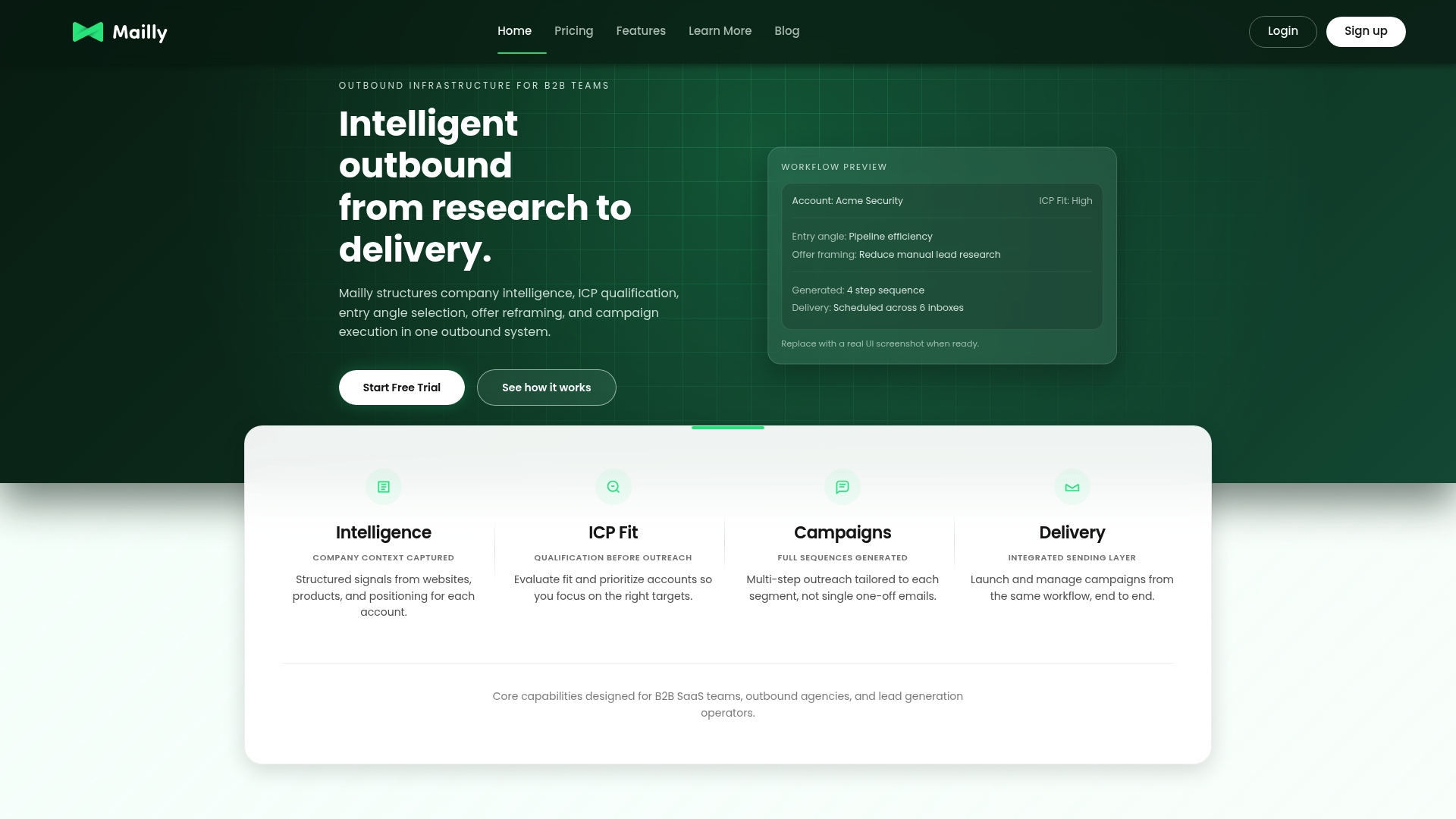
Mailly analyzes prospect positioning, product architecture, hiring signals, and competitive landscape to identify real business bottlenecks. Then it reframes your offer to align with actual priorities and builds psychologically sequenced campaigns designed for engagement, not volume.
The result is cold outreach that feels intentional and contextually relevant rather than templated. Automate research, optimize sequencing, and personalize at scale with AI tools for cold outreach. Implement the complete cold outreach workflow guide to transform your B2B SaaS pipeline.
Frequently Asked Questions
What is the ideal number of touches in a cold email sequence?
Four to seven touches spaced 3 to 5 days apart optimize engagement without causing recipient fatigue. This sequence length increases meeting bookings by 30% compared to shorter sequences. Vary message themes across touches to maintain interest and demonstrate value from multiple angles.
How can I personalize cold emails without a huge time investment?
Leverage using AI for personalization to automate contextual data gathering and template customization. Focus manual personalization on high-impact elements like subject lines and opening hooks. This hybrid approach enables research-driven relevance at scale without proportional time investment.
What metrics should I track to measure cold email success?
Track open rates (target 25%+), reply rates (target 20%+), meeting booking rates, and conversion to pipeline. Monitor cold outreach metrics by segment and sequence position to identify optimization opportunities. Use A/B testing on subject lines and CTAs to continuously improve performance.
When should I consider using AI tools for cold outreach?
Implement AI for cold outreach when scaling personalized campaigns beyond 50-100 prospects per week. AI improves targeting accuracy and campaign efficiency by 40%, enabling research-driven relevance at volume. Start manual to learn ICP patterns, then scale with AI once you identify winning approaches.
How do I avoid overwhelming prospects with follow-ups?
Space follow-ups 3 to 5 days apart with a maximum of 7 touches per sequence. Vary message content and value proposition across touches rather than repeating the same pitch. Include clear opt-out language and honor unsubscribe requests immediately. Review detailed cold emailing tips for SaaS founders to balance persistence with respect.
