

Most B2B SaaS founders still chase cold email success by blasting untargeted lists, thinking more messages mean more meetings. The reality is that this approach usually delivers low engagement and risks damaging your sender reputation. Building a strategic cold email system means relying on research, relevance, and value-centered sequencing instead of volume games. This guide uncovers what actually drives replies and exposes the myths that sabotage your outreach before it begins.
Table of Contents
- Defining Cold Email Strategy And Common Myths
- Types Of Cold Email Approaches For B2B SaaS
- How Contextual Personalization Drives Engagement
- Legal Compliance And Risks In Global Outreach
- Mistakes To Avoid For High-ROI Campaigns
Key Takeaways
| Point | Details |
|---|---|
| Cold Email Strategy is Systematic | Cold email outreach must be based on thorough research and understanding of prospects rather than sheer volume. |
| Quality Over Quantity | Sending fewer, more personalized emails yields higher engagement rates than mass emailing poorly-qualified leads. |
| Effective Personalization is Contextual | True personalization involves demonstrating an understanding of the prospect’s specific business challenges, not mere surface-level details. |
| Legal Compliance is Essential | Understanding and adhering to regional cold email regulations is crucial to avoid penalties and maintain deliverability. |
Defining Cold Email Strategy and Common Myths
Cold email strategy is a structured approach to prospect outreach based on research, positioning analysis, and psychological sequencing—not volume or templated blasts.
Most founders treat cold email like a numbers game. You send 1,000 emails, expect 1% response, and call it a win. But this approach conflates effort with results.
The truth: cold email works when it’s engineered as a system. Cold email strategy demands understanding your prospect’s business context, competitive position, and actual priorities before writing a single subject line.
Let’s address what cold email strategy actually is—and bust the myths holding you back.
What Cold Email Strategy Really Means
Cold email strategy starts upstream from the email itself. It begins with diagnostic work: analyzing your ICP, mapping their business architecture, identifying monetization pressures, and spotting hiring signals that reveal operational bottlenecks.
Only after this research do you craft messaging. The email becomes a vehicle for relevance, not a guessing game.
This differs fundamentally from tactics like subject line optimization or copywriting frameworks. Those matter. But they operate downstream from strategy.
Strategy asks: “Who should we contact and why?” Tactics ask: “How do we phrase the ask?” Most cold email training focuses exclusively on tactics.
- Diagnostic phase: Analyze prospect company positioning, product architecture, go-to-market model
- Signal phase: Identify hiring patterns, funding moves, market expansion indicating real pain points
- Positioning phase: Reframe your offer to align with discovered priorities
- Sequencing phase: Build email campaigns with psychological design, not just volume
Without this foundation, even perfect copy performs poorly because it addresses the wrong problem.
Three Myths Destroying Your Outreach
Myth 1: Volume solves everything. Sending more emails to poorly-qualified prospects doesn’t increase conversion—it burns domain reputation and trains prospects to delete you. Quality of fit matters more than quantity of sends.
Myth 2: Your value proposition is what matters most. Prospects don’t care what you built. They care what problems you solve for their specific business. Generic positioning kills response rates because it feels templated.
Myth 3: Cold email is dying. This claim usually comes from people running high-volume, low-personalization campaigns. Cold email thrives when it’s strategic and contextual. It dies when it’s spray-and-pray.
Strategic cold email outperforms because it addresses real business priorities, not because it’s clever or trendy.
How Myths Break Your Campaigns
When you believe volume wins, you optimize for speed over accuracy. You blast templates. You track open rates and clicks instead of lead quality. You measure vanity metrics.
When you believe your product matters most, you write about features. You talk about speed, scalability, automation. But your prospect is worried about churn, revenue impact, or team burnout—different problems entirely.
When you believe cold email is dead, you abandon it. You move to paid ads or inbound. But those channels cost more per qualified lead and take longer to scale.
Prospects still open cold emails. They still reply. The difference is they only do it when the email feels intentional and contextually relevant.
Pro tip: Before sending any cold email, map one prospect’s business challenges across three dimensions: current competitive position, recent hiring/funding signals, and product/pricing evolution. This single exercise reveals whether you understand their context well enough to claim relevance.
Types of Cold Email Approaches for B2B SaaS
B2B SaaS companies have multiple cold email approaches available, but not all yield the same results. The key distinction isn’t the tactic—it’s whether the approach prioritizes relevance over volume.
Most SaaS founders default to what doesn’t work: blast campaigns targeting anyone with a title match. But this burns your sender reputation and wastes outreach.
Effective approaches follow a different philosophy. They focus on narrow targeting, value-first positioning, and sequence design that builds psychological resonance.
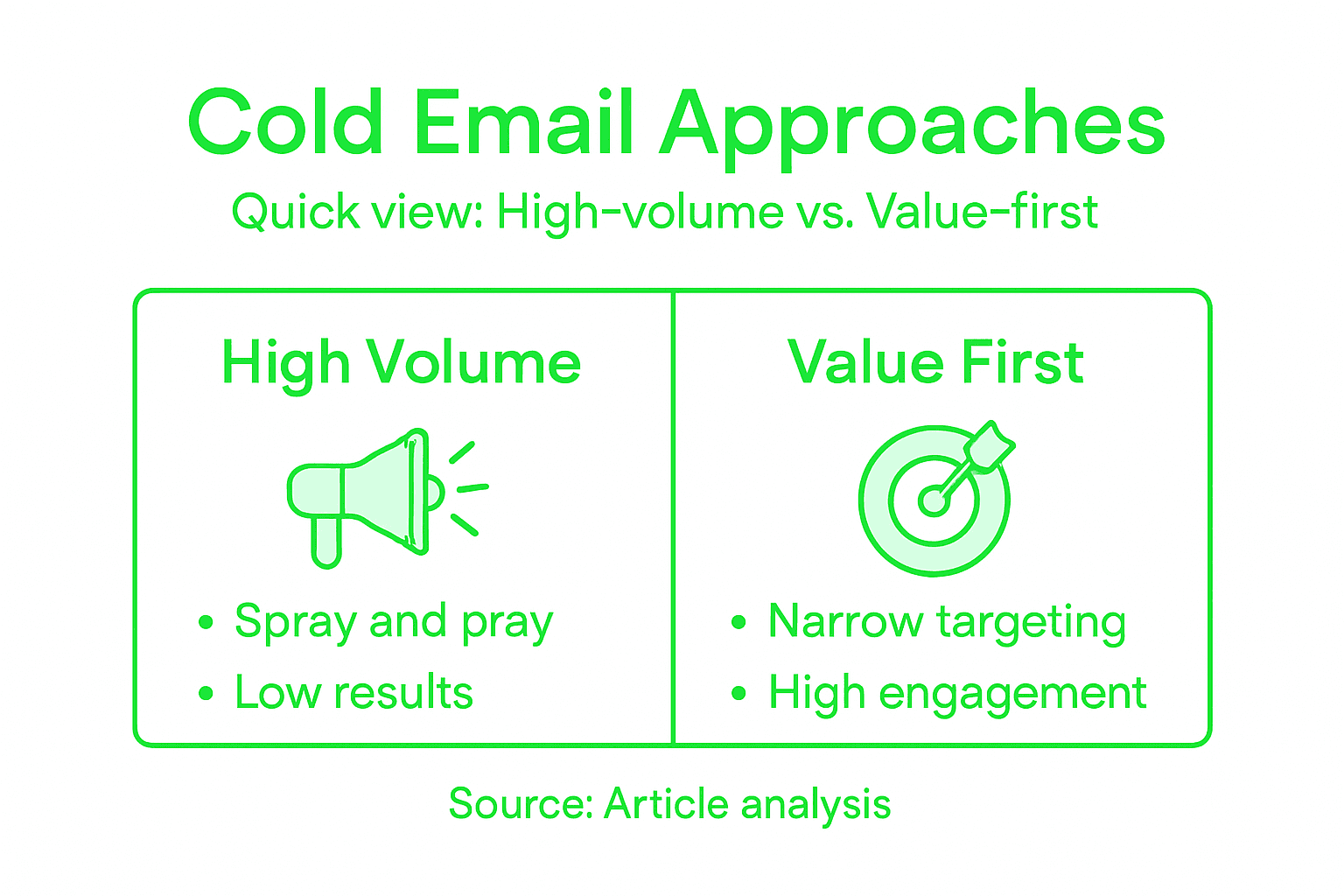
Let’s examine the approaches that actually drive pipeline, plus the ones you should avoid.
The High-Volume Broadcast Approach
This is the spray-and-pray method. You buy a list of 10,000 “decision-makers,” write one email, and send it out. Response rates hover around 1-2% if you’re lucky.
Why it fails: Your email lands in inboxes alongside thousands of identical messages. Prospects see no relevance. Spam filters catch more than actual people do.
This approach treats cold email like a lottery. You’re betting on sheer numbers to produce winners.
The problem accelerates over time. High-volume sending damages domain reputation. ISPs flag your domain. Future campaigns perform worse. You’ve burned the channel.
When founders ask “Why isn’t cold email working?” they’re usually running this exact approach.
The Narrow Targeting, Value-First Approach
This is the inverse. You identify 50-100 highly-qualified prospects based on real business context. Your email addresses a specific problem they’re actually facing.

You send a 3-5 email sequence that builds credibility progressively. The first email introduces context, not asks. Subsequent emails build on that foundation.
Results differ dramatically: effective cold email strategies targeting the right accounts with narrow positioning achieve 8-15% positive reply rates—not opens, but actual replies.
- Account selection: Research ICP fit, recent funding, hiring velocity, product expansion signals
- Email structure: Lead with insight, position value to their specific context, ask for discussion
- Sequence design: 3-5 emails over 10-14 days, each providing value independently
- Deliverability protection: Warm up domains, validate lists, monitor sender reputation
This requires more work upfront. But the work is the strategy, not the execution.
The Hybrid Approach: Warm Outreach Plus Cold
Some SaaS companies combine cold email with warm introductions. You identify targets via LinkedIn, engage with their content, then reach out with context.
This reduces cold email volume but increases relevance. Your message lands on someone who already recognizes your name.
Hybrid works well if your team has time for relationship building before the ask. It typically converts higher than pure cold email, but slower.
Here’s a concise comparison of core cold email approaches for B2B SaaS:
| Approach Type | Targeting Style | Engagement Rate | Main Business Risk |
|---|---|---|---|
| High-Volume Broadcast | Broad, untargeted lists | 1-2% reply rate | Domain reputation damage |
| Narrow Targeting, Value-First | Focused, research-driven | 8-15% positive replies | Time-intensive setup |
| Hybrid (Warm + Cold) | Relationship-based and cold | Moderate, higher with warm leads | Slower pipeline growth |
| Account-Based | Multiple stakeholders, few accounts | Highest for enterprise | High resource investment |
The Account-Based Approach
You target 5-10 high-value accounts. Multiple team members contact different stakeholders across the same company simultaneously.
This is expensive per account but maximizes conversion for enterprise deals. You’re not chasing volume; you’re orchestrating a campaign.
Narrow targeting beats broad volume because relevance determines whether a prospect reads your email, not how many inboxes it lands in.
Which Approach Fits Your Stage
Early-stage SaaS founders should prioritize the narrow targeting, value-first approach. You need to prove repeatable messaging before scaling.
Growth-stage companies can combine narrow targeting with hybrid warm outreach. You have more team bandwidth.
Enterprise-focused SaaS typically needs account-based approaches. Your deal sizes justify the complexity.
Never start with high-volume broadcasting. You’ll burn domain reputation for minimal return.
Pro tip: Test your cold email approach on 25 highly-qualified prospects first. Measure replies, not opens. If you can’t achieve 5%+ reply rate at this small scale, your positioning isn’t resonating—fix it before scaling volume.
How Contextual Personalization Drives Engagement
Contextual personalization isn’t about inserting a prospect’s name into a template. It’s about demonstrating you understand their specific business situation, competitive pressures, and operational priorities.
When a prospect reads your email, they’re asking one question: “Does this person understand my world?” Generic personalization fails because it feels transactional. Real personalization answers that question decisively.
The difference is dramatic. Personalized emails addressing actual business context see reply rates 3-5x higher than template variations.
Why Generic Personalization Fails
Most cold emails use surface-level personalization: company name, recent funding announcement, a LinkedIn connection. These details feel like research, but they’re not strategic.
A prospect sees: “Congrats on your Series B!” This signals you skimmed their press release, nothing more. Everyone with a list saw the same news.
Your email disappears because it doesn’t differentiate. You’re one of dozens sending identical variations.
True personalization requires context. What does their Series B actually mean for their business? Are they expanding into new markets? Hiring specific functions? Building new product capabilities?
Context reveals the real opportunity for relevance.
How to Build Contextual Personalization
Contextual personalization starts with research that goes beyond job titles and LinkedIn profiles. You’re mapping their business architecture.
Begin with these layers:
- Positioning analysis: What problem does their product solve? Who are they competing against? What’s their differentiation?
- Go-to-market signals: Pricing model, customer acquisition channel, product positioning in their category
- Organizational changes: Hiring patterns reveal operational priorities. A spike in engineering hires suggests product development. Sales hires suggest market expansion.
- Tech stack assessment: What tools are they using? What gaps exist that your solution could address?
- Competitive context: How does your offer position relative to their current solutions and competitors?
This research takes 15-20 minutes per prospect. But it transforms your cold email from generic to intentional.
The Engagement Multiplier
Email campaign psychology shows that prospects respond when they feel understood. Contextual personalization creates that feeling because you’re addressing their actual situation, not a templated scenario.
Your email message shifts from “We help companies like yours” to “I noticed your team is scaling customer success operations—here’s why that matters and how we typically help.”
One is generic. One is diagnostic.
The second version triggers engagement because the prospect recognizes their own situation in your words. You’ve done homework. You understand their context.
This builds credibility before you’ve pitched anything.
Personalization drives engagement because it proves you researched their specific business, not just their title.
Where Personalization Breaks Down
Personalization without strategic positioning fails. You can mention their hiring, their funding, their product roadmap. But if your offer doesn’t connect to their actual pain point, none of it matters.
Contextual personalization requires two elements working together: research plus strategic fit. One without the other wastes your effort.
Pro tip: Create a simple one-page research template for each prospect: business model, recent changes, competitive position, and one specific pain point you’re solving. Use this template to guide your email positioning, not just surface-level details.
Legal Compliance and Risks in Global Outreach
Cold email isn’t universally legal. Your outreach strategy must adapt to regional regulations or you face fines, deliverability damage, and legal liability.
The mistake founders make: treating compliance as optional or as a checkbox exercise. Regulations differ dramatically across markets. What’s compliant in the United States violates European law.
Ignoring this creates operational risk. Your domain gets flagged. Your deliverability tanks. You face potential penalties.
Understanding regional frameworks isn’t optional—it’s foundational to sustainable outreach.
The Regulatory Landscape
Cold emailing regulations vary significantly by region, requiring compliance with CAN-SPAM in the United States, GDPR in the European Union, CASL in Canada, and country-specific laws elsewhere.
Each framework has distinct requirements. Some demand explicit prior consent before sending. Others allow cold outreach with specific compliance mechanics.
The stakes aren’t theoretical. GDPR violations carry fines up to 4% of annual revenue. CASL violations reach $15 million CAD per violation. CAN-SPAM fines escalate per email sent.
Compliance isn’t a cost—it’s a business requirement.
Key Compliance Elements Across Regions
While regulations differ, certain compliance patterns repeat across jurisdictions:
- Sender transparency: Your identity and contact information must be accurate and included in every email
- Opt-out mechanisms: Recipients must have a clear, functional way to unsubscribe or object to future emails
- Non-deceptive messaging: Subject lines, sender names, and content must accurately represent your intent
- Targeted, non-spam approach: Mass blasting to purchased lists violates most frameworks; targeted, research-driven outreach aligns better with legal intent
- Data handling: Personal data collection and storage must follow regional privacy standards
These elements create a baseline. Region-specific requirements layer on top.
United States: CAN-SPAM
CAN-SPAM permits cold commercial email if it complies with specific rules. You don’t need prior consent, but you must follow format requirements.
Critical obligations:
- Include accurate header information and physical address
- Honor unsubscribe requests within 10 business days
- Monitor agents’ compliance if using third parties
- Avoid deceptive subject lines or sender information
CAN-SPAM violations carry penalties of $43,792 per email (2024 rates) for knowing violations.
European Union: GDPR
GDPR is stricter. You need explicit consent before sending marketing emails to most recipients. B2B outreach to business addresses has limited exceptions, but data processing still requires lawful basis.
Key requirements:
- Lawful basis for processing contact data
- Clear privacy disclosures
- Data subject rights (access, deletion, portability)
- Data processing agreements with any vendors
The penalty risk makes GDPR compliance non-negotiable for European outreach.
Canada: CASL
CANADA’s CASL requires explicit prior consent before sending commercial electronic messages. Unlike CAN-SPAM, consent is mandatory, not optional.
Consent must be clear, documented, and specific to your outreach. The recipient must affirmatively agree to receive your messages.
Violations carry up to $15 million CAD per violation, making CASL the strictest North American framework.
Here is a summary of key legal frameworks impacting global cold email compliance:
| Legal Framework | Consent Requirement | Penalty Risk | Unique Challenge |
|---|---|---|---|
| CAN-SPAM (US) | No prior consent needed | Up to $43,792/email | Must honor unsubscribe quickly |
| GDPR (EU) | Explicit consent required | Up to 4% of revenue | Lawful basis for all data use |
| CASL (Canada) | Affirmative consent required | Up to $15M CAD/violation | Documentation of consent essential |
Operational Risk If You Don’t Comply
Beyond legal penalties, non-compliance damages your outreach operationally. ISPs monitor compliance patterns. High complaint rates from non-compliant campaigns trigger domain reputation damage.
Your future campaigns—even compliant ones—suffer lower deliverability because your domain is flagged.
Compliance protects both legal exposure and operational sustainability. Non-compliance burns your sender reputation.
Building Compliant Campaigns
Compliance requires documenting your approach. Track consent sources. Maintain unsubscribe lists. Monitor complaint rates.
If targeting multiple regions, use the strictest standard that applies. GDPR compliance usually satisfies other frameworks. CAN-SPAM compliance works for United States campaigns but not GDPR territories.
When in doubt, bias toward stricter compliance. The operational and financial cost of violations exceeds the friction of tighter requirements.
Pro tip: Before launching any cold email campaign, audit your target list by region and document your legal basis for outreach in each jurisdiction. Maintain separate compliance documentation for different regulatory zones. This documentation becomes critical if compliance is ever questioned.
Mistakes to Avoid for High-ROI Campaigns
High-ROI cold email campaigns fail not because of bad tactics, but because of structural mistakes in strategy and execution. Most founders repeat the same errors repeatedly, wondering why scaling doesn’t improve results.
These mistakes are predictable. They’re also preventable if you understand what causes them.
Let’s examine the mistakes that destroy campaign performance, and how to avoid them.
Mistake 1: Confusing Activity with Strategy
You send 500 emails this week. Next week, 1,000. You measure success by volume sent, not by leads qualified or meetings booked.
This is activity masquerading as strategy. You’re busy, but not effective.
High-ROI campaigns measure backward: start with your revenue target, work backward to required meetings, then calculate required outreach volume. Most founders do the opposite. They pick a volume number and hope it produces results.
The distinction matters because volume without qualification burns your domain reputation and produces low-quality pipeline.
Mistake 2: Treating Every Prospect Identically
You find a template that works. Now you scale it to everyone on your list. Small companies, enterprises, different industries—all get the same message.
This fails because different prospects have different contexts. An early-stage startup’s revenue challenges differ from an enterprise’s operational complexity.
Personalization at scale requires ICP segmentation, not individual customization. You create 3-5 message variants, each targeting a distinct prospect profile. Each variant reflects their specific business context.
One template for everyone guarantees mediocre response across all segments.
Mistake 3: Leading with Your Product
Your email opens with what you built: “We’ve automated email outreach with AI.” Then you explain features. Then you ask for a meeting.
Your prospect doesn’t care what you built. They care what problems you solve for their business.
Why most outbound fails is often because campaigns prioritize product features over prospect priorities. The fix: lead with insight about their business, position your solution as an answer to that insight, ask for conversation.
Feature-first positioning kills engagement because it feels templated. Insight-first positioning builds credibility.
Mistake 4: Ignoring Sequence Design
One email and you’re done. If they don’t reply, you move on.
Psychologically, most prospects need multiple touch points before engaging. A single email has minimal chance of landing at the right moment, with the right context.
Proper sequences work like this:
- Email 1: Introduce insight about their business
- Email 2: Provide a specific example of how you’ve helped similar companies
- Email 3: Ask a low-friction question about their current approach
- Email 4: Share a relevant resource or perspective
- Email 5: Final ask with clear value proposition
Sequences spread over 10-14 days. Each email provides value independently. Together, they build psychological resonance.
Mistake 5: Not Measuring the Right Metrics
You optimize for open rates. You tweak subject lines. You chase a 35% open rate.
But opens don’t convert to revenue. Replies do. Meetings do. Pipeline does.
Track these metrics instead:
- Reply rate: Percentage of emails that received any response
- Positive reply rate: Percentage expressing genuine interest
- Meeting conversion: Percentage of positive replies that become meetings
- Pipeline value: Total opportunity size from campaign
Open rates are vanity metrics. They feel good but don’t drive revenue.
Mistake 6: Scaling Before You’ve Found Signal
You run a campaign to 50 prospects. You get 2% positive reply rate. So you scale to 5,000 prospects.
But if your message isn’t resonating at small scale, scaling amplifies the problem. You’ve just sent 5,000 irrelevant emails.
The rule: achieve 5%+ positive reply rate on a test group before scaling volume. If you can’t hit that threshold, your positioning or targeting needs work.
Scaling breaks campaigns that weren’t working in the first place.
Campaign failure usually traces back to strategy, not tactics. Fix strategy first, then optimize execution.
The Integration Error Most Founders Make
Mostakes compound. You use volume metrics instead of quality metrics. You don’t segment. You lead with features. You don’t sequence.
Each mistake alone damages performance. Together, they ensure failure. Success requires avoiding all of them.
Pro tip: Before scaling any campaign, conduct a 30-prospect test with your target ICP. Measure positive reply rate, not opens. If you’re not hitting 5%+, pause scaling and diagnose your positioning, targeting, or message structure before expanding volume.
Transform Your Cold Email Strategy with AI-Driven Precision
The article highlights that success in cold email outreach depends on a well-engineered system focused on deep contextual research, strategic positioning, and psychologically designed sequences rather than high volume or generic templates. If you struggle to reach prospects with relevant messaging that resonates with their actual business priorities or find your campaigns delivering low reply rates despite heavy sending, these challenges stem from missing that foundational strategy insight.
Mailly is built exactly to solve this problem. Our AI-powered outbound strategy engine starts by analyzing your ideal customer profile’s positioning, hiring signals, monetization pressures, and competitive context. Mailly then reframes your offer to target precise bottlenecks and automates crafting email sequences designed to build genuine engagement through relevance—not random blasts. This approach directly addresses the common pitfalls of wasted volume, poor personalization, and weak sequencing discussed in the article.
See how strategic cold email outreach can unlock 8-15% reply rates by aligning deeply with your prospect’s challenges. Take the first step toward scaling effective outbound by visiting Mailly’s homepage. Learn why starting with research and positioning, not just copy, is essential at Mailly’s Strategy page. When you are ready to move beyond guesswork to a proven system, explore how we build campaigns that deliver at Mailly.io. Act now to stop wasting time on volume and start engaging with intent.
Frequently Asked Questions
What is a cold email strategy?
A cold email strategy is a structured approach to outreach that focuses on research, understanding the business needs of prospects, and crafting personalized messages rather than sending bulk templated emails.
How can I improve my cold email response rates?
Improving response rates can be achieved by focusing on narrow targeting, performing in-depth research on your prospects, using contextual personalization in your messaging, and designing email sequences that build credibility.
What common myths exist about cold email outreach?
Common myths include the belief that volume solves everything, that your value proposition is the most important factor, and that cold email is no longer effective. These misconceptions can hinder successful outreach efforts.
How does compliance impact cold email campaigns?
Compliance with email regulations is crucial to avoid legal penalties and damage to your sender reputation. Different regions have varying requirements, such as consent for sending marketing emails, which must be understood and adhered to for successful outreach.
