

Most B2B marketers believe sending more emails guarantees better results. The truth is, volume-focused cold email campaigns fail 90% of the time. Intentional campaigns grounded in research and psychological sequencing consistently outperform mass blasts by up to 50%. This guide shows you how to shift from quantity to strategic relevance.
Table of Contents
- Understanding Intentional Email Campaigns
- How Contextual Research Shapes Effective Outreach
- Psychological Sequencing: Building Relevance Step-By-Step
- Common Misconceptions About Cold Email Strategy
- Framework For Designing Intentional Email Campaigns
- Bringing It All Together: Applying Intentionality For SaaS Growth
- Explore Mailly For Intentional Cold Email Success
- Frequently Asked Questions
Key takeaways
| Point | Details |
|---|---|
| Quality beats volume | Intentional campaigns prioritize recipient-specific relevance over sending thousands of generic emails. |
| Research drives results | Deep contextual analysis of company positioning and pain points creates personalized outreach that converts. |
| Psychological sequencing works | Strategically timed emails reduce fatigue and build engagement through behavioral science principles. |
| Volume myths persist | Common beliefs about mass emailing undermine campaign performance by ignoring personalization. |
| Framework enables execution | A structured approach to diagnosis, alignment, sequencing, and metrics optimizes intentional campaigns. |
Understanding intentional email campaigns
Intentional campaigns target the right audience with messages tailored to their specific business needs. They rely on contextual research including company positioning and growth signals to ensure relevance.
This approach contrasts sharply with volume-based campaigns that send generic emails widely. Mass blasts often cause low engagement and high unsubscribe rates because they ignore recipient context.
Intentionality shifts focus from quantity to quality. The result is measurably higher open rates, reply rates, and conversion rates across the sales funnel.
Key benefits include:
- Higher pipeline quality from better-matched prospects
- Faster sales cycles through relevant messaging
- Improved sender reputation and deliverability
- Reduced wasted effort on unqualified leads
- Stronger relationships built on understanding
Strategic, contextual research drives engagement far more effectively than sending thousands of templated messages. When you understand a prospect’s actual challenges, you can position your solution as the answer they need now.
How contextual research shapes effective outreach
Thorough business research enables you to craft targeted email content that resonates with SaaS buyers. This means examining company product architecture, market position, and hiring trends.
You identify recipient business bottlenecks to tailor value propositions specifically. Reframing offers based on pain points dramatically boosts relevance and appeal to decision makers.

Research shows contextual analysis improves open rates by 20-30%. The conversion lift can reach 15-25% compared to generic campaigns.
| Metric | Without Research | With Contextual Research | Improvement |
|---|---|---|---|
| Open Rate | 18% | 24% | +33% |
| Reply Rate | 2% | 4.5% | +125% |
| Meeting Conversion | 0.5% | 1.2% | +140% |
| Pipeline Value | $50K | $95K | +90% |
Pro Tip: Use AI tools to collect and analyze real-time company signals like funding announcements, leadership changes, and product launches for up-to-date targeting insights.
Optimizing outreach relevance requires connecting your solution to the prospect’s current business reality. Generic pain points feel hollow. Specific, researched insights demonstrate you understand their world.
Key research areas include:
- Product monetization model and pricing changes
- Recent organizational growth or contraction signals
- Competitive positioning and market pressures
- Technology stack and integration requirements
- Customer segments and go-to-market strategy
Best practices for B2B cold outreach emphasize depth over breadth. Spending 15 minutes researching one high-value prospect outperforms sending 50 unresearched emails.
Psychological sequencing: Building relevance step-by-step
Behavioral science supports sending sequenced emails that gradually increase relevance and anticipation. This approach reduces fatigue by spacing outreach and varying message intent.
Sequenced campaigns show 40% higher engagement and 60% lower unsubscribe rates compared to random follow-ups. The difference comes from respecting the recipient’s attention and building value progressively.
Step-by-step cold emailing for SaaS focuses on cadence design. Your first email introduces a relevant insight. The second adds proof or social validation. The third offers a specific next step.
Pro Tip: Align messaging in sequences with identified buyer journey stages and evolving pain points to maintain relevance throughout the campaign.
Psychological triggers to incorporate:
- Curiosity through compelling subject lines and open loops
- Social proof via customer success stories and metrics
- Reciprocity by sharing valuable resources before asking
- Scarcity using time-limited insights or opportunities
- Authority through thought leadership and expertise
B2B cold outreach tips emphasize that timing matters as much as content. Sending three emails in three days overwhelms. Spacing them over two weeks with different value angles builds momentum.
Each touchpoint should feel like a natural continuation, not a desperate repeat. Reference previous messages briefly, then introduce new information that advances the conversation.
Common misconceptions about cold email strategy
Myth 1: Sending more emails means more success. The data shows volume-only campaigns underperform by up to 40% compared to targeted approaches.
Myth 2: Basic personalization like first names is enough. Without deep business context, superficial customization fails to differentiate your outreach from competitors.
| Approach | Volume-Based | Intentional |
|---|---|---|
| Email Quantity | High (1000+/week) | Moderate (100-200/week) |
| Research Per Contact | Minimal (<1 min) | Deep (10-15 min) |
| Open Rate | 12-18% | 22-28% |
| Reply Rate | 1-2% | 4-6% |
| Unsubscribe Rate | 5-8% | 1-2% |
| Pipeline Quality | Low fit | High fit |
| Sender Reputation | Declining | Strong |
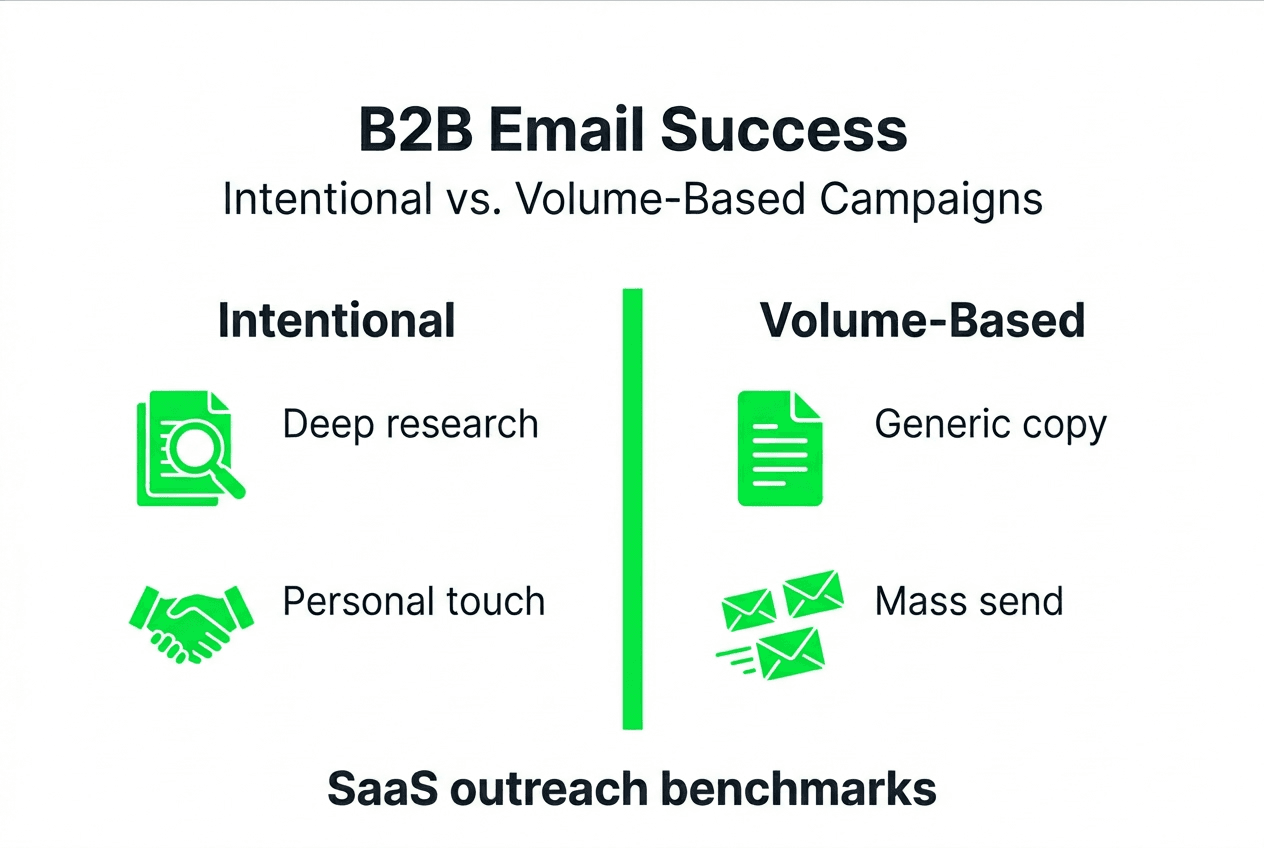
Ignoring recipient context leads to poor engagement metrics and higher unsubscribes. Your emails land in spam folders when engagement signals tell providers your content is irrelevant.
Cold email strategy must treat personalization as a strategic growth driver, not a luxury add-on. When you demonstrate understanding of a prospect’s specific challenges, you earn the right to their attention.
Personalizing cold emails goes beyond using merge tags. It means researching their business model, identifying real bottlenecks, and reframing your offer to address those specific issues.
The mass email success myth persists because it feels efficient. Sending 1000 emails seems more productive than researching 50 prospects deeply. But the math favors quality when you measure actual pipeline value generated.
Framework for designing intentional email campaigns
A clear strategic framework enables you to create research-driven campaigns with measurable success. Follow these four phases:
Diagnosis: Conduct deep ICP and bottleneck analysis using contextual research on target companies. Examine their product architecture, monetization model, hiring signals, and competitive landscape to evaluate fit.
Alignment: Reframe your offers to clearly address key pain points uncovered during diagnosis. Connect your solution directly to their business priorities and current challenges.
Psychological Sequencing: Design your outreach cadence applying behavioral principles for engagement. Space touchpoints strategically and vary message intent to build relevance over time.
Metrics Optimization: Track open rates, response rates, and conversions to refine continuously. Use data to identify what resonates and iterate on messaging, timing, and targeting.
Step-by-step cold emailing frameworks work best when you commit to the research phase. Skipping diagnosis undermines everything that follows.
Data-driven cold outreach requires measuring beyond vanity metrics. Track pipeline velocity, deal size, and win rates to understand true campaign impact.
Start small with 20-30 highly researched prospects. Test your messaging and sequencing before scaling. This approach surfaces what works without burning your list on poorly optimized campaigns.
Iterate based on feedback. When prospects reply with objections or questions, incorporate those insights into future campaigns. Your messaging should evolve as you learn what resonates.
Bringing it all together: Applying intentionality for SaaS growth
Intentional email campaigns yield significant uplift in response and meeting conversion rates. Companies using this approach report 3-5x improvements in qualified pipeline generation.
Using AI-powered research tools enhances efficiency and accuracy of recipient profiling. You gain insights in minutes that previously took hours of manual research.
Sustained improvements in pipeline velocity and quality boost sales success long term. Better-matched prospects close faster and have higher lifetime value.
Key advantages for SaaS marketers:
- Higher response rates from relevant, personalized messaging
- Improved meeting conversion through strategic targeting
- Reduced time wasted on unqualified prospects
- Stronger sender reputation and deliverability
- Faster sales cycles with better-fit customers
- Scalable research using AI and automation
- Data-driven optimization of campaigns
View intentional campaigns as a strategic investment, not just a tactic. The upfront research effort compounds over time as you build better processes and deeper understanding of your market.
Your competitive advantage comes from knowing prospects better than competitors do. When you demonstrate that understanding through contextual, relevant outreach, you earn trust and attention that generic campaigns never achieve.
Explore Mailly for intentional cold email success
Shifting from volume to intentionality requires the right tools. Mailly offers AI-powered deep research to inform highly relevant cold email campaigns.
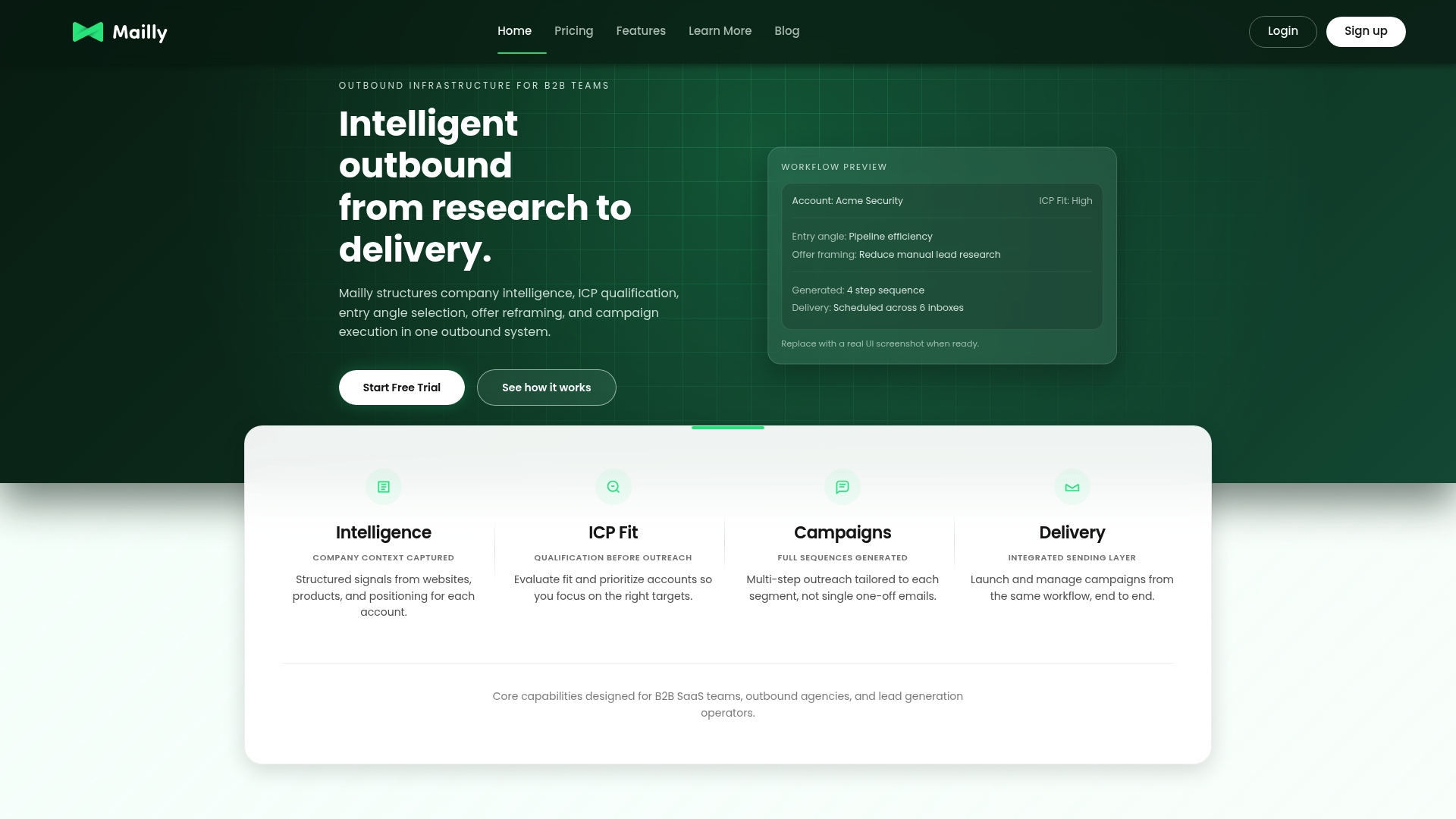
Designed specifically for B2B SaaS marketers, Mailly analyzes company positioning, product architecture, and business bottlenecks to identify ICP fit. It reframes your offers based on actual recipient priorities.
Mailly supports the full strategic framework including targeting, contextual personalization, and psychological sequencing. The platform builds campaigns designed for relevance, not volume.
Try Mailly to maximize your cold outreach impact through intentional campaign design that transforms how you approach prospecting.
Frequently asked questions
What are intentional email campaigns in B2B SaaS?
Intentional email campaigns are strategically planned outreach based on deep contextual research to ensure relevance and higher engagement. They prioritize recipient-specific business needs over generic messaging at scale.
How do intentional campaigns differ from volume-based emailing?
Intentional campaigns focus on research and personalization for fewer, higher-quality prospects, while volume approaches send generic messages to thousands. The intentional method achieves 2-3x higher response rates with better pipeline quality.
What research drives effective intentional campaigns?
Effective research examines company product architecture, monetization models, hiring signals, competitive positioning, and technology stack. This contextual analysis identifies real business bottlenecks your solution can address.
What results can I expect from intentional email campaigns?
Companies typically see 20-30% higher open rates, 100-150% improved reply rates, and 3-5x better qualified pipeline generation. Meeting conversion rates often double compared to volume-based approaches.
How does psychological sequencing improve engagement?
Psychological sequencing spaces emails strategically and varies message intent to build relevance over time. This reduces fatigue, lowers unsubscribe rates by 60%, and increases engagement by 40% compared to random follow-ups.
What are common mistakes in cold email strategy?
The biggest mistakes include prioritizing volume over relevance, using only superficial personalization, ignoring recipient business context, and failing to measure meaningful metrics like pipeline quality and deal velocity.
