

Cold email outreach in B2B SaaS faces a persistent challenge: generic messaging leads to reply rates well below 5%. Meanwhile, cold email campaigns deliver $36 ROI per dollar spent when executed with precision. This guide walks you through the complete cold email sequence process to turn prospects into engaged conversations.
Table of Contents
- Preparing For Your Cold Email Sequence
- Executing The Cold Email Sequence Process Step By Step
- Avoiding Common Mistakes And Optimizing Results
- Measuring Success And Iterating Your Cold Email Campaigns
- Discover Mailly’s AI Cold Email Outreach Platform
Key takeaways
| Point | Details |
|---|---|
| High ROI potential | Cold email returns $36 for every $1 spent when personalized correctly |
| Personalization drives replies | Tailored sequences boost engagement far above generic blasts |
| Structure beats single shots | Multi-touch sequences outperform standalone emails consistently |
| Audience segmentation matters | Knowing personas and pain points improves targeting precision |
| Iteration improves results | Tracking metrics and adjusting campaigns increases success over time |
Preparing for your cold email sequence
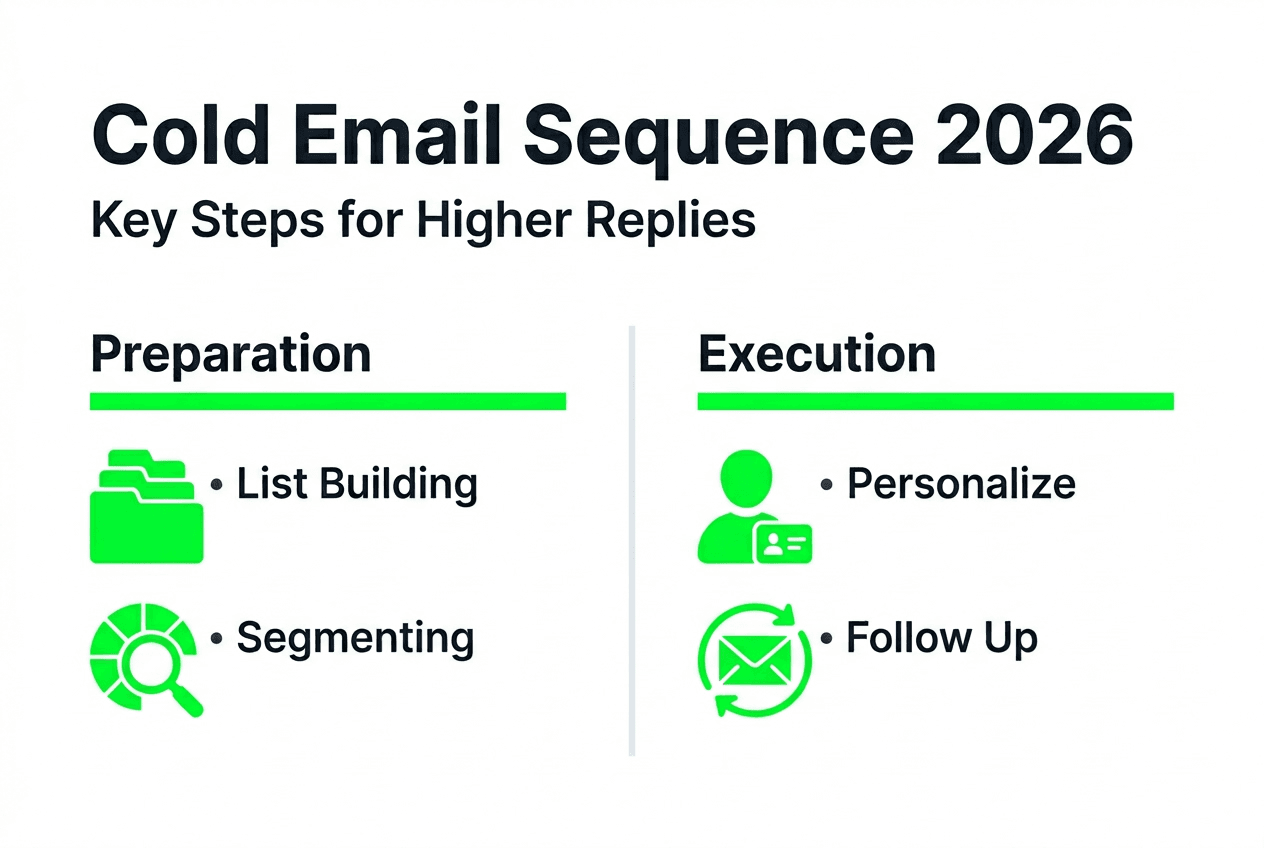
Before you write a single line of copy, you need solid groundwork. Cold email campaigns rely on CRM exports and segmented lists built by sales development reps. Without proper segmentation, your messages hit the wrong people at the wrong time.
Start by assembling prospect lists from your CRM. Export contacts who match your ideal customer profile based on company size, industry vertical, and job role. Define clear buyer personas that capture decision-making authority and budget control. A marketing director at a 50-person SaaS company has different priorities than a VP of sales at a 500-employee enterprise.
Next, identify pain points for each segment. What keeps your prospects awake at night? Are they struggling with churn, pipeline velocity, or customer acquisition costs? Tailor your messaging assumptions around these specific bottlenecks. Set realistic goals and metrics before launch: aim for measurable benchmarks like 20% open rates, 5% reply rates, or 10 qualified meetings per 100 prospects.
Ensure alignment between SDRs and marketing teams on messaging tone, timing, and follow-up cadence. Misalignment creates confusion and wastes effort. Review this step-by-step cold email guide for deeper preparation tactics.
Pro Tip: Build separate lists for different operational maturity levels. A startup founder needs different value propositions than a scale-up executive.
Key preparation steps include:
- Segment your CRM by industry, company size, and role
- Create buyer personas with documented pain points
- Set measurable campaign goals before sending
- Align SDR and marketing teams on messaging strategy
- Test your domain health and email deliverability first
Executing the cold email sequence process step by step
Once preparation is complete, execution becomes systematic. A well-structured cold email sequence typically includes 4 to 6 touches spaced over 2 to 3 weeks. Each touch serves a distinct purpose in moving prospects toward engagement.
Email 1 introduces your value clearly and personally. Skip generic openers like “Hope this finds you well.” Instead, reference a specific trigger: a recent hiring post, a product launch, or a funding round. State your value proposition in one sentence: how you solve a pain point they likely face. Keep it under 100 words.
Email 2 shifts focus to the problem itself. Highlight the business impact of the pain point you identified. Use data or industry benchmarks to make it tangible. For example, “Teams without automated workflows waste 15 hours per week on manual tasks.” This positions you as someone who understands their world.
Email 3 introduces social proof. Share a brief case study or customer win that mirrors their situation. Mention a company in their industry, their size range, or their growth stage. Specificity builds credibility. End with a low-friction call to action like “Worth a quick call to explore if this fits your roadmap?”
Email 4 through 6 vary by response behavior. If they opened but didn’t reply, try a different angle or format. Ask a single question. Share a relevant resource. Use a pattern interrupt like “Should I close your file?” Persistence without pestering is the goal.
Pro Tip: Space your emails 3 to 5 days apart. Closer intervals feel aggressive; longer gaps lose momentum.
Here’s a sample sequence timeline:
| Touch | Day | Purpose | Call to Action |
|---|---|---|---|
| Email 1 | 0 | Personalized intro with value | Ask for feedback or interest |
| Email 2 | 3 | Problem-focused, impact-driven | Pose a question about their challenge |
| Email 3 | 7 | Social proof and case study | Suggest a short exploratory call |
| Email 4 | 11 | Different angle or resource share | Offer a helpful asset or tool |
| Email 5 | 15 | Pattern interrupt or permission to close | Yes/no question for engagement |
| Email 6 | 20 | Final value reminder or breakup | Last chance for conversation |
This structure mirrors successful examples of cold email sequences that convert in B2B tech. Every email should stand alone but also build on previous touches. If a prospect reads Email 4 first, it should still make sense.
Keep calls to action simple and low-commitment. “Does this resonate?” works better than “Book a 30-minute demo here.” You’re earning attention, not demanding it. Use the cold email checklist for B2B founders to validate your sequence before launch.
Avoiding common mistakes and optimizing results
Even well-intentioned sequences fail when teams repeat avoidable errors. Generic messaging reduces response rates across SaaS companies because prospects recognize templated outreach instantly. Personalization isn’t optional anymore.

One frequent mistake is treating all prospects identically. A CFO cares about ROI and risk mitigation; a product manager prioritizes user experience and speed to value. Segment your sequences by persona and operational maturity. Early-stage startups need proof of quick wins; enterprise buyers want compliance, security, and integrations.
Another pitfall is ignoring testing. Run A/B tests on subject lines, email length, and send times. A subject line like “Quick question about [Company Name]’s workflow” might outperform “Transform your sales process.” Test one variable at a time to isolate what drives results.
Monitor metrics religiously. Open rates below 15% suggest deliverability issues or weak subject lines. Reply rates under 3% indicate poor targeting or irrelevant messaging. Click-through rates reveal whether your calls to action resonate. Track these numbers by segment to identify patterns.
Adapt based on data. If a specific persona consistently ignores your emails, revisit your value proposition for that segment. If certain industries reply more often, allocate more resources there. Optimization is continuous, not a one-time fix.
Pro Tip: Review the cold email best practices for 2026 to stay current with evolving buyer expectations.
Common mistakes to avoid:
- Sending identical messages to every prospect without segmentation
- Writing overly long emails that bury your value proposition
- Using pushy or salesy language instead of consultative tone
- Neglecting to test subject lines, send times, and message formats
- Failing to monitor and act on performance metrics
“The best cold email sequences feel like they were written for one person, not a thousand. Specificity wins attention.”
Measuring success and iterating your cold email campaigns
Metrics transform guesswork into strategy. Track open rate, reply rate, click-through rate, and conversion rate for every sequence. Open rate tells you whether your subject lines and sender reputation work. Reply rate reveals message relevance and value clarity. Click-through rate shows call-to-action effectiveness. Conversion rate measures ultimate success: meetings booked, demos scheduled, or deals started.
Analyze data by segment to uncover what works. If your fintech persona replies at 8% while your e-commerce persona sits at 2%, double down on fintech and rethink e-commerce messaging. Persona-specific email sequences improve engagement significantly because they address real needs instead of assumed ones.
Regularly review campaign performance weekly or biweekly. Look for trends: Do certain days or times perform better? Do shorter emails outperform longer ones? Does social proof in Email 3 drive more replies than problem-focused Email 2? Use these insights to refine future campaigns.
Implement A/B testing systematically. Test subject lines first since they gate everything else. Then test email length, call-to-action phrasing, and personalization depth. Change one element per test to isolate impact. A test with 100 recipients per variant gives you statistically meaningful results.
Leverage CRM tools to automate measurement and reporting. Platforms like HubSpot, Salesforce, or Outreach track metrics natively and generate reports. Automation frees your team to focus on strategy rather than manual data collection. Learn more about cold outreach metrics for B2B SaaS to build a comprehensive tracking system.
Key metrics to track:
- Open rate: Percentage of recipients who opened your email
- Reply rate: Percentage who responded to your message
- Click-through rate: Percentage who clicked links in your email
- Conversion rate: Percentage who took your desired action (meeting, demo, signup)
- Unsubscribe rate: Percentage who opted out or marked as spam
Sample metrics dashboard:
| Metric | Target Benchmark | What It Reveals |
|---|---|---|
| Open Rate | 20-30% | Subject line effectiveness and sender trust |
| Reply Rate | 5-10% | Message relevance and value clarity |
| Click-Through Rate | 3-7% | Call-to-action strength and interest level |
| Conversion Rate | 1-3% | Overall sequence success and qualification |
| Unsubscribe Rate | <1% | Message fit and targeting accuracy |
Iteration is where good campaigns become great. Use your data to adjust targeting, refine messaging, and test new approaches. Every sequence teaches you something about your audience. Apply those lessons to the next campaign.
Discover Mailly’s AI cold email outreach platform
Building effective cold email sequences requires deep research, precise personalization, and continuous optimization. Mailly automates this complexity with AI-powered contextual analysis. Instead of starting with generic templates, Mailly researches each prospect’s positioning, product architecture, monetization model, and competitive landscape to identify real business bottlenecks.
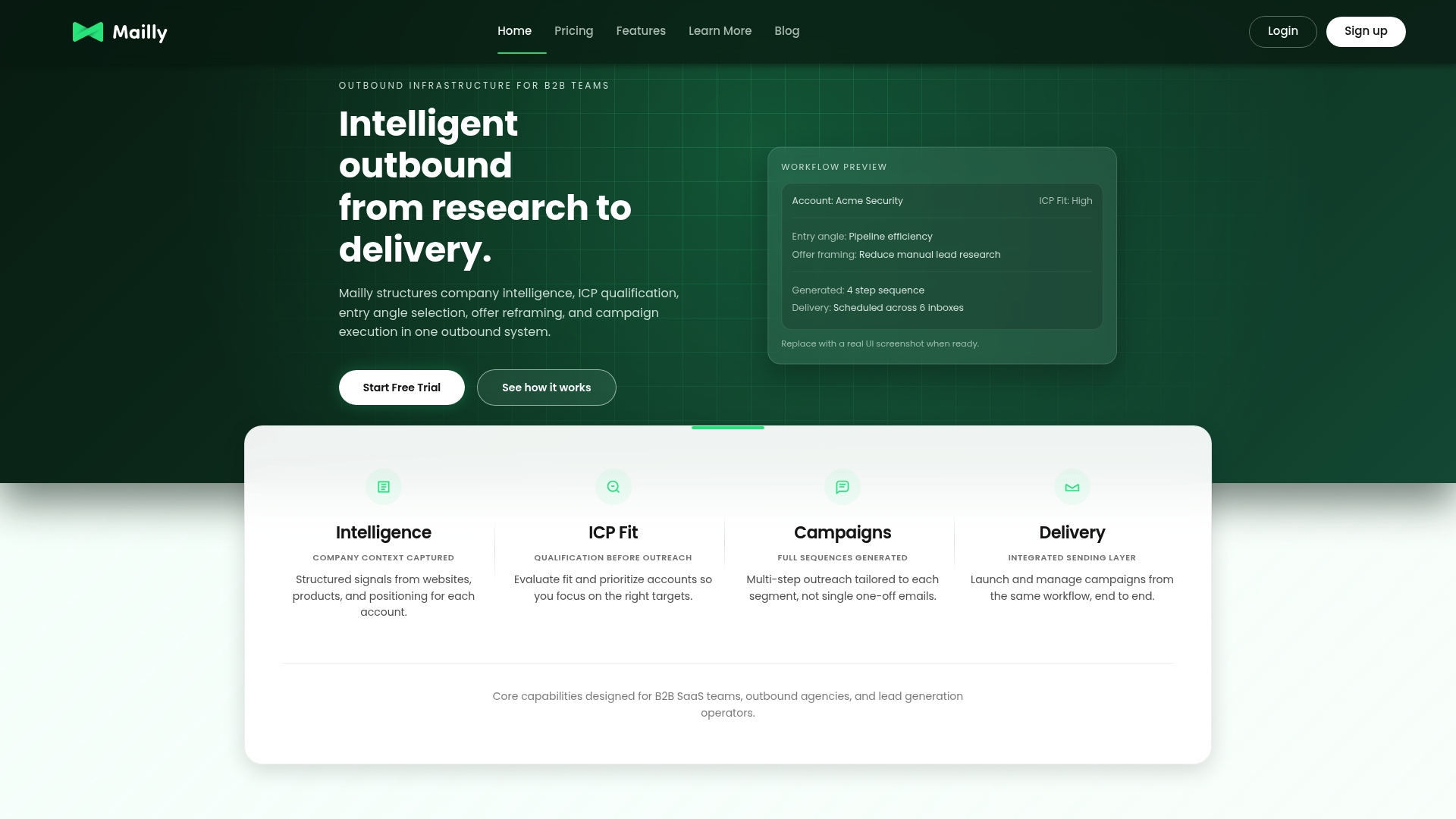
The platform segments audiences intelligently and personalizes messages based on operational maturity and strategic priorities. It tracks performance metrics automatically and suggests improvements grounded in psychological sequencing principles. Growth teams using Mailly’s AI cold email platform report higher reply rates and better ROI by replacing volume-based outreach with relevance-driven campaigns. If you’re ready to move beyond templated emails, Mailly helps you build sequences that feel intentional and strategically positioned.
FAQ
What is a cold email sequence in B2B sales?
A cold email sequence is a series of planned, personalized emails sent to prospects over time to start conversations and build interest. It aims to engage recipients through multiple touches rather than relying on a single outreach attempt. Effective sequences address specific pain points and guide prospects toward a clear next step.
How often should I follow up in a cold email sequence?
Typically, 4 to 6 emails spaced 3 to 5 days apart over 2 to 3 weeks work well for B2B outreach. This cadence maintains visibility without overwhelming prospects. Consistent but respectful frequency maximizes engagement while respecting recipient time and attention.
Why is personalization important in B2B cold emails?
Personalization targets specific pain points and buyer behaviors, which increases reply rates significantly. Generic messages lower engagement, especially in competitive SaaS segments. Customized sequences deliver measurably higher open and response rates by demonstrating relevance and understanding. Discover more about benefits of B2B outreach personalization to see the impact.
What metrics should I track to improve my cold email campaigns?
Track open rate, reply rate, click-through rate, and conversion metrics to understand campaign performance. Use this data to identify what messaging, targeting, and timing work best for your audience. Regular analysis helps you tweak sequences and improve results over time. Review key cold outreach metrics for a complete measurement framework.
