

Choosing the right cold email sequence can make or break your B2B tech outreach campaign. Many marketers struggle with low response rates because they rely on generic, poorly targeted sequences that fail to resonate with prospects. This article equips you with proven selection criteria, concrete sequence examples, and strategic frameworks to transform your cold email results and drive meaningful engagement with your ideal customers.
Table of Contents
- How To Choose The Right Cold Email Sequence: Selection Criteria
- Examples Of Effective Cold Email Sequences
- Popular Cold Email Frameworks And Their Strengths
- Sequence Length, Timing, And Psychological Sequencing Strategies
- Call-To-Action Best Practices In Cold Email Sequences
- Comparing Ai-Driven Vs Templated Cold Email Sequences
- Situational Recommendations: Pick The Best Sequence For Your B2B Tech Outreach
- Boost Your B2B Cold Email Success With Mailly
- Frequently Asked Questions
Key takeaways
| Point | Details |
|---|---|
| Personalization drives results | Contextual personalization boosts response rates by 26% compared to generic outreach. |
| Framework selection matters | Problem-Agitate-Solve sequences generate 18% higher reply rates than other frameworks in B2B technology sales. |
| Optimal sequence structure | 3-5 emails spaced over 10-14 days balance persistence with prospect fatigue. |
| AI outperforms templates | AI-powered personalized sequences deliver 30% higher lead conversion than volume-based templated approaches. |
| CTA effectiveness varies | Meeting requests and value-driven offers like free audits significantly outperform vague calls to action. |
How to choose the right cold email sequence: selection criteria
Effective cold email sequences share five critical characteristics that separate high performers from inbox clutter. Understanding these selection criteria helps you evaluate any sequence before deploying it.
Personalization depth determines engagement. Research shows personalization based on deep context increases response rates by 26%. This goes beyond using a first name. Effective sequences reference specific company challenges, recent hiring patterns, competitive positioning, or product roadmap signals that demonstrate genuine research.
Timing and sequence length respect buyer behavior. Optimal sequences contain 3-5 emails spaced 3-4 days apart to maintain presence without overwhelming prospects. This cadence allows recipients time to process your message while keeping your solution top of mind.
Psychological sequencing builds emotional connection. The best sequences use frameworks like Problem-Agitate-Solve that tap into buyer pain points progressively. Each email should advance the narrative, not repeat the same pitch.
Clear calls to action drive responses. Vague requests like “Let me know if you’re interested” fail compared to specific asks like “Are you available for a 15-minute call Thursday at 2pm?” Strong CTAs remove friction and make responding easy.
Alignment with buyer pain points ensures relevance. Your sequence must address real business bottlenecks your prospects face. Generic value propositions about “increasing efficiency” or “reducing costs” get ignored. Specificity wins.
Pro Tip: Before selecting a sequence, map it against these five criteria. If it scores low on personalization or buyer alignment, keep looking.
Additional evaluation factors include:
- Subject line quality and variety across the sequence
- Email length progression from initial outreach to follow-ups
- Value delivery in each touchpoint, not just sales pitches
- Adaptability for different buyer personas and company sizes
- Integration capability with your existing tech stack
Mastering cold email personalization transforms these criteria from theory into measurable results.
Examples of effective cold email sequences
Examining proven sequence structures reveals how top-performing B2B tech teams architect their outreach campaigns.
The standard 5-step sequence provides a foundational framework:
- Initial value proposition email highlighting a specific pain point
- Follow-up email adding social proof or case study evidence
- Alternative angle email reframing the problem from a different perspective
- Breakup email creating urgency with scarcity or deadline
- Final touchpoint offering a low-commitment next step
This structure works because each email serves a distinct purpose while building on previous touchpoints.

Problem-Agitate-Solve sequences excel in B2B technology sales by tapping into buyer psychology. Email one identifies a business problem using specific data points. Email two amplifies the problem’s consequences with concrete cost or risk examples. Email three presents your solution as the logical answer, supported by relevant proof points.
Social proof-driven sequences build credibility through strategic evidence placement:
- Email one introduces your solution with a compelling statistic
- Email two shares a relevant customer success story
- Email three includes third-party validation like awards or analyst mentions
- Email four presents a case study with measurable outcomes
These sequences work particularly well when targeting risk-averse enterprise buyers who need validation before engaging.
Competitor signal sequences leverage market positioning triggers. They reference competitor usage, recent funding rounds, product launches, or market shifts that create timely relevance. The specificity of these signals dramatically improves open and response rates.
AI-powered personalized sequences represent the evolution of cold outreach. Research confirms AI-powered sequences outperform templates by 30% in lead conversion. These sequences analyze company positioning, product architecture, hiring signals, and competitive landscape to craft contextually relevant messaging that feels intentional rather than random.
For detailed implementation guidance, explore these cold email sequence examples with specific copy and timing recommendations.
Popular cold email frameworks and their strengths
Understanding the underlying frameworks that power successful sequences helps you choose the right approach for your campaign objectives.
AIDA Framework structures sequences around Attention, Interest, Desire, and Action stages. Email one grabs attention with a provocative question or surprising statistic. Email two builds interest by exploring implications. Email three creates desire through social proof and outcomes. Email four drives action with a clear CTA. This framework works well for early-stage awareness building.
Problem-Agitate-Solve Framework resonates strongly when prospects actively experience pain points. Studies show Problem-Agitate-Solve sequences produce 18% higher reply rates in B2B technology outreach compared to other approaches. The framework’s power comes from emotional resonance before presenting solutions.
BAB Framework (Before-After-Bridge) paints a vivid contrast between current state and improved future, then positions your solution as the bridge. This framework excels when targeting prospects who may not fully recognize their problem severity.
Star-Story-Solution Framework opens with a relevant customer (star), shares their challenge and transformation (story), then connects to the prospect’s situation (solution). This narrative approach builds credibility through relatable examples.
| Framework | Best Use Case | Average Reply Rate | Key Strength |
|---|---|---|---|
| Problem-Agitate-Solve | Prospects with known pain points | 18% higher than average | Emotional resonance |
| AIDA | Early-stage awareness | Industry average | Structured progression |
| BAB | Prospects unaware of problem severity | Above average | Contrast visualization |
| Star-Story-Solution | Risk-averse enterprise buyers | Above average | Social proof integration |
Framework selection should align with buyer maturity, purchase urgency, and your solution’s complexity. High-consideration enterprise software benefits from Story-based frameworks, while tactical tools perform better with Problem-Agitate-Solve approaches.
For comprehensive framework implementation, review this cold email frameworks overview with practical application examples.
Sequence length, timing, and psychological sequencing strategies
Optimal sequence architecture balances persistence with respect for prospect attention.
Research-backed sequence length shows diminishing returns beyond 5 emails, with recommendations for 3-4 emails spaced over 10-14 days. This timeframe provides sufficient touchpoints without triggering unsubscribe fatigue. The fifth email functions best as a polite breakup message that leaves the door open.
Strategic email spacing matters as much as count. Sending emails 3-4 days apart respects buyer processing time while maintaining campaign momentum. Tuesday through Thursday sends typically outperform Monday and Friday outreach in B2B contexts.
Psychological triggers amplify engagement when deployed strategically:
- Urgency: Limited-time offers or expiring opportunities create action motivation
- Exclusivity: Early access or select group positioning increases perceived value
- Reciprocity: Leading with valuable insights triggers return engagement
- Social proof: Peer success examples reduce perceived risk
- Pattern interrupts: Unexpected questions or contrarian viewpoints capture attention
Pro Tip: Layer one psychological trigger per email rather than stacking multiple triggers that can feel manipulative. Subtlety preserves authenticity.
“The best cold email sequences feel like a natural conversation progression, not a bombardment. Each touchpoint should earn the right to the next interaction.”
Behavioral timing adaptation improves results. If a prospect opens multiple emails but doesn’t respond, adjust your sequence to include a direct “I noticed you’ve been checking these out” acknowledgment. This personalization demonstrates attention and often breaks through hesitation.
Email length progression should start concise (75-125 words), expand slightly in the middle (125-175 words) to add depth, then return to brevity (50-100 words) in final touchpoints. This rhythm mirrors natural conversation patterns.
Implement these timing strategies using the 2026 cold email timing guidance that reflects current buyer behavior trends.
Call-to-action best practices in cold email sequences
Your CTA determines whether prospects respond or delete, making it the most critical sentence in your sequence.
Meeting requests consistently generate higher positive responses than generic “interested?” questions. Specific asks like “Are you available for a 20-minute conversation next Tuesday or Wednesday?” reduce decision friction and increase commitment.
Value-driven CTAs that offer free audits, assessments, or custom analyses engage prospects by leading with tangible benefit rather than sales intent. These work particularly well in initial sequence emails where trust remains low.
CTA placement timing affects conversion rates significantly. Early sequence emails should use soft CTAs like “Would this be worth exploring?” while later emails can request concrete next steps like demo scheduling. This progression builds comfort gradually.
Personalized CTAs aligned with specific recipient needs dramatically outperform generic alternatives. Referencing their company’s recent product launch or hiring push in your CTA demonstrates research and increases relevance.
Action-oriented language clarity beats clever wordplay. Compare “Let’s connect” (vague) versus “Reply with your availability for Thursday” (specific). The latter removes ambiguity and makes responding easy.
| CTA Type | Response Rate | Best Use | Example |
|---|---|---|---|
| Specific meeting request | Highest | Later sequence emails | “15-minute call Tuesday 2pm?” |
| Free audit offer | High | Early sequence emails | “Free 10-minute website audit?” |
| Question-based | Medium | Initial outreach | “Does this challenge sound familiar?” |
| Generic interest check | Lowest | Avoid | “Let me know if interested” |
Additional CTA optimization strategies:
- Include calendar links to eliminate back-and-forth scheduling
- Offer multiple time options to increase scheduling likelihood
- Frame CTAs as questions rather than demands to reduce pressure
- Test different CTA positions (end of email versus mid-email)
- Use contrasting visual formatting to make CTAs stand out
Master these techniques through cold email call to action tips that provide split-test results and optimization frameworks.
Comparing AI-driven vs templated cold email sequences
The evolution from templated to AI-powered sequences represents a fundamental shift in cold outreach effectiveness.
AI-driven sequences leverage deep recipient context including company positioning, product architecture, monetization model, hiring signals, and competitive landscape. This research foundation enables messaging that addresses actual business priorities rather than assumed generic needs. Data shows AI-powered sequences achieve 30% higher conversion than templated alternatives.
Templated sequences prioritize volume over relevance, using placeholder fields for basic personalization like company name and industry. While scalable, this approach suffers from low response rates and high unsubscribe rates as recipients immediately recognize mass outreach.
| Aspect | AI-Driven Sequences | Templated Sequences |
|---|---|---|
| Personalization depth | Deep contextual research | Basic field replacement |
| Response rate | 30% higher conversion | Industry baseline |
| Scalability | High with quality maintained | High but quality suffers |
| Brand perception impact | Positive, thoughtful positioning | Risk of spam association |
| Sequence adaptation | Dynamic based on engagement | Static predetermined flow |
| Setup time | Higher initial investment | Quick deployment |
Psychological sequencing differs dramatically between approaches. AI systems analyze buyer maturity and adjust messaging intensity, problem framing, and evidence types accordingly. Templates use the same emotional arc regardless of recipient context.
Long-term performance trends favor AI approaches. While templates may generate initial responses through sheer volume, AI sequences build stronger pipeline quality and higher close rates because early engagement stems from genuine relevance.
Cost considerations require nuanced analysis. Templates appear cheaper initially but hidden costs include damaged sender reputation, wasted prospect opportunities, and sales team time spent on unqualified responses. AI sequences cost more upfront but deliver superior ROI through qualified engagement.
Explore concrete performance differences in this AI vs templated email outcomes analysis with real campaign data.
Situational recommendations: pick the best sequence for your B2B tech outreach
Sequence selection should adapt to your specific business context, audience characteristics, and campaign objectives.
For startups with limited data, Problem-Agitate-Solve sequences focused on universal pain points provide strong results without requiring extensive buyer intelligence. Lead with industry-wide challenges your ideal customers face, then position your solution as purpose-built for those problems.
Established enterprises should leverage AI-powered sequences that capitalize on rich buyer insights available through market intelligence tools. Your brand recognition supports more sophisticated, research-driven outreach that demonstrates strategic understanding.
When targeting C-suite executives, shorter sequences (3 emails maximum) with strong social proof outperform longer cadences. Executive time constraints demand immediate value demonstration. Each email should reference relevant peer outcomes or industry-specific metrics.
For mid-market prospects, 4-5 email sequences with progressive value revelation work well. These buyers need more nurturing than enterprise executives but less education than small business owners. Blend case studies, product capabilities, and ROI frameworks across the sequence.
Campaign objective alignment matters significantly:
- Lead generation campaigns: Use shorter, CTA-focused sequences driving meeting bookings
- Awareness building: Deploy longer educational sequences with content offers
- Competitive displacement: Leverage competitor signal sequences with differentiation messaging
- Expansion within existing accounts: Use relationship-based sequences referencing past interactions
Pro Tip: Match sequence intensity to purchase urgency. High-urgency prospects (recent funding, new executive hire) warrant condensed sequences with aggressive follow-up. Low-urgency prospects benefit from patient, educational approaches.
Buyer maturity dictates appropriate sophistication levels. Early-stage prospects need problem education before solution presentation. Mature buyers already researching solutions respond better to differentiation and proof-point sequences.
Implement these selection principles using guidance from selecting cold email sequences tailored to growth team contexts.
Boost your B2B cold email success with Mailly
Transforming cold email theory into consistent results requires the right technology foundation.
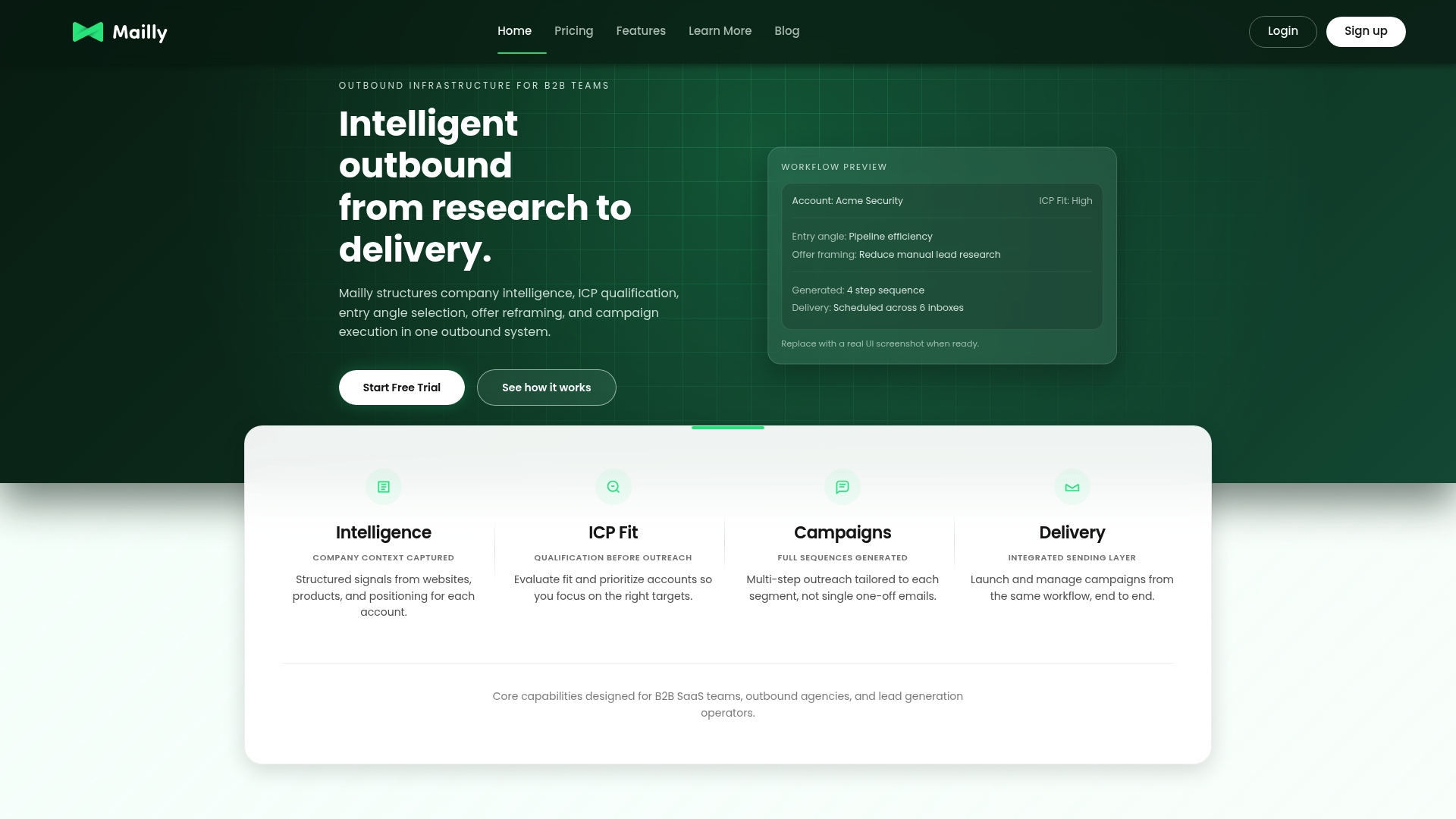
Mailly is an AI-powered outbound strategy engine that begins with deep contextual research rather than generic email templates. The platform analyzes company positioning, product architecture, monetization models, hiring signals, and competitive landscape to evaluate ICP fit and identify genuine business bottlenecks.
Based on this research, Mailly reframes your offer to align with recipient priorities and builds psychologically sequenced campaigns designed for relevance. The result is outreach that feels intentional and strategically positioned.
B2B technology sales teams use Mailly to increase qualified response rates while reducing wasted outreach on poor-fit prospects. The platform integrates seamlessly with existing marketing stacks, enabling scalable personalization without sacrificing quality.
Frequently asked questions
What is a cold email sequence and why is it important?
A cold email sequence is a planned series of emails sent to prospects over time aimed at generating engagement and nurturing interest. It matters because single emails rarely convert, while well-crafted sequences progressively build familiarity and trust, increasing response likelihood without overwhelming recipients.
How many emails should be in an effective cold email sequence?
An effective sequence typically contains 3-5 emails spaced over 10-14 days to balance persistence with prospect fatigue. Research shows diminishing returns beyond the fifth email, with optimal results coming from focused, high-quality touchpoints rather than extended bombardment.
What types of call to action work best in cold email sequences?
Clear meeting requests and value-driven offers like free audits or assessments generate significantly higher positive responses than vague interest checks. Personalizing CTAs to align with specific prospect needs and including concrete next steps like calendar links dramatically boost effectiveness.
Can AI-powered sequences really outperform traditional templates?
Yes, AI-driven sequences achieve 30% higher conversion than standard templates by tailoring messaging with deep contextual research. They enable dynamic adjustments based on engagement signals and recipient behavior, creating relevance that generic templates cannot match.
