

Cold email reply rates have plummeted from 7% to just 5.1% within a year, signaling a crisis for B2B sales teams. Traditional generic approaches no longer cut through inbox clutter. This guide reveals why cold outreach fails and delivers practical strategies to transform your results through contextual personalization, multi-channel persistence, and intelligent targeting that resonates with modern buyers.
Table of Contents
- The Decline Of Traditional Cold Outreach
- Why Cold Outreach Fails Today: The Core Problems
- Common Misconceptions About Cold Outreach
- Effective Multi-Channel Integration And Persistence
- Practical Strategies To Improve Cold Outreach Results
- Bridging Theory To Practice: Common Tradeoffs And Limitations
- Summary: Transforming Cold Outreach From Failing To High-Impact
- Boost Your Cold Outreach With Mailly’s AI Platform
- Frequently Asked Questions
Key takeaways
| Point | Details |
|---|---|
| Generic messaging kills engagement | Irrelevant, templated outreach causes immediate disengagement as buyers ignore repetitive pitches lacking personal context. |
| Multi-channel persistence drives results | Combining email, phone, and LinkedIn with 5+ touchpoints increases response rates by 287% compared to single-channel efforts. |
| Deep personalization is non-negotiable | Contextual research into business signals, pain points, and priorities creates messages that feel intentional rather than automated. |
| Quality targeting beats volume | Focusing on well-researched, high-fit prospects dramatically improves reply rates while reducing unsubscribe complaints. |
| Balance automation with human insight | AI tools accelerate research and personalization, but human review ensures authenticity and strategic relevance in messaging. |
The decline of traditional cold outreach
The numbers tell a sobering story. Within just one year, average reply rates dropped from 7% to 5.1%, while open rates fell from 36% to 27.7%. These steep declines reflect a fundamental shift in buyer behavior and inbox dynamics.
B2B decision makers now receive over 120 sales emails every week. This relentless bombardment creates what researchers call buyer exhaustion, where even legitimate outreach gets ignored or deleted. The mental cost of sorting through irrelevant pitches has become too high.
Traditional mass email tactics amplify this problem. When every vendor sends the same generic pitch, buyers develop immunity to sales language. They recognize templated approaches instantly and tune them out.
Consider these warning signs:
- Reply rates continue dropping quarter over quarter
- Prospects mark messages as spam more frequently
- Cold calling connect rates have fallen below 2%
- LinkedIn connection requests go unanswered
The cold outreach decline isn’t temporary. It represents a permanent shift requiring fundamentally different strategies to break through and engage modern buyers effectively.
Why cold outreach fails today: the core problems
Cold outreach collapses when it ignores how buyers actually make decisions in 2026. Several interconnected issues sabotage campaigns before they even start.
Generic templates destroy credibility instantly. When your message could apply to any company in any industry, buyers recognize the lack of effort. Token personalization like inserting a name or company doesn’t fool anyone anymore.

Buyers complete 70% of their evaluation before engaging sales reps. They research solutions independently, read reviews, and form opinions long before opening your email. Outreach that ignores this reality feels out of touch and irrelevant.
Poor targeting creates a cascade of problems:
- Messages reach prospects with no need for your solution
- Irrelevant pitches trigger spam complaints and unsubscribes
- Low engagement tanks your sender reputation
- Future emails land in spam folders automatically
Automation amplifies mistakes at scale. Tools that blast thousands of identical messages create robotic interactions. Recipients sense the lack of human thought and disengage immediately.
The absence of contextual relevance kills conversations. Without understanding a prospect’s business model, competitive pressures, or strategic priorities, your message becomes noise. You need to anchor outreach in real business signals.
Pro Tip: Before sending any cold email, ask yourself: “Would I respond to this message if I received it?” If the answer is no, rewrite it with specific context about the recipient’s situation.
Implementing best practices for cold outreach requires addressing these fundamental issues rather than tweaking subject lines or send times. Surface-level optimizations can’t fix strategic failures.
Common misconceptions about cold outreach
Several persistent myths mislead sales leaders into ineffective strategies. Understanding what actually works requires dispelling these false beliefs.
Myth one: Cold outreach is dead. Despite declining metrics, 82% of buyers still accept cold calls when done well. The medium isn’t broken, but the execution is. Quality outreach that demonstrates genuine understanding of buyer needs still generates responses.
Myth two: More volume equals more results. Blasting higher message counts actually reduces reply rates. As you increase volume, personalization quality drops, triggering spam filters and buyer disengagement. Ten highly researched messages outperform 100 generic ones.
Myth three: Personalization means using merge tags. Inserting {{first_name}} or {{company}} isn’t real personalization. Buyers see through this immediately. True personalization requires understanding business context, recent company changes, and strategic priorities.
Myth four: Spam filters are the main problem. While deliverability matters, buyer disengagement is the real killer. Your message might reach the inbox, but if it lacks relevance, it gets deleted unread. Technical delivery is table stakes, not the solution.
Myth five: AI tools eliminate the need for human insight. AI in cold outreach accelerates research and scales personalization, but algorithms can’t replicate strategic thinking. The best results come from combining machine efficiency with human judgment about messaging and positioning.
Pro Tip: Track not just open and reply rates, but also the quality of responses. Are prospects engaging substantively or just asking to be removed? Quality metrics reveal whether your approach truly resonates.
Focusing on relevance over volume, depth over breadth, transforms cold outreach from an interruption into a valued conversation starter.
Effective multi-channel integration and persistence
Single-touch campaigns rarely generate results. Modern buyers need multiple exposures across different channels before they engage.
Multi-channel strategies boost responses by 287% compared to email-only approaches. This dramatic improvement comes from meeting prospects where they’re most receptive, whether that’s email, LinkedIn, phone, or direct mail.
Yet 44% of sales reps give up after just one attempt. This premature abandonment wastes opportunities, since most deals require five or more touchpoints before conversion. Persistence isn’t pushy when each interaction adds value.
Consider this comparison:
| Approach | Touchpoints | Channels | Typical Reply Rate |
|---|---|---|---|
| Single email blast | 1 | Email only | 1-2% |
| Basic sequence | 3 | Email only | 3-4% |
| Multi-channel campaign | 6-8 | Email, phone, LinkedIn | 8-12% |
| Signal-based outreach | 5-7 | Multiple, timed to events | 12-18% |
Signal-based research transforms persistence into relevance. Rather than following a rigid schedule, you reach out when prospects show buying intent through hiring signals, funding announcements, or technology changes.
Building effective sequences requires:
- Start with a researched, contextual email that references specific business signals
- Follow up with a phone call mentioning the email and adding new insights
- Connect on LinkedIn with a personalized note expanding on the value proposition
- Send a second email with a case study relevant to their industry
- Make a final phone attempt offering a specific solution to an observed challenge
Each touchpoint should provide fresh value, not rehash previous messages. Varying your medium and message keeps outreach from feeling repetitive.
A well-designed cold outreach workflow balances persistence with respect for prospect time. You’re demonstrating commitment while proving you understand their business deeply enough to add value.
Practical strategies to improve cold outreach results
Transforming failing outreach into high-performing campaigns requires systematic application of proven tactics. These strategies address root causes rather than symptoms.
Anchor messages to real business signals. Monitor hiring patterns, funding announcements, technology adoption, and leadership changes. When a company hires a VP of Sales, they’re likely evaluating sales enablement tools. This context makes your outreach timely and relevant.
Personalize beyond surface tokens. Research the prospect’s competitive landscape, business model, and strategic priorities. Reference specific challenges their industry faces or opportunities their recent moves create. This depth shows genuine interest.
Balance automation with human oversight. Use AI tools to accelerate account research and draft initial messages, but always review for accuracy and tone. Automated systems sometimes miss nuance or make logical errors that human review catches.
Invest time in pre-send research. Spending 10 minutes understanding a prospect’s business yields far better results than sending 20 generic emails in that time. Quality research compounds through higher reply rates and better conversations.
Pro Tip: Create a research checklist covering company positioning, recent news, technology stack, competitive landscape, and team structure. Consistent research depth improves message quality across your entire team.
Prioritize quality over quantity ruthlessly. A personalized outreach workflow targeting 20 well-researched accounts outperforms blasting 500 generic messages. Better targeting reduces wasted effort and improves sender reputation.
Test messaging systematically. Run controlled experiments changing one variable at a time: subject lines, opening hooks, value propositions, or calls to action. Track which variations drive engagement and double down on winners.
Develop a contextual cold outreach strategy that aligns your offer with prospect priorities. Rather than leading with product features, frame your solution around the business outcomes they’re pursuing based on observable signals.
Time outreach strategically. Reach out when prospects are most likely to be receptive: after funding rounds, during fiscal year planning, or when competitors make moves that create opportunities for differentiation.
Bridging theory to practice: common tradeoffs and limitations
Implementing ideal cold outreach strategies requires navigating real-world constraints and tradeoffs. Understanding these limitations helps set realistic expectations.
Volume versus quality creates constant tension. Highly personalized messages take 15-20 minutes each to research and craft. That limits daily output to 20-30 prospects per rep. Meanwhile, targets demand higher pipeline numbers that pressure teams toward volume.
Persistence requires resources many teams lack. Running 6-8 touchpoint sequences across multiple channels needs coordination, tracking systems, and dedicated time. Smaller teams often can’t sustain this level of effort across enough accounts.
Even optimized outreach yields modest reply rates. Improving from 2% to 8% represents a 4x improvement, but still means 92% of prospects don’t respond. This reality requires mental resilience and pipeline volume to offset rejection.
Balancing these factors demands strategic choices:
- Focus on fewer, higher-value accounts with deeper personalization
- Use AI tools to accelerate research without sacrificing quality
- Accept that some prospects require more touches than your resources allow
- Prioritize accounts showing buying signals over cold prospects
Technology helps but doesn’t eliminate tradeoffs. Tools accelerate research and automate follow-up sequencing, yet human judgment remains essential for strategic messaging. The most effective approach combines AI efficiency with human insight.
Tracking the right cold outreach success metrics helps optimize resource allocation. Monitor reply rates, meeting conversion, and pipeline contribution to identify where additional effort yields returns versus diminishing results.
Realistic expectations prevent team burnout. Cold outreach is one channel among many. It complements inbound marketing, referrals, and partnerships rather than replacing them. Setting achievable goals based on industry benchmarks maintains motivation.
Summary: transforming cold outreach from failing to high-impact
Cold outreach fails primarily because generic, high-volume approaches ignore how modern buyers evaluate solutions. Irrelevant messaging triggers immediate disengagement in oversaturated inboxes.
The path to better results follows clear principles:
- Anchor outreach in genuine business context through signal-based research
- Personalize messages beyond token replacement to demonstrate real understanding
- Execute multi-channel sequences with 5-7 touchpoints to maximize exposure
- Balance AI automation with human strategic oversight for authentic messaging
- Prioritize quality targeting over volume to improve efficiency and sender reputation
Implementing these strategies requires shifting from spray-and-pray tactics to research-driven campaigns. The investment in contextual personalization pays dividends through higher reply rates, better conversation quality, and improved pipeline contribution.
Successful cold outreach transformation isn’t about minor tweaks to existing processes. It demands fundamentally rethinking how you identify prospects, research their needs, and craft relevant messages that break through noise.
Teams that make this transition report not just better metrics, but more enjoyable work. Researching prospects deeply and crafting thoughtful messages feels more professional than blasting generic templates. The positive responses validate the effort.
Boost your cold outreach with Mailly’s AI platform
Transforming cold outreach theory into consistent results requires the right tools and processes. That’s where Mailly makes the difference.
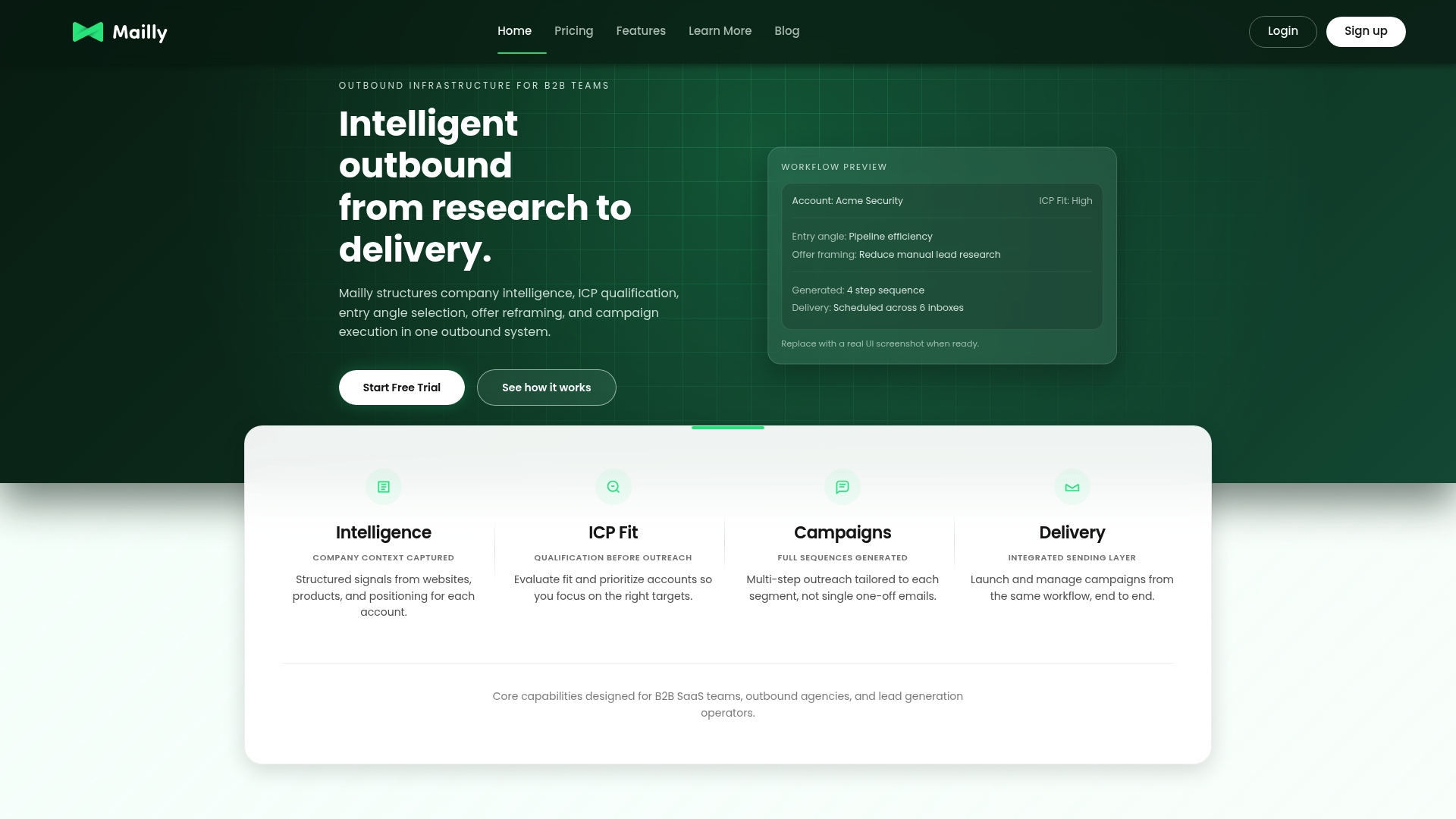
Mailly’s AI-powered platform starts with deep contextual research, analyzing company positioning, product architecture, monetization models, and competitive landscapes. This intelligence identifies genuine ICP fit and surfaces real business bottlenecks your solution addresses.
Based on these insights, Mailly reframes your offer to align with recipient priorities and builds psychologically sequenced campaigns designed for relevance, not volume. The result is outreach that feels intentional and strategically positioned rather than templated.
Sales teams using Mailly report significantly higher response rates and meeting bookings while spending less time on manual research. The platform accelerates personalization without sacrificing the authenticity that modern buyers demand.
Frequently asked questions
Why does cold outreach fail so often in 2026?
Cold outreach fails primarily due to generic messaging that ignores buyer context and business priorities. With B2B decision makers receiving over 120 sales emails weekly, templated pitches get deleted instantly. Buyers complete most research independently before engaging sales, making irrelevant outreach feel tone-deaf and poorly timed.
How many touchpoints does effective cold outreach require?
Most successful cold outreach campaigns use 5-7 touchpoints across multiple channels. Single-touch efforts rarely generate responses, yet 44% of reps quit after one attempt. Multi-channel sequences combining email, phone, and LinkedIn improve reply rates by 287% compared to single-channel approaches, provided each touchpoint adds fresh value.
Does personalization actually improve cold email results?
Genuine personalization dramatically improves results, but token replacement like inserting names doesn’t count. Effective personalization requires researching business signals, competitive dynamics, and strategic priorities to craft contextually relevant messages. This depth demonstrates real interest and understanding, separating your outreach from generic noise that buyers ignore.
Are spam filters the main reason cold emails fail?
Spam filters impact deliverability, but buyer disengagement is the primary failure cause. Even emails reaching the inbox get deleted if they lack relevance. Technical delivery is necessary but insufficient. The real challenge is crafting messages that resonate enough for busy prospects to invest time responding rather than immediately archiving.
