

Sending cold emails that never get opened or replied to can feel discouraging and wasteful. You put in the effort, but nothing seems to stick because your message sounds like everyone else’s—or worse, lands with the wrong audience. Finding the right approach takes more than just clever wording or a catchy subject line.
With the right research, framework, and message sequencing, you can move from being ignored to getting real conversations with decision-makers. This list breaks down actionable steps for researching prospects, personalizing your messaging, and measuring what works, so every cold email you send has a stronger chance of success.
Discover how to build a smarter outreach process with proven methods that go beyond guesswork. Get ready to uncover practical techniques for cold email research and strategy that help you turn missed opportunities into real replies.
Table of Contents
- 1. Identify The Ideal Customer Profile With Research
- 2. Analyze Company Positioning For Relevant Messaging
- 3. Pinpoint Real Business Bottlenecks To Address Needs
- 4. Reframe Your Offer Based On Recipient Priorities
- 5. Sequence Emails For Psychological Engagement
- 6. Measure And Optimize Outreach Results
Quick Summary
| Key Message | Explanation |
|---|---|
| 1. Define Your Ideal Customer Profile | Understand specific characteristics and needs of your best customers to improve targeting and messaging. |
| 2. Research Company Positioning | Analyze how prospects position themselves in the market to tailor outreach that resonates with their narrative. |
| 3. Identify Real Business Bottlenecks | Focus on actual constraints causing friction in operations to provide relevant solutions in your emails. |
| 4. Reframe Offers Around Recipient Priorities | Customize your value proposition to align with the specific problems and needs of each recipient. |
| 5. Implement Effective Email Sequences | Use a series of strategic emails to build engagement and maintain interest without overwhelming prospects. |
1. Identify the Ideal Customer Profile with Research
Your cold email strategy fails before you even write a subject line if you don’t know who you’re targeting. Building an ideal customer profile (ICP) requires real research, not guesswork.
Why does this matter? When you understand the specific characteristics, behaviors, and needs of your best-fit customers, you can align your messaging with their actual priorities rather than spraying generic pitches across your entire prospect list.
The signal-to-noise ratio improves dramatically when you know exactly who benefits most from what you sell.
What Goes Into Your ICP
Your ideal customer profile should capture these dimensions:
- Firmographic data: Company size, industry, revenue, location, growth stage
- Behavioral signals: Hiring patterns, technology stack, recent funding, product launches
- Business challenges: Specific pain points your product solves, operational bottlenecks
- Decision-making structure: Who holds budget authority, typical buying committee size
- Purchase readiness: Indicators they’re actively evaluating solutions
Research shows that customer data analysis and segmentation reveals demographic, psychographic, and behavioral features of your best-fit customers. This targeted understanding enables refined messaging and optimized marketing spend.
How to Research Your ICP
Start by examining your existing customers. Which ones generate the most revenue? Have the shortest sales cycles? Show the highest engagement? These patterns reveal your real sweet spot, not your theoretical one.
Analyze hiring signals on LinkedIn and job boards. A company hiring sales engineers or customer success roles signals they’re scaling their offering. A company hiring in your domain often needs your solution.
Monitor earnings calls and press releases. These reveal strategic priorities, competitive pressures, and resource allocation decisions that affect buying behavior.
Use intent data tools to identify companies actively researching solutions in your category. Intent doesn’t lie about priority.
Your ICP is built on data from your best customers and market signals, not on assumptions about who should buy from you.
Applying Research to Cold Email
Once you’ve defined your ICP, every cold email becomes personalized by design. You’re writing to the specific role that experiences the problem your product solves. You’re referencing business context that matters to them.
This is where outreach strategy transforms from volume-based to relevance-based. You send fewer emails to more qualified targets with stronger contextual hooks.
Pro tip: Create 3-4 distinct ICP segments with separate messaging strategies. Not all high-growth SaaS companies have identical priorities, so your research should reflect these variations in what you communicate.
2. Analyze Company Positioning for Relevant Messaging
Knowing your prospect’s industry isn’t enough. You need to understand how they position themselves in that market and what makes them different from competitors.
Company positioning shapes how prospects perceive their own value and competitive advantages. When you understand their positioning strategy, your cold email can align with their narrative instead of fighting against it.
This transforms your outreach from generic to contextually intelligent.
Why Company Positioning Matters for Cold Email
Every company has a story about why they exist and what makes them distinct. Maybe they’re the premium option competing on quality. Maybe they’re the cost leader. Maybe they’re the innovation disruptor.
When you misalign with their positioning, your message lands wrong. A company positioning itself as a high-touch, premium solution doesn’t respond well to emails about cost savings. A scrappy startup positioning itself as an innovator might ignore traditional, enterprise-focused value propositions.
Effective positioning involves identifying company uniqueness and developing consistent messaging that aligns with what the company offers to meet customer expectations.
Your cold email needs to respect their positioning and show how your solution complements or enhances it.
How to Research Company Positioning
Start with their website and messaging. What language dominates their homepage? What problems do they emphasize? Which customer segments do they highlight?
Read their recent press releases and blog posts. These reveal strategic priorities and how they want to be perceived in the market.
Analyze their job postings. The roles they’re hiring for signal what they’re building toward and what competitive advantages they’re betting on.
Examine competitor comparisons they’ve published. How they position themselves relative to alternatives reveals what they consider their key differentiators.
Applying Positioning to Your Message
Once you understand their positioning, your cold email hook should acknowledge it. Not by flattering them, but by showing you understand their strategy and how your solution fits into it.
If they position as a market innovator, emphasize how your solution supports their innovation agenda. If they’re building for enterprise customers, show how you solve enterprise-specific challenges.
This creates a bridge between their self-perception and your value proposition.
- Reference their recent product announcements or strategic moves
- Acknowledge the customer segment they’re targeting
- Show how you solve problems aligned with their positioning
- Avoid messaging that contradicts their market narrative
When your cold email respects a company’s positioning strategy, it feels like you understand their business, not like you’re selling to them.
Pro tip: Document 3 to 5 positioning archetypes within your target market, then create messaging variations for each. This prevents one-size-fits-all emails while maintaining efficiency at scale.
3. Pinpoint Real Business Bottlenecks to Address Needs
A prospect’s stated problems rarely match their actual business constraints. Your cold email needs to identify and address the real bottlenecks slowing their operations, not the generic challenges everyone in their industry claims to face.
Bottlenecks are the constraints that create friction in workflows and limit productivity. When you pinpoint these accurately, your value proposition shifts from “here’s a solution” to “here’s the answer to your specific constraint.”
This is where cold email moves from template-based to diagnostically informed.
Understanding Where Bottlenecks Hide
Bottlenecks arise from task dependencies, resource scarcity, or process complexity. They’re rarely obvious because companies adapt around them. A bottleneck becomes invisible when it’s been a problem for long enough.
Task dependencies create queues. When one step in a workflow can’t move forward until another completes, work piles up. A sales team might be bottlenecked by a slow contract approval process in legal, not by lead quality.
Resource scarcity forces difficult tradeoffs. A team with limited engineering capacity might bottleneck on technical debt instead of feature development. Understanding which resources are constrained reveals what actually blocks their progress.
Process complexity obscures what’s actually slowing things down. The real bottleneck might be buried three steps into a six-step workflow, invisible without deep process analysis.
How to Research Bottlenecks
Examine their recent hiring patterns. What roles are they adding? If they’re hiring heavily in customer support but not in product, they’re probably bottlenecked on support capacity, not on building features.
Listen to their earnings calls and earnings reports. Leadership discusses constraints and challenges explicitly when explaining why growth slowed or why they’re making strategic changes.
Analyze their product roadmap and changelog. What features are they shipping slowly? What categories of work seem stalled? Delays signal bottlenecks.
Research press coverage about their challenges. Industry analysts and journalists often report on operational constraints before companies publicly acknowledge them.
Turning Bottleneck Research Into Cold Email
When you identify a real bottleneck, your email becomes diagnostic. You’re not selling a feature. You’re addressing a constraint that’s limiting their growth or operational efficiency.
The most powerful cold emails acknowledge the specific bottleneck, explain why it matters, and show how your solution addresses it.
- Reference the bottleneck by name or describe it specifically
- Show why it matters to their business model
- Connect it to observable decisions or recent announcements
- Position your solution as the resolution to that constraint
Prospects respond when you address bottlenecks they know exist but haven’t solved yet.
Pro tip: Create a “bottleneck map” for each prospect segment showing the 2 to 3 most common constraints. This helps you rapidly identify which bottleneck angle to emphasize when researching individual prospects.
4. Reframe Your Offer Based on Recipient Priorities
You have the same product for every prospect, but your message should never be identical. Reframing means translating your core value proposition into language and context that align with what each recipient actually cares about.
This isn’t about deception. It’s about recognizing that your solution solves different problems for different buyers, and your cold email should emphasize the problem that matters most to them.
The difference between a deleted email and a reply often comes down to whether you framed your offer around their priority or yours.
Why Reframing Matters More Than Features
A prospect doesn’t care about your product’s capabilities in isolation. They care about what those capabilities enable them to achieve given their current constraints.
Say you build automation software. Your product’s core benefit is reducing manual work. But to a customer bottlenecked on compliance, the relevant benefit is reducing compliance errors. To a company with high team turnover, the relevant benefit is reducing onboarding time. Same product, different frames.
When you reframe around their priority, you answer the question they’re actually asking: “Does this help me solve my specific problem?”
A three-phase approach to reframing involves exploring where your solution intersects with market demand, testing small variations with real audiences quickly, and refining based on responses to ensure alignment with recipient needs.
How to Identify Recipient Priorities
Priorities reveal themselves through multiple signals. A company hiring aggressively signals growth is a priority. A company announcing a cost-cutting initiative signals efficiency is urgent. A company investing in compliance infrastructure signals regulatory risk matters.
Read their recent announcements and earnings calls. Listen for what leadership emphasizes repeatedly. Those repeated themes signal priorities.
Analyze their recent job postings. The roles they’re filling reveal what they’re investing in and where they’re experiencing gaps.
Examine their customer testimonials and case studies. How they describe success to prospects often reveals what they value most.
Reframing Your Message
Once you’ve identified their priority, reframe your opening around it. Instead of leading with what your product does, lead with the outcome that matters to them.
- Lead with their priority, not your feature
- Show how your solution directly addresses that priority
- Use language they use when discussing the problem
- Reference evidence of why this priority matters to them
- Avoid feature or capability jargon
The strongest cold emails make the recipient feel like you built your solution specifically for their situation.
Pro tip: Build 3 to 4 reframed versions of your core pitch, each emphasizing different priority angles. Then match prospects to the frame most relevant to their specific situation during research.
5. Sequence Emails for Psychological Engagement
One cold email rarely converts. The magic happens in the sequence, where each subsequent email builds on the previous one to create momentum and demonstrate persistence without becoming intrusive.
Email sequences work because they respect how human psychology actually functions. People need multiple exposures to information before acting. They respond better to consistent communication that builds context over time than to isolated, high-pressure asks.
Your sequence strategy determines whether a prospect ignores you or becomes genuinely interested.
How Psychological Sequencing Works
Effective email sequences deliver tailored content based on recipient behavior and interaction patterns. Each email serves a specific psychological purpose in the conversation, progressively building trust and credibility.
The first email introduces context and establishes relevance. It answers the question “Why are you reaching out to me specifically?” without asking for anything yet.
The second email provides value or additional context. Maybe it’s a specific insight about their business, a relevant case study, or a thoughtful observation about their market. The goal is to demonstrate you’ve done legitimate research and aren’t spraying template emails.
The third email shifts toward a soft ask. But it’s phrased as a question or invitation, not a demand. “Would a 15-minute conversation about how we’ve helped similar companies be worth your time?” works better than “Let’s schedule a call.”
The fourth email is optional and often works best as a brief check-in that references their lack of response without guilt-tripping. “Looks like this might not be the right timing” paired with an ongoing availability statement respects their position while keeping the door open.
Spacing and Timing Matter Psychologically
Sequence timing affects open rates and response rates significantly. Too fast feels aggressive. Too slow and context fades from memory.
Space your emails strategically:
- Email 1: Initial outreach
- Email 2: Three to five days later
- Email 3: Five to seven days after that
- Email 4: Seven to ten days after email 3
This timing respects their email volume while maintaining enough recency that your first email doesn’t fade completely from memory.
Personalizing Your Sequence
Sequences only work when emails are personalized and aligned with recipient priorities. Generic sequences get ignored regardless of timing.
Personalization means different things at different sequence stages. The first email must reference something specific to their company. The second should address their actual bottleneck or business challenge. The third should position your solution in terms they care about.
Sequences fail when they’re templated. They succeed when each email demonstrates you understand the recipient’s specific situation.
Pro tip: Create three distinct sequence tracks based on recipient segment. When you identify which track applies to a prospect during research, your sequence variation increases relevance dramatically while maintaining operational efficiency.
6. Measure and Optimize Outreach Results
You can’t improve what you don’t measure. Cold email feels like a numbers game until you start tracking the right metrics, at which point it becomes a system you can actually optimize.
Most founders measure vanity metrics like open rates and click rates, which tell you nothing about whether your outreach is actually driving revenue. Real measurement requires tracking metrics that connect to business outcomes and reveal what’s actually working.
This is where cold email transitions from activity to strategy.
The Metrics That Actually Matter
Not all metrics are created equal. Some tell you what’s happening. Others tell you whether it matters for your business.
Engagement quality matters more than raw volume. One thoughtful reply from a decision-maker is worth more than fifty opens from gatekeepers. Track not just response rate, but response quality and who’s responding.
Conversion rate measures how many conversations become qualified opportunities or sales. This is where the rubber meets the road. You can have great open rates and response rates, but if conversations don’t convert, your system is still broken.
Cost per opportunity connects your outreach effort to actual business value. How much time and resources did you invest to generate one qualified lead? Track this ruthlessly.
Reply rate by segment reveals which audience segments respond most. Maybe your outreach works great for enterprise but poorly for mid-market. Maybe it converts well in one industry but falls flat in another.
Effective outreach measurement involves defining SMART goals and relevant KPIs like engagement, reach, and conversion to ensure objectives are met efficiently and transparently.
How to Track and Optimize
Set up tracking systems before you start outreach. Spreadsheets work fine for starting. As you scale, use your CRM to track which prospects received which email, when they opened it, whether they replied, and whether they converted.
Test one variable at a time. Change your subject line but keep everything else identical. Change your opening hook but keep the rest the same. This isolates what actually moves the needle.
Analyze results weekly. Look for patterns in your best-performing emails and worst-performing ones. What topics generate replies? What hooks get ignored? What email timing works best for your audience?
Document what works and what doesn’t:
- Subject lines that generate above-average opens
- Opening hooks that trigger replies
- Sequence timing that works for your audience
- Segments that convert at highest rates
- Reframes that resonate most
You optimize outreach by measuring constantly, not by guessing what works based on feel or theory.
Pro tip: Set a weekly review cadence where you analyze your three best-performing and three worst-performing emails. Document the differences and systematically incorporate high-performing elements into future campaigns.
This table summarizes the strategic approaches and specific techniques presented in the article to optimize cold email outreach and achieve effective engagement and conversion.
Master Cold Email Strategy with AI-Powered Precision
The article highlights crucial challenges B2B founders face when crafting cold email campaigns such as identifying the ideal customer profile, aligning messaging with company positioning, uncovering real business bottlenecks, and sequencing emails for psychological impact. These pain points often result in generic outreach that fails to connect or convert. If you want to overcome these obstacles and deliver personalized, research-driven cold emails that resonate deeply with your prospects’ true priorities and market realities, you need a smarter approach.
Mailly is designed to solve exactly these problems. By leveraging AI to perform deep contextual research around company positioning, product architecture, hiring signals, and competitive landscape, Mailly identifies your best ICP fit and real bottlenecks unique to each prospect. Then it reframes your offer through personalized messaging and builds carefully sequenced campaigns for psychological engagement—not just blasting emails by volume. The result is outreach that feels intentional, relevant, and strategically aligned rather than templated or random.
Ready to transform your cold email game? Explore how Mailly’s AI-powered outbound strategy engine can help you research smarter, personalize better, and engage prospects more effectively in your next campaigns at Mailly.
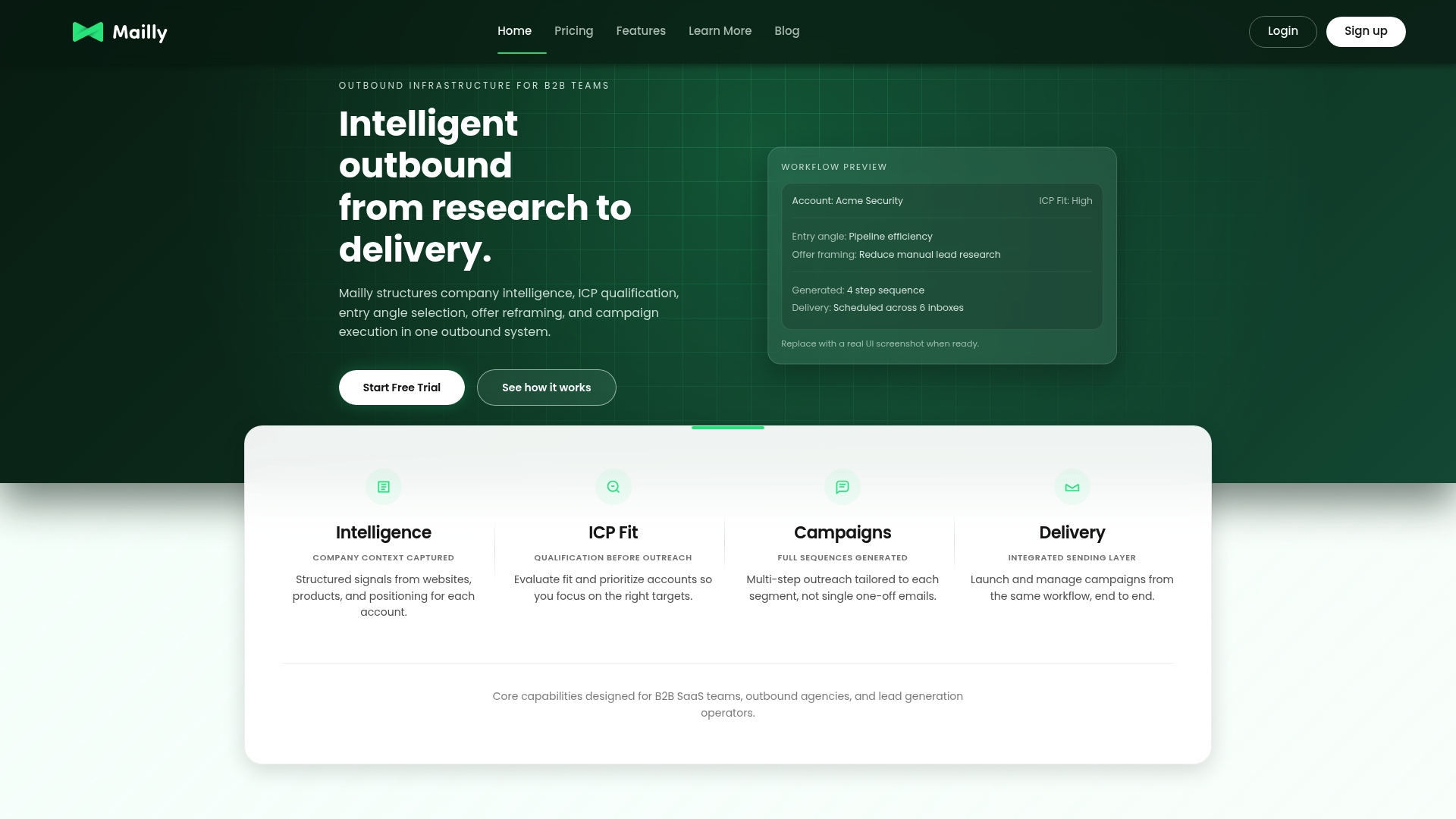
Take the next step today by visiting Mailly and start building cold email sequences that speak directly to your prospects’ needs and priorities with precision and scale. Don’t let generic outreach hold you back any longer—make every email count with Mailly.
Frequently Asked Questions
What are the essential steps for creating a cold email checklist for B2B founders?
To create a cold email checklist, focus on identifying your ideal customer profile, analyzing company positioning, pinpointing real business bottlenecks, reframing your offer, sequencing emails, and measuring results. Start by developing a detailed profile of your target customers to tailor your outreach effectively.
How do I identify my ideal customer profile for cold emailing?
Identify your ideal customer profile by researching your existing customers and analyzing firmographic data, behavioral signals, and decision-making structures. Create a list of characteristics that define your best-fit customers to target your cold emails more effectively.
Why is company positioning important for my cold emails?
Company positioning is crucial because it helps you align your cold email messaging with how a prospect views their unique value and competitive edge. Understand their narrative and tailor your outreach to complement their positioning, which increases the likelihood of engagement.
How can I determine the real business bottlenecks of my prospects?
To determine real business bottlenecks, analyze hiring signals, review earnings calls, and examine product roadmaps. Focus on identifying hidden constraints that may not be immediately obvious, ensuring your emails address specific pain points and operational limitations.
What should I include in my cold email sequence?
A good cold email sequence should include a series of tailored emails that progressively build context and establish relevance. Start with an introduction, followed by value-driven content, a soft ask, and an optional check-in, spacing each email appropriately over the course of several days to maintain engagement.
How can I measure the effectiveness of my cold email outreach?
Measure the effectiveness of your cold email outreach by tracking engagement quality, conversion rates, cost per opportunity, and reply rates by segment. Analyze these metrics regularly to identify patterns and optimize your approach, making adjustments to improve results continuously.
