

Every American SaaS marketer knows the pain of sending countless cold emails, only to be met with silence or generic replies. Breaking through the noise requires more than a list of job titles or surface-level LinkedIn data. Deep contact insights powered by AI-driven automation enable your team to shift from generic outreach to true personalization, so you can reach the right people with messages that actually matter. Discover practical steps to transform scattered data into higher conversions and meaningful engagement.
Table of Contents
- Step 1: Gather And Analyze Deep Contact Insights
- Step 2: Reframe Your Offer Based On Real Priorities
- Step 3: Craft Psychologically Sequenced Email Campaigns
- Step 4: Review And Optimize For Maximum Relevance
Quick Summary
| Key Insight | Explanation |
|---|---|
| 1. Gather Deep Prospect Insights | Move beyond basic data to uncover business challenges and decision-making roles. Utilize multiple sources like LinkedIn, company websites, and news articles. |
| 2. Reframe Your Offer | Tailor your messaging to address the specific needs and priorities of your prospects. Align your solution with their real problems rather than your product features. |
| 3. Implement Psychologically Sequenced Emails | Structure your email campaigns to build trust and guide prospects through a decision-making journey, addressing objections and creating urgency. |
| 4. Optimize for Engagement | Focus on meaningful engagement metrics like reply rates rather than open rates. Analyze responses to refine your outreach and improve conversion rates. |
| 5. Leverage AI for Efficiency | Use AI-powered automation to enhance prospect profiling and data gathering, making it faster and more scalable than manual efforts. |
Step 1: Gather and Analyze Deep Contact Insights
This step transforms raw prospect data into actionable intelligence. You’re moving past surface-level LinkedIn profiles and generic company information to uncover what actually matters: the specific business challenges your prospect faces, their role in decision-making, and whether they align with your solution.
Start by identifying your target accounts and contacts using multiple data sources. LinkedIn profiles give you job titles and work history, but you need more depth. Company websites reveal positioning and product focus. News articles show recent funding, executive changes, and strategic pivots. Job postings indicate hiring priorities and pain points.
Here’s what to extract from each contact:
- Role and seniority level within their organization
- Recent activity signals showing budget or growth indicators
- Reporting structure and decision-making authority
- Competitive context their company operates in
- Known business challenges based on hiring, product announcements, or earnings calls
- Buying timeline signals if any exist
Manually gathering this information for dozens of prospects is exhausting. This is where AI-powered automation becomes practical. You can use AI to enrich contact profiles by combining data from multiple sources, extracting patterns, and synthesizing findings into a structured format.
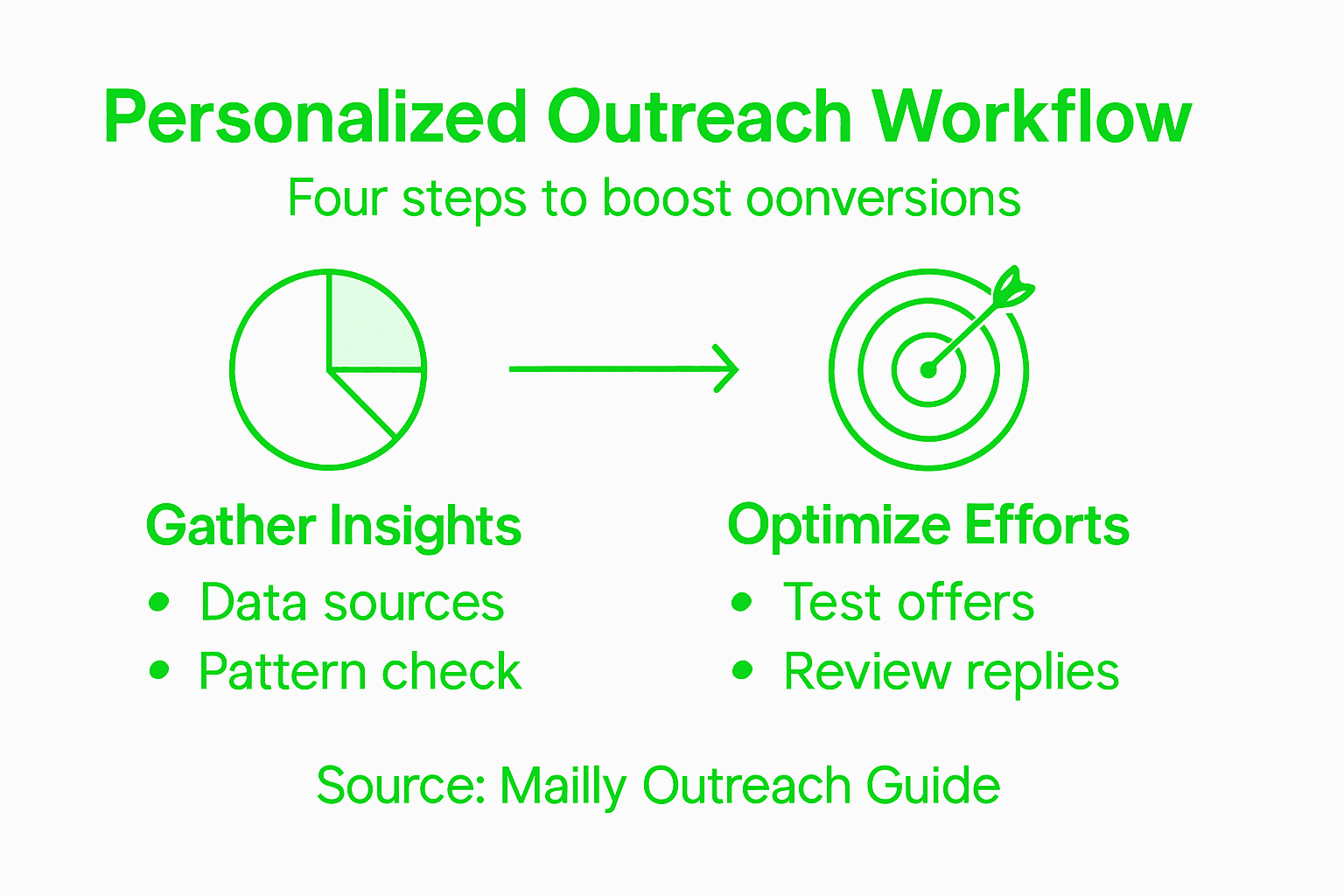
Here’s a quick reference comparing manual vs. AI-powered prospect insight gathering:
| Method | Efficiency | Data Depth | Scalability |
|---|---|---|---|
| Manual Research | Slow, time-intensive | Surface-level to moderate | Limited by human effort |
| AI-Powered Automation | Fast, automated | Deep, multi-source synthesis | Easily scales to hundreds |
This table highlights why modern outreach leans on automation for actionable intelligence.
The goal isn’t to know everything about your prospect—it’s to know what matters for your specific pitch.
Once you have gathered the data, begin pattern analysis. Look for alignment signals: Does their recent hiring match your product’s capability? Did they recently change vendors in your category? Are they operating in an industry or region where your solution has proven ROI?
Organize these insights into a decision matrix. Which prospects show the strongest buying signals? Which ones have the clearest connection between their situation and your offer? This prioritization prevents you from wasting outreach on weak opportunities.
Pro tip: Use a simple scoring system based on ICP fit, buying signals, and relevance to your specific offer—then focus outreach volume on your highest-scoring prospects first.
Step 2: Reframe Your Offer Based on Real Priorities
Now that you understand your prospect’s actual situation, stop pitching what you sell and start addressing what they need. This is the critical pivot from generic messaging to genuine relevance. Your offer must align with their specific business priorities, not your product roadmap.

Begin by identifying the disconnect between your initial positioning and their reality. Your typical value prop might emphasize speed or cost savings. But what if this prospect’s real bottleneck is implementation complexity or team adoption? What if they’re actually drowning in tools and need consolidation, not another platform?
Here’s the reframing process:
- Map their stated challenges to your solution’s capabilities
- Identify which benefits actually matter to their role and business
- Remove messaging about features nobody asked for
- Lead with the outcome they care most about
- Reference their specific context to prove you understand them
When crafting personalized outreach messages, anchor every claim in what you learned during research. Don’t say your platform reduces manual work. Say it eliminates the repetitive data entry that’s keeping their team from strategic work. Don’t mention your integration library. Mention how you connect to the specific tools they already depend on.
Your offer isn’t what you want to sell. Your offer is what they actually need to buy.
Test your reframed messaging at small scale before committing to a full campaign. Send personalized outreach to 10-15 prospects with your new angle and measure response rates. Did engagement improve? Did the conversations shift toward more meaningful dialogue? Use that feedback to refine further.
The goal is moving beyond transactional pitches. You want prospects reading your message and thinking, “This person actually gets what we’re dealing with.” That recognition transforms cold outreach from interruption into invitation.
Pro tip: Mention a specific recent action or announcement from their company in your first email—hiring patterns, product launches, or funding news—to prove your offer is based on real knowledge, not a template.
Step 3: Craft Psychologically Sequenced Email Campaigns
A single email rarely converts. Your prospect needs to see a progression that builds trust, addresses doubts, and creates momentum toward action. This is where psychological sequencing transforms isolated messages into a cohesive strategy.
Sequencing works because human decision-making isn’t linear. Your first email introduces the idea. The second email addresses the objection they’re likely thinking. The third email provides social proof or urgency. Each message moves them closer to a yes.
Here’s how to structure an effective sequence:
- Email 1: The Hook – Lead with your reframed offer and a single compelling reason they should care
- Email 2: Build Credibility – Share relevant case studies, customer outcomes, or specific results from companies like theirs
- Email 3: Address the Elephant – Acknowledge common objections (cost, implementation, vendor lock-in) and disarm them
- Email 4: Create Urgency – Reference limited windows, upcoming changes, or time-sensitive opportunities
- Email 5: Direct Call to Action – Ask for a specific, low-friction next step
When designing your sequence, apply psychological principles like reciprocity and social proof to each message. Reciprocity means giving value before asking for anything. Share a relevant insight, a benchmarking data point, or industry analysis. Social proof means showing that others like them have succeeded.
The best email sequences feel like a conversation, not a campaign.
Timing matters as much as content. Space emails 3-5 days apart to allow for reading and thought, but not so far apart that momentum dies. Monitor open rates and response rates at each step. If 70% of prospects open email 1 but only 20% open email 2, your second message isn’t compelling enough.
Personalization deepens effectiveness. Use the insights you gathered in Step 1 to reference specific details in each email. Mention their recent hire, their competitor’s announcement, or their industry shift. Generic sequences get ignored. Personalized sequences get responses.
Pro tip: Test your sequence on 20-30 prospects before scaling, measuring open rates, click rates, and reply rates at each step—then optimize based on where you lose engagement.
Step 4: Review and Optimize for Maximum Relevance
You’ve gathered insights, reframed your offer, and sent your sequence. Now comes the work that separates winners from vanity metric chasers: reviewing performance and ruthlessly optimizing for relevance.
Don’t measure success by open rates alone. That’s a vanity metric. A 35% open rate means nothing if nobody replies. Focus instead on engagement that signals genuine interest: reply rates, click-through rates on specific links, meeting requests, and quality of conversations.
To help refine your outreach, here’s a summary of key performance metrics and what they reveal:
| Metric | What It Measures | Actionable Signal | Example Adjustment |
|---|---|---|---|
| Open Rate | Email subject appeal | Low means subject needs work | Change subject line wording |
| Reply Rate | Message relevance | High shows genuine interest | Double down on successful segments |
| Click-Through Rate | Engagement with content | Low signals weak call to action | Revise email links or offer |
| Quality of Replies | Depth of conversation | Detailed replies indicate fit | Replicate context that triggered interest |
Use this reference to optimize each stage of your campaign for real impact.
Here’s what to review after your first 50-100 outreach attempts:
- Which emails get the highest reply rates?
- Which prospects reply to specific email sequences (e.g., email 2 vs. email 3)?
- Are replies questions or objections? (Questions mean interest; objections mean your positioning missed)
- Which prospect segments reply most? (Company size, industry, role)
- What messaging themes trigger action?
When you optimize outreach relevance, you’re looking for patterns. If prospects in the logistics industry reply at 2x the rate of manufacturing companies, that’s a signal. Your offer fits their priorities better. Double down on logistics. If email 2 outperforms email 1 by 40%, your credibility-building message resonates more than your hook. Swap the order.
Relevance compounds when you stop guessing and start learning from real responses.
Analyze the quality of replies, not just the quantity. A single thoughtful reply from a decision-maker beats 10 polite rejections. What triggered that quality response? Was it a specific detail about their company? A particular pain point you mentioned? Replicate it.
Use this data to refine your next 100 outreach attempts. Test a new value proposition angle. Try a different email sequence order. Adjust your targeting to focus on warmer segments. Each iteration should improve your reply rate by at least 15-20%.
This is where outreach transforms from spray-and-pray into a precise, calibrated system. You’re building institutional knowledge about what actually moves your ICP toward conversation.
Pro tip: Track reply rate by cohort (the segment or message version sent on a specific date), not in aggregate—this reveals which changes actually moved the needle and which were noise.
Unlock Higher Conversion with Truly Personalized Outreach
The article highlights the challenge of transforming generic cold outreach into strategic, deeply relevant conversations. Many B2B teams struggle with gathering meaningful data, reframing offers around real business priorities, and crafting email sequences that build trust and urgency. Your goal is to move beyond surface-level contact info and impersonal messaging to genuinely connect with prospects based on actual needs and buying signals.
Mailly is designed to solve these exact pain points. Our AI-powered platform automates deep contextual research by analyzing company positioning, hiring trends, competitive landscape, and more. It reframes your offer to match your prospect’s priorities and builds psychologically sequenced email campaigns crafted for maximum relevance — not just volume. This approach turns cold emails into intentional, high-conversion conversations aligned with the insights described in the article.
Ready to align your outreach with what truly matters
Explore how Mailly’s outbound strategy engine can help you deploy personalized, insight-driven campaigns that accelerate engagement. Don’t let guesswork hold back your conversions. Take the first step now by seeing how our AI transforms outreach and start connecting with prospects who are genuinely ready to listen.
Frequently Asked Questions
How can I gather deep contact insights for personalized outreach?
Start by using multiple data sources such as LinkedIn, company websites, and news articles to gather specific insights about your prospects. Extract key information like their role, seniority, recent activities, and known business challenges to tailor your outreach effectively.
What should I do if my initial offer doesn’t align with a prospect’s needs?
Reframe your offer to focus on the specific business priorities of the prospect instead of just promoting your product features. Identify their challenges and articulate how your solution addresses those pain points directly.
How do I structure a psychological email sequence for outreach?
Create a sequence that builds a narrative across multiple emails, starting with an engaging hook and gradually addressing objections while providing social proof. Use five emails, each with a distinct purpose, spread out over several days to maintain engagement.
What key performance metrics should I review for my outreach campaign?
Focus on metrics such as reply rates, click-through rates, and the quality of replies to gauge engagement levels. Analyze these metrics to identify trends and adjust your strategy, aiming for a 15-20% improvement in response rates after each iteration.
How often should I test and optimize my outreach messages?
Test your outreach messages on a small scale with 20-30 prospects and refine them based on performance metrics. Reassess and optimize your strategy for each subsequent outreach attempt, ensuring continuous improvement based on real responses.
