

Jamming inboxes with generic pitches wastes precious time and leaves founders guessing about real product-market fit. Early-stage B2B SaaS founders often grapple with reaching the right decision makers while validating whether their solution actually solves a pressing pain. With deep behavioral segmentation and context-aware personalization, you can create targeted cold email strategies that address buyer-specific needs. Learn how to apply precision customer clustering and psychological sequencing to ensure every email lands with relevance, helping you move from hopeful outreach to measurable responses.
Table of Contents
- Step 1: Analyze Ideal Customer Profile And Positioning
- Step 2: Personalize Offers Using Deep Contextual Research
- Step 3: Craft Psychologically Sequenced Email Campaigns
- Step 4: Test And Optimize Outreach Results
Quick Summary
| Key Insight | Explanation |
|---|---|
| 1. Define Your Ideal Customer Profile (ICP) | Analyze existing customers to identify behaviors and needs that fit your product’s strengths, guiding targeted outreach. |
| 2. Personalize Based on Contextual Research | Go beyond basic personalization; research target accounts to address their specific challenges directly. |
| 3. Use Psychological Email Sequencing | Design email campaigns with carefully timed messages that build credibility and maintain interest without repeating the same ask. |
| 4. Track and Optimize Key Performance Metrics | Focus on reply and meeting conversion rates to measure success, refining outreach strategies based on data. |
| 5. Continuous Testing Leads to Improvements | Regularly test variables in your outreach approach to identify effective changes, fostering a cycle of gradual optimization. |
Step 1: Analyze ideal customer profile and positioning
You’re about to do something most SaaS founders skip: actually defining who should buy from you instead of guessing. This step determines whether your cold emails land in front of the right people or waste everyone’s time. Get this right, and your outreach becomes surgical. Get it wrong, and you’re just broadcasting into the void.
Start by examining your existing paying customers. Look at the ones who signed up fastest, adopted your product quickest, and renew without friction. What industries are they in? What size company? What revenue range? What problems were they trying to solve when they found you?

This is where clustering customer segments by behavior patterns becomes valuable. You’re not looking for surface-level demographics like “tech companies with 50-200 employees.” You’re looking for operational patterns. Do your best customers operate in specific verticals? Do they use particular technology stacks? Are they hiring rapidly or consolidating?
Now reverse-engineer your positioning. How are you actually helping these customers? Not what your marketing page says, but what problem disappears when they use your product. Maybe you reduce onboarding time by 70%. Maybe you eliminate manual data entry. Maybe you catch compliance issues before they become disasters.
Here’s the critical part: align your positioning with what actually matters to your ICP. Your segmentation approach should drive targeted outreach relevance, meaning every cold email mentions a specific pain point you solve for that exact segment.
List out your core positioning angles:
- The primary problem you solve
- The business impact (revenue gain, cost reduction, risk mitigation, time saved)
- The customer segment where this matters most
- How you’re different from alternatives they’re already using
Your positioning isn’t about being clever. It’s about specificity. Instead of “we make data management easier,” try “we reduce financial close cycles from five days to one day for enterprise CFOs.” See the difference? One triggers interest. One gets deleted.
Your ICP and positioning are the foundation for every email you’ll send. Without clarity here, you’ll optimize messaging later and still miss entirely.
Pro tip: Interview three of your best customers about why they actually chose you. Their language becomes your positioning language in cold emails, which consistently outperforms generic marketing copy.
Step 2: Personalize offers using deep contextual research
Personalization isn’t about inserting someone’s first name into a template. It’s about understanding what keeps them awake at night and showing them exactly how you solve that problem. This step transforms your generic value proposition into something that feels written for them specifically.
Begin by researching the exact business context of your target account. What’s happening in their industry right now? Are they facing regulatory pressure? Did they just get funding? Are they in a cost-cutting phase or growth phase? Check their recent funding announcements, job postings, press releases, and LinkedIn activity.
Then investigate their operational pain points. Look at the tools they’re currently using. If they’re using three different systems to solve one problem, they’re bleeding money on integration and manual work. That’s an angle. If they just hired a new VP of Operations, they’re likely in a reorganization phase and receptive to new solutions. That’s an angle.
Context-aware personalization models work by dynamically matching user circumstances with relevant offers. You’re doing the same thing manually. You’re matching what you know about their situation with the specific benefit of your product that matters most to them.
Build a research template for each account:
- Recent business events (funding, hiring, acquisitions, leadership changes)
- Current technology stack and obvious gaps
- Industry trends affecting their business model
- Competitor moves or market disruption in their space
- Specific KPI they likely care about (revenue growth, cost reduction, compliance)
Now here’s where most founders miss the mark: they mention what the prospect’s problem is, but they don’t connect it to what specifically happens when you solve it. Don’t say “we help reduce manual data entry.” Say “you’re spending 12 hours per week on manual reconciliation that a VP could delegate to a junior analyst if you had automated reconciliation.” That’s the offer. That’s concrete. That’s personalized.
Reframe your core offering around the specific context you discovered. If your product is a workflow tool, and your research shows they’re experiencing team communication breakdowns, your offer isn’t about workflows. It’s about eliminating the communication tax that’s slowing them down.
Personalization fails when you’re still talking about your product. It succeeds when you’re talking about their world getting better.
Pro tip: Spend 20 minutes researching one account before writing to them. That 20 minutes of context lets you write three sentences in your email that feel like they understand their situation better than their own CEO, making them far more likely to respond.
Here’s how different personalization approaches compare in cold email outreach:
| Personalization Level | Method | Prospect Impact |
|---|---|---|
| Basic | Name and company insertion | Minimal relevance; low response |
| Contextual | Reference current challenges | Higher interest; feels tailored |
| Behavioral | Address account-specific pain | Strongest engagement; high trust |
Step 3: Craft psychologically sequenced email campaigns
One email won’t close a deal. You need a sequence that builds credibility, demonstrates understanding, and creates the right moment for a response. Psychological sequencing means timing each email to trigger specific mental responses that move the prospect closer to engagement.
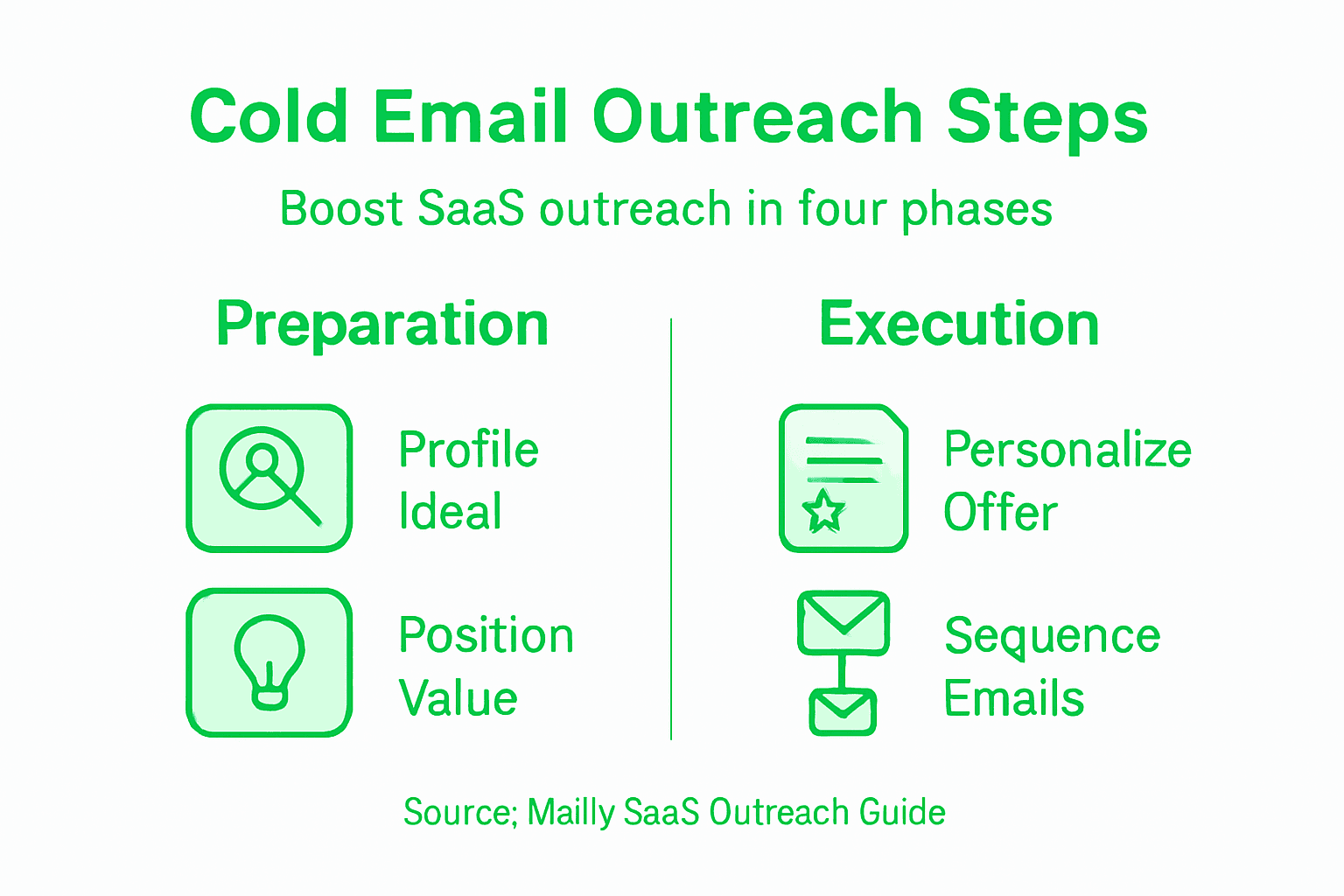
Start with your opening email. This is where you establish familiarity and relevance. Reference something specific about their work, a recent announcement, or a decision they made. Deep research-backed opening lines that demonstrate genuine understanding create immediate credibility. Don’t open with your pitch. Open with evidence that you’ve done your homework.
The first email should accomplish one thing: show them you understand their context. Keep it short. One or two sentences explaining what caught your attention, then a brief description of why you’re reaching out. End with a low-pressure ask—not “can we schedule a call,” but “would a five-minute conversation be worth your time?”
Now design your follow-up sequence. Space them out strategically over 7 to 14 days. Each email should serve a different purpose rather than repeating the same message.
Here’s the psychological sequence that works:
- First email: Build credibility through demonstrated research
- Second email (3-4 days later): Introduce a specific insight or data point relevant to their situation
- Third email (5-7 days later): Share a short case study or example of how you’ve solved similar problems
- Fourth email (if needed): Create mild urgency by mentioning limited availability or a time-sensitive opportunity
Multi-step sequencing leverages psychological principles like reciprocity, social proof, and scarcity. Each email feels like a natural continuation rather than another sales pitch. When the second email lands, they remember the first one. By the third, you’re building pattern recognition.
Avoid the trap of repeating your ask in every email. Vary the hook. Vary the angle. Keep them guessing what you’ll say next, which triggers curiosity and attention.
A sequence of three thoughtful emails generates more responses than ten emails saying the same thing. Psychology beats volume every time.
Pro tip: Write your entire sequence before sending the first email. This ensures each email complements the others and builds momentum instead of contradicting your earlier positioning or asking the same question twice.
Step 4: Test and optimize outreach results
You’ve built your ICP, personalized your offers, and crafted your sequences. Now comes the part that separates winners from founders who waste months on assumptions: measuring what actually works and ruthlessly eliminating what doesn’t.
Start by tracking the metrics that matter. Open rates tell you nothing about campaign effectiveness. Reply rates and meeting conversions are what signal real interest. If your open rate is 45% but your reply rate is 2%, you have an attention problem, not a measurement problem.
Testing and optimizing based on response data shows that continuous refinement of personalization depth, sequence length, and call-to-action clarity drives measurable improvements. The founders who see sustained growth aren’t the ones who nailed it on day one. They’re the ones who changed something every single week.
Build a simple testing framework:
- Subject line variations: Test personalized subject lines against curiosity-driven ones. Track which gets higher open rates from your ICP specifically, not your entire list.
- Opening hooks: Does research-backed credibility work better than a question? Test both and measure reply rates, not just opens.
- Sequence length: Does your ICP respond better to three emails or five? Run one variation for two weeks, then switch and measure the difference.
- Call-to-action clarity: Compare “would a brief conversation help?” against “let’s hop on a call Thursday at 2pm.” Direct asks often outperform soft asks.
Don’t test everything at once. Change one variable, run it for at least 50 touches, and measure the impact. Then move to the next variable. This takes discipline, but it’s the only way to build a system that compounds.
Track your numbers in a spreadsheet. Outreach volume sent, replies received, meetings booked, deals closed. Watch for patterns. Are certain industries responding better? Are your emails to specific titles generating higher reply rates? This is the data that tells you where to double down.
Data without action is just noise. Test something this week, measure it, and change your approach next week. That’s how you escape the spray-and-pray trap.
Pro tip: Set a weekly optimization rhythm. Every Monday, look at last week’s metrics, identify your worst-performing element, and test a specific change. Small, consistent improvements compound into 300% response rate increases over three months.
To optimize your outreach campaigns, compare these key testing variables:
| Variable Tested | Why It Matters | What to Measure |
|---|---|---|
| Subject Line | Increases open rates | Open rate by target segment |
| Opening Hook | Builds credibility | Reply rate per version |
| Sequence Length | Prevents message fatigue | Response by sequence step |
| Call-to-Action Type | Drives meeting conversions | Conversion to meetings booked |
Unlock Precision Outreach That Truly Connects with Mailly
Cold emailing for SaaS founders is not about blasting generic messages but about deeply understanding your ideal customer profile and delivering offers that matter in their unique context. As the article highlights, challenges like identifying operational pain points and crafting psychologically sequenced campaigns require rigorous research and strategic alignment. If you want to move beyond basic personalization and create outreach that feels intentional and relevant Mailly offers the perfect solution.
Our AI-powered outbound strategy engine goes beyond surface-level copywriting by analyzing your positioning product architecture monetization model hiring signals and competitive landscape. This allows Mailly to pinpoint the actual bottlenecks your prospects face and reframe your offers accordingly. By leveraging contextual research and building psychologically sequenced email campaigns Mailly helps you craft outreach that converts prospects into conversations and conversations into customers.
Take the step to transform your cold outreach from guesswork into a data-driven strategy that resonates now Visit Mailly to see how our platform can empower you to send emails that truly engage your SaaS ideal customer profile and boost your response rates starting today.
Frequently Asked Questions
What is the first step in boosting outreach for my SaaS through cold emailing?
To boost outreach effectively, start by analyzing your ideal customer profile and positioning. Identify your existing paying customers, their challenges, and how your product solves specific problems for them.
How can I personalize my cold emails to get better responses?
Personalize your cold emails by conducting deep contextual research on your target accounts. Understand their specific business challenges and relate your solution directly to those issues to make your outreach feel tailored to them.
What should I include in a cold email sequence?
A cold email sequence should include a series of emails designed to engage and build credibility over time. Each email should have a different focus, such as establishing familiarity, providing insights, sharing case studies, and creating urgency.
How do I measure the success of my cold email campaigns?
Measure success by tracking reply rates and meeting conversions rather than just open rates. Analyze which aspects of your emails lead to higher engagement, and adjust your approach based on this data for continual improvement.
What are some effective follow-up strategies for cold emailing?
Effective follow-up strategies involve spacing your emails out and varying their content to maintain the prospect’s interest. Create a sequence that introduces new insights or urgency while avoiding repetitive messaging to enhance response rates.
How often should I optimize my cold email outreach process?
You should optimize your cold email outreach process at least once a week. Review your metrics to identify underperforming elements and test changes to improve engagement rates systematically.
