
If you are searching for “how to automate email marketing,” you are likely looking for a way to save time. You want to press a button, walk away, and have leads appear in your inbox.
This is the promise that every marketing tool has sold for the last decade. And for a long time, it worked.
You could upload a CSV of 10,000 random contacts, set up a generic 4-step sequence (Day 1, Day 3, Day 7), and rely on the law of large numbers to generate meetings. It was a “volume game.”
But in 2026, this definition of automation is dead. In fact, it is actively dangerous.
The major email providers (Google, Microsoft, Yahoo) have fundamentally changed the rules of the game. They now use AI-driven filters that detect “linear automation patterns.” If you send the same template to 500 people at 9:00 AM, you aren’t automating your marketing; you are automating the destruction of your domain reputation.
True automation in the modern era is not about automating the delivery (the “blast”). It is about automating the intelligence (the “decision”).
This guide will explain the shift from “Blind Automation” to “Signal-Based Automation”, the only methodology that scales in a post-spam-filter world.
The Automation Trap: Why “Drip” Sequences Fail
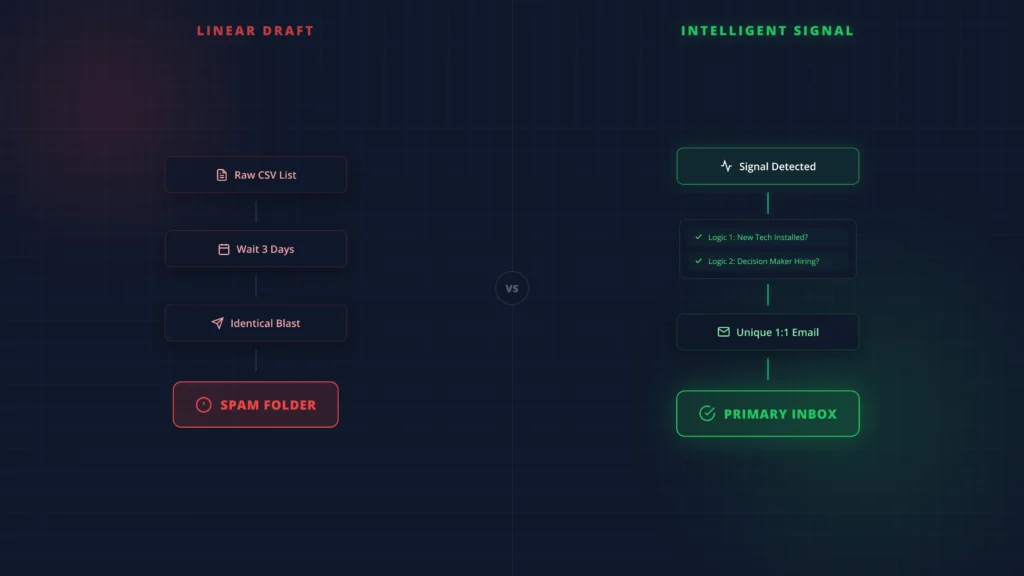
The traditional model of email automation looks like a conveyer belt. You dump a lead at the start, and the machine blindly pushes them through a pre-set path regardless of who they are or what is happening in their world.
The Old Way (Linear):
- Step 1: Send generic “Value Prop” email.
- Step 2: Wait 3 days.
- Step 3: Send “Just bumping this” email.
- Step 4: Repeat until blocklisted.
This approach fails for two reasons:
- It creates patterns: Algorithms see thousands of identical messages leaving your server at identical intervals. This is the digital fingerprint of spam.
- It ignores context: You are emailing a CFO about “saving money” on the same day they just raised $50M in Series B funding. Your automation made you look tone-deaf.
To win today, we must dismantle the conveyor belt and replace it with a Neural Network. We need automation that listens before it speaks.
Phase 1: Automating the “Who” (Research)
The biggest bottleneck in outbound is not writing emails; it is researching contacts. A human SDR takes 15-20 minutes to properly research a prospect—checking their LinkedIn, their company news, their tech stack, and their recent hiring activity.
In the past, you had to choose: do you research manually (low volume, high quality) or automate blindly (high volume, low quality)?
The Intelligence Layer solves this trade-off.
Modern tools like Mailly don’t just “mail merge” a first name. They deploy autonomous agents to visit the prospect’s website and answer complex questions:
- “Does this company use a competitor?”
- “Is their pricing usage-based or seat-based?”
- “Who is the decision-maker for security?”
This allows you to automate the Research Phase. You can feed raw, messy lists into the engine, and it will filter out the noise, leaving you with only the high-probability targets.
Learn more about automating the research phase to stop wasting credits on bad leads.
Phase 2: Automating the “When” (Signals)
Timing is the most underrated variable in sales. A mediocre email sent at the perfect time outperforms a perfect email sent at the wrong time.
Instead of automating based on Time (e.g., “Send on Tuesday”), you should automate based on Triggers.
This is called Signal-Based Outbound. You set up “listening posts” across the web that wait for specific events to occur. When the event happens, the automation fires instantly.
Examples of High-Value Triggers:
- The “New Tool” Trigger: A company adds “HubSpot” to their DNS records.
Action: Send an email about your HubSpot integration. - The “New Hire” Trigger: A company posts a job for “VP of Marketing.”
Action: Email the CEO about how you can support the incoming VP. - The “Funding” Trigger: A company announces a Series A.
Action: Email the founder about scaling their infrastructure.
This is not “spam.” This is timely relevance. The recipient perceives it as serendipity, not intrusion.
Master the mechanics of a signal-based outbound strategy to see how this architecture replaces the old “spray and pray” model.
Phase 3: The “How” (Infrastructure)
Finally, we must address the unsexy reality of automation: Plumbing.
If you try to send 5,000 signal-based emails from a single G-Suite account, you will be shut down in 48 hours. The scale required for modern growth necessitates a robust technical backend.
You cannot manually manage the DNS records, SPF authentications, and warm-up schedules for 25 different domains. It is humanly impossible to track the health of every inbox on a spreadsheet.
This is where infrastructure automation becomes critical. You need a system that:
- Rotates Inboxes: Spreads volume across 50+ accounts so no single account exceeds daily limits.
- Auto-Warms: Automatically replies to seed accounts to maintain a high sender score.
- Balances Load: Detects if a domain is “tired” and rests it for 3 days before sending again.
This is the difference between a freelancer with a Gmail account and a revenue operation. You need an automated deliverability infrastructure that acts as a shield for your primary domain.
Conclusion: The Future is Autonomous
The question “how to automate email marketing” has a new answer.
It is no longer about buying a tool that sends emails while you sleep. It is about building an Intelligence Layer that thinks while you sleep.
The winners of 2026 will not be the ones with the largest lists. They will be the ones with the smartest filters. They will stop asking “How many emails can I send?” and start asking “How many buy signals did I detect?”
Don’t automate the noise. Automate the signal.
Key Takeaways
- Linear is Dead: Calendar-based “drip” sequences are easy for spam filters to spot and block.
- Automate Research: Use AI to vet prospects before you email them. Quality > Quantity.
- Trigger > Time: Send emails based on company events (funding, hiring, tech install), not arbitrary dates.
- Protect the Domain: Use automated infrastructure to rotate inboxes and manage deliverability health.
