
For the better part of a decade, the global B2B sales playbook preached a singular, unshakable commandment: “Be human.”
The methodology was straightforward, universally adopted, and for a long time, highly effective. A Sales Development Representative (SDR) would invest five to ten minutes scanning a prospect’s LinkedIn profile, notice they attended the University of Michigan, and open their outreach with a spirited “Go Wolverines!” reference. Or perhaps they would spot a photo of a golden retriever on Instagram and make a “cute dog” comment.
Historically, this strategy functioned as a “Proof of Work.” In the cryptographic sense, it was a costly signal. It indicated to the recipient that you were not a bot, that you had invested actual minutes of your limited lifespan into understanding them as a person, and consequently, they owed you the social currency of a response. It relied entirely on the scarcity of information and the high cost of manual research.
The Collapse of “Proof of Work” in Cold Email in 2026
As we navigate the harsh, automated landscape of cold email, this advice has shifted from outdated to actively detrimental. The technological substrate of the internet has shifted beneath our feet, rendering the “human touch” of the 2010s obsolete.
The ubiquity of Large Language Models (LLMs) and autonomous agents has fundamentally dismantled the traditional mechanics of trust in digital communication. Today, an AI agent can scrape a prospect’s entire digital footprint, identifying their alma mater, hobbies, recent tweets, obscure podcast appearances, and even their writing style, and synthesize a “hyper-personalized” introduction in under 300 milliseconds.
The result is a crisis of authenticity. Being “friendly” is no longer evidence of human effort. It is now often the primary marker of automated spam. The harder an email tries to bond over trivia, the more it feels synthetic. We have entered an era where “effort” can be spoofed at scale, meaning “effort” no longer holds value in the marketplace of attention.
Entering the Uncanny Valley of Sales
We have arrived in the “Uncanny Valley” of outbound sales. This concept, originally from robotics, describes the revulsion humans feel when something looks almost human but is clearly not. When a C-Level executive opens an email that attempts to be overly chatty, familiar, or “relatable,” their internal alarm bells ring immediately.
The psychological processing of the inbox has changed dramatically over the last decade:
- 2015 Logic: “He mentioned my hiking trip to Patagonia. He must be a real person who cares about building a relationship. I should read this.”
- 2026 Logic: “He mentioned my hiking trip. This is an AI agent running a basic email personalization script. It’s trying to manipulate me with fake empathy. Block and Delete.”
The attempt to feign intimacy with a stranger is now a liability. It wastes the prospect’s most finite resource: Time. A “warm” introduction requires 3-5 seconds to scan and conveys zero business utility. In the high-volume inbox of a decision-maker, those wasted seconds are fatal to your open rates.
According to research by Gartner, B2B buyers now spend only 17% of their buying journey meeting with potential suppliers. This means when you do get their attention, you cannot afford to waste it on pleasantries. The modern executive does not want a new friend; they want fewer problems.
The Pivot: Relevance Over Personalization
Many founders and sales leaders, seeing their open rates plummet, are asking: is email marketing still effective in this hostility-filled environment? The answer is a resounding yes, but only if you are willing to abandon the “friend zone” and move toward high-value consulting. The winners of the next decade will not replace “Robotic” emails with “Friendly” emails. They will replace “Personalized” emails with “Relevant” emails.
While these terms are often used interchangeably in marketing circles, there is a massive philosophical distinction between them that drives email marketing conversion.
1. Personalization (The Old Way)
Focus: The Individual’s Trivia.
“Hey John, saw you’re a fan of F1 racing! Who are you rooting for this season? Anyway, we sell cloud security…”
Why it fails: You are asking a busy stranger to engage in non-business small talk before you have earned their respect or attention. It is “Fake Rapport.” It feels manipulative because the sender is feigning interest in F1 racing solely to pitch a product. It bridges a gap that doesn’t exist with a bridge nobody asked for.
2. Relevance (The New Way)
Focus: The Company’s Structural Problems.
“John, saw you just posted the ‘Head of Security’ role and installed Okta last week. Usually, this means you’re prepping for SOC 2 compliance…”
Why it wins: You aren’t trying to be their buddy. You are demonstrating that you understand their current operational reality better than they do. You have done the work to understand their context, and you are connecting the dots for them. This approach respects their intellect and their time.
The Signal-Based Approach to Outreach
To execute relevance at scale, you must move beyond static lists of contacts. You need a dynamic understanding of who you are targeting. This begins with sophisticated ideal customer profile (ICP) creation that goes beyond “Industry” and “Company Size.”
True relevance relies on “Trigger Events”, shifts in a company’s status quo that create a vacuum for your solution. To craft a truly relevant message that drives email marketing conversion, you need to synthesize four distinct layers of data simultaneously:
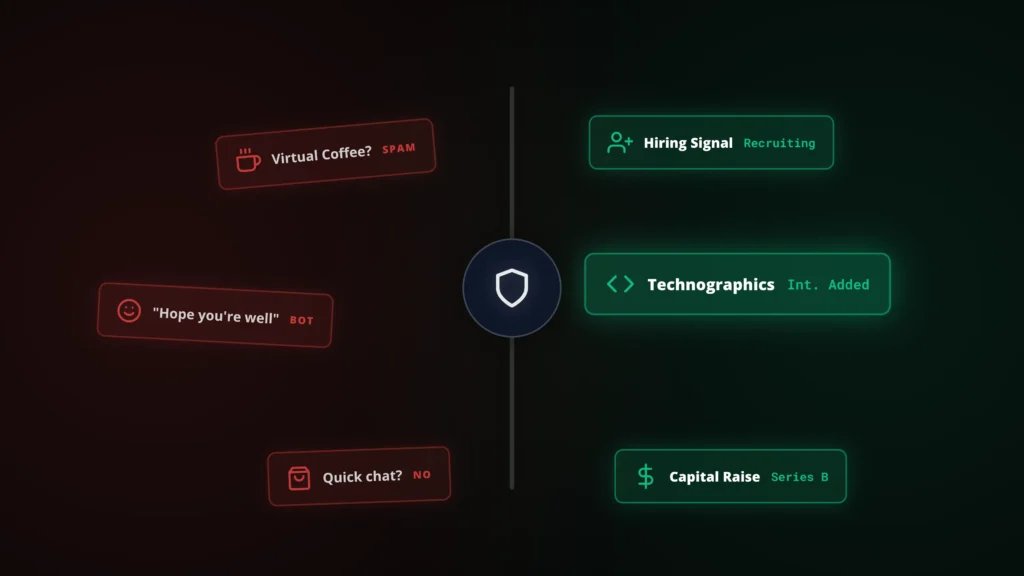
- Technographics: What software stack did they just implement? (e.g., Did they just drop HubSpot for Salesforce? This implies a move upmarket and a need for more complex data orchestration).
- Hiring Signals: Are they recruiting for growth or backfilling churn? (e.g., Hiring 10 SDRs implies a need for lead data; hiring a CFO implies a tightening of budget and focus on profitability).
- News Events: Did they recently raise capital, or did they suffer a data breach? Did they open a new office in EMEA?
- Competitor Landscape: What moves are their rivals making that threaten their market share?
The Context Window Advantage
Why is true relevance so rare? Because humans are biologically inefficient at cross-referencing massive, disconnected datasets in real-time. We are linear thinkers, whereas relevance is often lateral. We struggle to see the invisible lines connecting a press release to a software installation.
This is where the engineering architecture of tools like Mailly becomes critical. To succeed in modern cold email, you cannot rely on surface-level data. A human SDR might take 45 minutes to assemble this puzzle for a single lead, tabs open across three screens, trying to connect the dots. The Mailly Intelligence Layer performs this in seconds.
It doesn’t do this by being “Creative,” but by utilizing a massive Context Window to identify patterns that humans miss. The goal is not to write a poem. The goal is to solve a logic puzzle: Given these 4 signals, what is the highest probability business problem this company is facing right now?
The “So What?” Test for Copywriting
Once you have the signals, how do you write the email? You apply the “So What?” test. Look at every sentence in your draft and ask, “So what?” If the answer isn’t immediately clear in dollars or hours saved, delete it.
The “Friendly” Fail:
“I hope this email finds you well. I see you are scaling your team.”
Critique: So what? Every company wants to scale. This is noise.
The Relevant Win:
“You’re hiring 5 AEs in New York, but your Glassdoor reviews mention ‘poor lead quality’ is driving turnover.”
Critique: This hurts. It’s true. It demands attention. It connects an external signal (hiring) with an internal pain (attrition).
Stop Trying to Be Liked. Start Being Useful.
The era of the “Chatty SDR” is dead. The “Let’s grab a virtual coffee” cadence is filtering itself into oblivion. Your prospects do not want another friend on the internet; they have plenty. They want a solution to the fire burning on their desk.
Trust is no longer built through pleasantries; it is built through competence. When you accurately diagnose a problem a prospect hasn’t even publicly announced yet, you earn immediate credibility. You move from being a “vendor” to being a “peer.”
If you want to win in 2026, strip away the fluff. Kill the “Hope this finds you well.” Execute on raw, uncomfortably specific relevance. Don’t tell them you know they like deep-dish pizza. Tell them you know they are bleeding revenue, and exactly how to stop it.
Frequently Asked Questions
Does email marketing work in the age of AI?
Absolutely. However, the definition of “work” has changed. Does email marketing work if you rely on templates and surface-level personalization? No. That approach is currently seeing the lowest engagement rates in history because spam filters and human psychology have adapted to block it. But if you use email as a delivery mechanism for high-value, data-driven insights that solve immediate problems, it remains the highest ROI channel in B2B sales. The medium isn’t dead; the old playbook is.
How to create an email marketing campaign that converts in 2026?
If you are wondering how to create an email marketing campaign today, start by ignoring the copywriting and focusing on the list segmentation. The success of a campaign is 80% determined by who you are emailing and why, and only 20% by what you say.
- Step 1: Signal First. Don’t build a list of “CEOs.” Build a list of “CEOs hiring a VP of Sales who just raised Series B.” using Mailly’s automatic tools.
- Step 2: Map the Problem. Determine the inevitable pain point created by those specific signals (e.g., “They have money but no sales leadership, so they are likely wasting ad spend”).
- Step 3: Bridge the Gap. Write copy that connects the signal to your solution immediately.
- Step 4: Remove Fluff. Delete every sentence that does not advance the business logic. If it doesn’t help them make money or save time, cut it.
