

Cold email outreach in B2B sales can feel like sending messages into a void where getting noticed is a constant battle. Whether you work in SaaS or any other sector, turning emails into real opportunities takes more than just hitting send. What if you could pinpoint the exact metrics that reveal where your efforts are working and where they fall short?
This article walks you through the key performance indicators that shape cold email success, backed by industry benchmarks. You will discover practical strategies for improving open rates, reply rates, and converting initial interest into booked meetings. Get ready to uncover actionable insights that will sharpen your outreach, protect your sender reputation, and help you drive tangible business results.
Table of Contents
- Open Rate: Gauge Initial Interest Effectively
- Reply Rate: Measure Real Engagement
- Meeting Rate: Track Qualified Prospects
- Positive Response Rate: Identify True Intent
- Bounce Rate: Improve List Quality and Deliverability
- Conversion Rate: Tie Outreach to Actual Revenue
- Time to First Response: Optimize for Faster Engagement
Quick Summary
| Takeaway | Explanation |
|---|---|
| 1. Optimize Subject Lines | Craft subject lines that evoke curiosity and relevance to improve open rates. |
| 2. Personalize Outreach | Deeply research prospects to tailor messages to their specific pain points and needs. |
| 3. Ensure Technical Accuracy | Implement email authentication protocols to improve deliverability and reduce bounce rates. |
| 4. Highlight Immediate Value | Clearly demonstrate potential outcomes early in your emails to encourage faster responses. |
| 5. Track Positive Responses | Focus on meaningful engagement metrics to gauge genuine prospect interest and intent. |
1. Open Rate: Gauge Initial Interest Effectively
In the high-stakes world of B2B cold outreach, your email’s open rate is the critical first signal of campaign success. Think of it as your initial handshake – the moment potential clients decide whether you’re worth their precious attention.
Open rate represents the percentage of recipients who actually click and view your email, revealing how compelling your subject line and sender details truly are. According to recent B2B email performance data, the average cold email open rate in 2025 hovers around 39%, with significant industry variations:
- Energy management systems: 46% open rates
- SaaS companies: 25.7% open rates
- Technology sectors: 33-38% range
Understanding open rates goes beyond simple percentages. It’s a diagnostic tool that reveals:
- Subject line effectiveness
- Audience targeting precision
- Technical email deliverability
Your open rate is a direct reflection of how well you’ve matched your message to your ideal customer’s curiosity and needs.
To improve your open rates, focus on several strategic elements. First, craft subject lines that spark genuine curiosity without resorting to clickbait tactics. Use personalization, hint at specific value, and create a sense of urgency or relevance.
Technical setup matters immensely. Ensure proper authentication protocols like DMARC, SPF, and DKIM are implemented to prevent your emails from landing in spam folders. This technical groundwork significantly impacts your deliverability and, consequently, your open rates.
Timing is another critical factor. Thursday mornings have emerged as a sweet spot for B2B cold emails, when professionals are most likely to be receptive and scanning their inboxes.
Pro tip: Segment your email lists by industry and create hyper-targeted subject lines that speak directly to each sector’s unique challenges and interests.
2. Reply Rate: Measure Real Engagement
In the intricate dance of B2B cold outreach, the reply rate separates meaningful conversations from ignored messages. It’s the critical metric that transforms passive email sending into active business dialogue.
Reply rate goes beyond simple opens – it measures genuine human interaction and potential interest. When a prospect takes the time to respond, they’re signaling something far more valuable than a momentary glance.
Key components that influence reply rates include:
- Personalization depth
- Relevance to recipient’s challenges
- Clear value proposition
- Compelling and concise messaging
A successful reply isn’t just about getting a response. It’s about sparking a conversation that could evolve into a meaningful business relationship.
Understanding reply rates requires dissecting your outreach strategy. Are you speaking directly to the recipient’s specific pain points? Your message must feel like a tailored solution, not a generic broadcast.
Strategic approaches to improve reply rates involve:
- Conducting thorough research on each prospect
- Crafting hyper-personalized opening lines
- Demonstrating immediate, tangible value
- Using conversational, human language
Effective cold outreach isn’t about volume. It’s about precision and relevance. A single thoughtful, well-researched email that generates a reply is infinitely more valuable than hundreds of templated messages.
Pro tip: Create email templates with strategic “blank spaces” that you can quickly customize with specific prospect insights, making each message feel individually crafted.
3. Meeting Rate: Track Qualified Prospects
The meeting rate represents the ultimate validation of your cold outreach strategy – transforming initial contact into genuine sales opportunities. It’s the metric that separates promising leads from genuine business conversations.
Unlike open or reply rates, meeting rate reflects true prospect qualification. When a potential client agrees to sit down with you, they’re signaling serious interest in solving a specific business challenge.
Key indicators of a strong meeting rate include:
- Precise targeting
- Compelling value proposition
- Strategic email sequencing
- Relevance to prospect’s current needs
A high-quality meeting is worth infinitely more than a hundred generic email interactions.
Successful meeting rates demand a strategic approach. You’re not just trying to get a meeting – you’re demonstrating that you understand the prospect’s unique business landscape and can provide tangible value.
Effective tactics to improve meeting rates:
- Conduct deep research on each prospect’s business
- Highlight specific pain points in your initial outreach
- Offer clear, measurable potential outcomes
- Use social proof and targeted case studies
- Make scheduling frictionless
Psychological positioning matters immensely. Your outreach should feel like a potential solution, not a sales pitch. Prospects want to believe you’re offering a pathway to solving their most pressing business challenges.
Pro tip: Create a “meeting cost calculator” that demonstrates the potential ROI of your solution, giving prospects a concrete reason to invest 30 minutes with you.
4. Positive Response Rate: Identify True Intent
The positive response rate is the nuanced metric that separates genuine prospect interest from polite dismissals. It’s your window into understanding which outreach strategies actually resonate with potential clients.
Unlike generic reply metrics, positive response rate tracks meaningful engagement signals that indicate real business potential. Not all responses are created equal – a perfunctory “not interested” differs dramatically from a thoughtful inquiry about your solution.
Key characteristics of a positive response include:
- Specific questions about your offering
- Request for additional information
- Indication of current business challenges
- Willingness to explore further discussion
A truly positive response reveals more than surface-level interest. It exposes the underlying business needs driving potential engagement.
Effective positive response strategies require deep understanding of your prospect’s potential motivations. You’re not just sending emails – you’re crafting precise communication that speaks directly to specific business pain points.
Strategic approaches to improve positive response rates:
- Conduct granular research on each prospect
- Develop hyper-personalized messaging
- Demonstrate immediate and specific value
- Use provocative yet professional language
- Create clear pathways for next steps
Psychological positioning is critical. Your outreach must feel like a tailored solution, not a generic sales pitch. Prospects want to believe you understand their unique challenges better than they do.
Pro tip: Develop a “response quality scoring system” that helps you quantify and track the depth and potential of each prospect interaction.
5. Bounce Rate: Improve List Quality and Deliverability
Your email bounce rate is the silent killer of cold outreach campaigns – a metric that reveals the health of your contact database and email infrastructure. Understanding and minimizing bounces is crucial for maintaining a robust communication strategy.
According to email deliverability research, B2B email campaigns should maintain bounce rates under 2% to protect domain reputation. Rates at 5% or higher can severely damage your ability to reach potential clients.
Bounce types reveal different strategic challenges:
- Hard bounces: Permanent delivery failures
- Soft bounces: Temporary delivery issues
- Invalid email addresses: Outdated or incorrect contacts
- Domain-level rejections: Technical infrastructure problems
A low bounce rate isn’t just a metric. It’s a testament to your outreach precision and technical competence.
Technical strategies to reduce bounce rates include:
- Implement rigorous email list verification
- Use domain authentication protocols
- Maintain consistent sending volumes
- Regularly clean contact databases
- Monitor email server reputation
Proactive list management transforms your outreach from a scattered approach to a precision-engineered communication strategy. Every bounced email represents a missed opportunity and potential reputation damage.
The competitive SaaS environment demands meticulous email infrastructure. Your domain’s sender reputation directly impacts your ability to connect with potential clients, making bounce rate management a critical skill.
Pro tip: Invest in quarterly comprehensive email list hygiene, removing inactive or problematic contacts to maintain a laser-focused, high-quality communication channel.
6. Conversion Rate: Tie Outreach to Actual Revenue
Conversion rate is the ultimate performance metric that transforms cold outreach from a cost center into a revenue generation engine. It’s not just about sending emails – it’s about creating meaningful business interactions that drive tangible financial results.
According to B2B SaaS benchmarks, cold email conversion rates range from 0.5% to 1.5%, representing meetings booked or sign-ups relative to total email sends. These numbers might seem small, but they represent critical revenue potential.
Key components that influence conversion rates include:
- Intent data prioritization
- Hyper-personalized messaging
- Multi-channel follow-up strategies
- Precise ideal customer profile targeting
- Compelling value proposition
Conversion is not a number. It’s a reflection of how well you understand and solve your prospect’s actual business challenges.
Strategic approaches to improve conversion rates:
- Develop granular ideal customer profiles
- Create psychologically compelling messaging
- Design sophisticated follow-up sequences
- Implement intent data filtering
- Test and iterate continuously
Technical precision matters. Your outreach should feel less like a generic pitch and more like a tailored solution that addresses specific business bottlenecks. The most successful cold email campaigns read like they were written exclusively for one recipient.
The average B2B SaaS conversion rate sits around 1.1%, but top performers consistently outpace this benchmark through strategic, data-driven approaches.
Pro tip: Create a “conversion pathway” document that maps each email interaction to potential revenue outcomes, helping your team see cold outreach as a sophisticated revenue generation system.
7. Time to First Response: Optimize for Faster Engagement
Time to first response measures the critical window between your initial outreach and the prospect’s first meaningful engagement – a key indicator of your cold email’s psychological resonance and strategic precision.
When prospects respond quickly, they’re signaling more than casual interest. They’re revealing a genuine alignment with your value proposition. The faster the initial response, the higher the probability of converting that interaction into a substantive business opportunity.
Critical factors influencing response speed include:
- Subject line psychological triggers
- Immediate value demonstration
- Precise targeting
- Contextual relevance
- Communication clarity
Speed of response is a direct reflection of how well you’ve diagnosed and articulated the prospect’s underlying business challenge.
Strategic approaches to accelerate first response times:
- Craft hyper-specific subject lines
- Demonstrate immediate value in first paragraph
- Use conversational language
- Show deep understanding of prospect’s context
- Create clear pathways for engagement
Psychological positioning transforms cold emails from generic interruptions into targeted solutions. Your message should feel like a precisely engineered response to a problem the prospect didn’t even realize they could solve so quickly.
Successful B2B communication requires strategic research approaches that go beyond surface-level personalization. Each email must feel like a custom-built diagnostic tool designed exclusively for the recipient.
Pro tip: Develop a “response acceleration framework” that maps psychological triggers specific to different industry segments, allowing you to craft emails that demand immediate attention.
Below is a comprehensive table summarizing the key metrics and strategies discussed throughout the article for B2B cold email outreach.
| Metric | Description | Key Strategies | Benefits |
|---|---|---|---|
| Open Rate | Measures the percentage of recipients who open your email. | Create compelling subject lines, implement authentication protocols, and choose optimal sending times. | Increased email engagement and greater visibility of your message. |
| Reply Rate | Tracks the percentage of recipients who reply, indicating engagement. | Perform thorough recipient research, focus on personalization, and address specific needs. | Initiates business dialogue and assesses potential interest. |
| Meeting Rate | Represents the percentage of interactions leading to scheduled meetings. | Understand prospect needs, present value propositions clearly, and reduce scheduling friction. | Builds stronger connections and potential partnerships or sales. |
| Positive Response Rate | A metric separating genuine interest from generic replies. | Send tailored messages addressing specific challenges, and actively engage with recipient inquiries. | Identifies promising prospects for continued communication. |
| Bounce Rate | Reflects health of email list and deliverability infrastructure. | Use robust email verification tools, authenticate domains, and maintain list hygiene. | Protects sender reputation and enhances email campaign reach. |
| Conversion Rate | Tracks the percentage of outreach translating into revenue-generating actions. | Employ hyper-targeted messaging based on ideal customer profiles and provide compelling offers. | Directly contributes to project goals and revenue generation. |
| Time to First Response | Measures the duration between sending an email and receiving a response. | Craft engaging subject lines, and structure emails to quickly convey value and encourage prompt action. | Shortens engagement cycle and reflects alignment with prospect requirements. |
Transform Your B2B SaaS Cold Outreach with Data-Driven Precision
Measuring cold outreach success is critical but can feel overwhelming when trying to improve open rates, reply rates, or meeting rates. The article highlights common pain points around matching messaging to ideal customer profiles and the challenge of turning metrics into meaningful conversations. If you want to move beyond generic templated campaigns and create emails that truly resonate with your prospects’ business needs, you need an approach that relies on deep contextual research and expert sequencing.
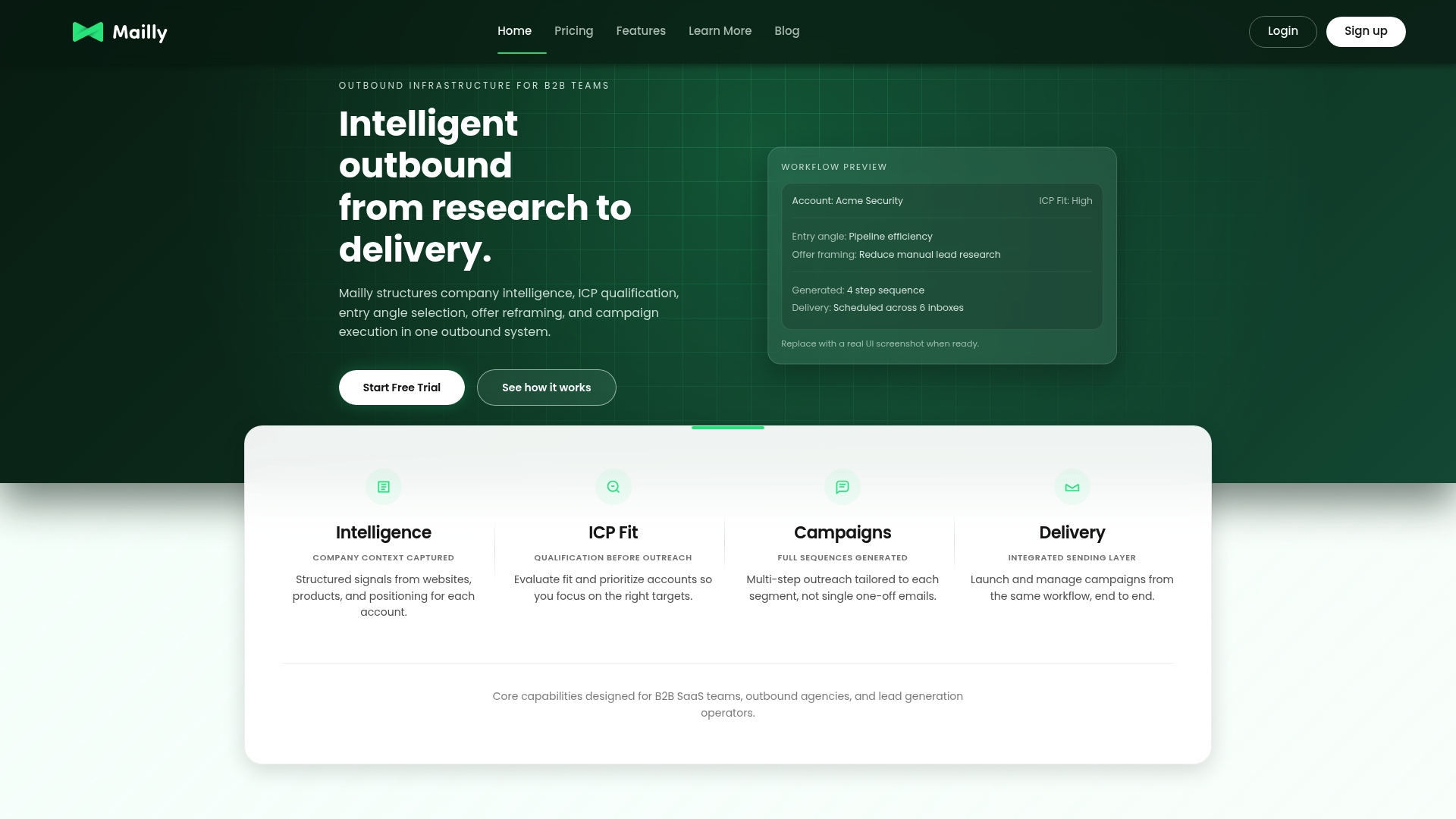
Discover how Mailly redefines outbound strategy by analyzing your company’s positioning, product model, and market signals to build hyper-personalized campaigns designed to boost critical metrics like positive response rate and time to first response. Don’t wait to turn data into revenue. Visit Mailly now and start transforming your cold outreach into strategic conversations that convert.
Ready to optimize every metric and see measurable results? Learn more about our AI-powered outbound strategy and how it creates intentional, context-rich email sequences proven to outperform traditional campaigns.
Frequently Asked Questions
What are the key cold outreach metrics for B2B SaaS success?
The key cold outreach metrics include open rate, reply rate, meeting rate, positive response rate, bounce rate, conversion rate, and time to first response. Track these metrics to assess the effectiveness of your outreach strategy and identify areas for improvement.
How can I improve my cold email open rates?
To improve your cold email open rates, focus on crafting compelling subject lines that evoke curiosity and relevance. Experiment with personalization and timing, aiming for Thursday mornings, to increase your chances of drawing attention from recipients.
What should I do if my reply rate is low?
If your reply rate is low, analyze your outreach messages for personalization and relevance. Conduct thorough research on each prospect, tailor your messaging to address their specific challenges, and be concise about the value you provide.
How can I increase my meeting rate from cold outreach?
Increase your meeting rate by ensuring your email content highlights your understanding of the prospect’s needs and offers clear, measurable outcomes. Maintain a streamlined scheduling process to remove barriers and make it easy for prospects to agree to a meeting.
What steps can I take to reduce my email bounce rate?
To reduce your email bounce rate, regularly verify and clean your email list to ensure it contains accurate and valid addresses. Implement authentication protocols and monitor your email server’s reputation to maintain deliverability and protect your outreach effectiveness.
How can I measure and improve my conversion rate from cold outreach?
Measure your conversion rate by tracking the number of leads that convert to meetings or sign-ups from total emails sent. Continuously refine your outreach by developing ideal customer profiles, using sophisticated follow-up techniques, and personalizing your messaging to resonate with specific business challenges.
