

Many B2B SaaS founders in North America struggle with cold email campaigns that deliver disappointing results and risk damaging sender reputation. The traditional approach of plugging a first name into a template falls flat because superficial tactics rarely foster trust or engagement. By embracing genuine personalization built on real prospect research, teams unlock increased response rates and deeper market insights. This article reveals the myths, signals, and strategic benefits driving modern, targeted outreach that actually resonates.
Table of Contents
- Defining Cold Email Personalization And Myths
- Modern Approaches: Deep Contextual Research
- Key Personalization Signals In B2B Outreach
- Psychological And Strategic Benefits For SaaS Teams
- Pitfalls Of Generic Outreach: Real Risks And Costs
Key Takeaways
| Point | Details |
|---|---|
| Deep Personalization Over Superficial Tactics | Genuine personalization requires in-depth research about a prospect’s business context rather than generic templates. |
| Psychological and Strategic Benefits | Personalized outreach increases engagement rates and builds trust, making communications feel valuable rather than intrusive. |
| Risks of Generic Outreach | Non-personalized emails can harm brand reputation, increase spam complaints, and lead to long-term damage to communication channels. |
| Importance of Contextual Research | Leverage advanced research techniques and tools to gather meaningful insights that facilitate targeted and relevant engagement. |
Defining Cold Email Personalization and Myths
Cold email personalization has evolved far beyond simply inserting a recipient’s first name into a generic template. Genuine personalization demands deep contextual understanding of each prospect’s unique business landscape, challenges, and potential opportunities.
True personalization requires moving past superficial tactics and developing a nuanced approach that demonstrates authentic research and strategic insights. The days of one-size-fits-all outreach are over. Modern B2B communication demands a more sophisticated strategy that respects the recipient’s time and specific business context.
Key characteristics of effective cold email personalization include:
- Demonstrating genuine knowledge about the recipient’s company
- Highlighting specific challenges relevant to their industry
- Connecting your value proposition directly to their strategic goals
- Using precise, contextual language that shows real understanding
- Avoiding generic compliments or surface-level observations
Personalization Myths frequently misguide sales and marketing teams. Superficial personalization tactics often backfire, creating more friction than connection. Common misconceptions include:
- Simply mentioning someone’s recent LinkedIn post constitutes meaningful personalization
- Using a recipient’s name automatically makes an email feel personalized
- Generic industry facts can replace genuine research
- Personalization is primarily about styling, not substance
Deep personalization is about relevance, not volume. Your goal is creating a message so targeted it feels like a direct conversation, not a mass communication.
Pro tip: Invest 15-20 minutes of focused research on each prospect to uncover unique insights that transform your cold email from noise to meaningful dialogue.
Modern Approaches: Deep Contextual Research
Deep contextual research represents the cutting edge of B2B cold email personalization, moving far beyond traditional surface-level tactics. Advanced AI technologies now enable sophisticated contextual understanding of recipient backgrounds, creating unprecedented opportunities for meaningful engagement.

The modern approach to contextual research involves a multi-layered strategy that synthesizes data from multiple sources to build a comprehensive prospect profile. This isn’t about collecting random facts, but constructing a nuanced understanding of a company’s strategic positioning, challenges, and potential opportunities.
Key components of deep contextual research include:
- Analyzing company financial reports and quarterly earnings
- Reviewing recent press releases and public announcements
- Examining leadership changes and organizational shifts
- Investigating current technology stack and infrastructure
- Understanding competitive landscape and market positioning
- Tracking recent funding rounds or investment activities
Technological Innovations are transforming how B2B professionals conduct research. AI-powered tools now enable rapid, sophisticated intelligence gathering that was previously impossible. These technologies can:
- Scan multiple data sources simultaneously
- Extract meaningful contextual insights
- Correlate seemingly unrelated information
- Generate predictive business intelligence
Contextual research is about quality, not quantity. The goal is to develop insights so precise they feel like an insider conversation, not a generic pitch.
Technical Challenges in deep research involve balancing comprehensive information gathering with ethical data usage. Professionals must navigate complex privacy considerations while extracting valuable business intelligence.
Pro tip: Develop a systematic research workflow that allocates specific time blocks for investigating each prospect, ensuring depth and quality over speed.
Key Personalization Signals in B2B Outreach
Advanced personalization signals have transformed B2B outreach from generic mass communication to precision-targeted engagement. These signals represent complex data points that reveal deep insights into a prospect’s current business state, challenges, and potential receptivity to new solutions.
Effective personalization goes beyond surface-level demographic information, diving into nuanced behavioral and contextual indicators that signal genuine business opportunities. Modern B2B professionals leverage multiple signal categories to craft highly relevant communication strategies that resonate with specific organizational needs and priorities.
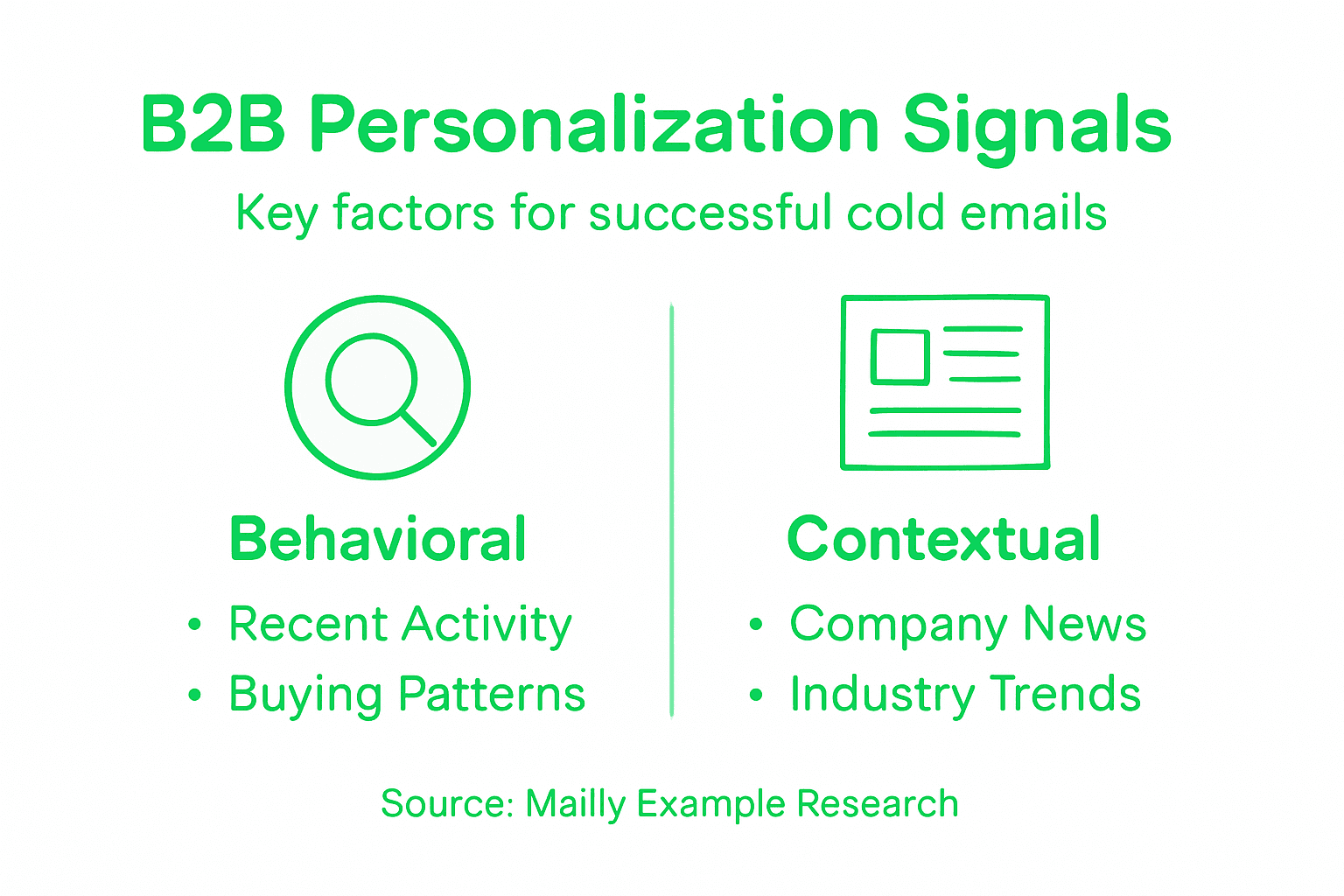
Key personalization signals can be categorized into several critical domains:
Behavioral Signals:
- Recent leadership transitions
- Expansion or contraction of team sizes
- Changes in funding or investment status
- Technological infrastructure upgrades
- Public job postings indicating growth areas
Intent-Based Signals:
- Engagement with relevant online content
- Participation in industry webinars
- Social media interaction patterns
- Search behavior related to specific solutions
- Attendance at professional conferences
Firmographic Signals:
- Company size and revenue range
- Industry vertical and market positioning
- Geographic distribution of operations
- Competitive landscape analysis
- Technological ecosystem and integration preferences
The most powerful personalization signals are those that reveal underlying business challenges and strategic objectives, not just superficial company details.
Technical Considerations in signal analysis require sophisticated data aggregation and interpretation techniques. Successful professionals combine multiple signal types to create a holistic understanding of potential opportunities.
The table below summarizes how different signal types contribute to effective B2B outreach:
| Signal Type | Example Insight | Business Value |
|---|---|---|
| Behavioral | Leadership change detected | Timely, relevant conversation starter |
| Intent-Based | Recent webinar attendee | Signals current solution research |
| Firmographic | New market entry | Tailors messaging to growth phase |
Pro tip: Develop a systematic scoring mechanism that weights different personalization signals, allowing you to prioritize and customize outreach based on signal strength and relevance.
Psychological and Strategic Benefits for SaaS Teams
Personalized cold email strategies offer profound psychological advantages that extend far beyond traditional outreach metrics. By demonstrating genuine understanding and strategic alignment, SaaS teams can transform cold communication from a transactional interaction into a meaningful business dialogue.
The psychological impact of targeted personalization fundamentally reshapes how prospects perceive incoming communications. When recipients recognize that an email has been crafted with specific knowledge about their challenges, organizational context, and potential opportunities, their cognitive defense mechanisms lower, creating a more receptive environment for meaningful engagement.
Psychological Benefits:
- Reduces perceived communication noise
- Builds immediate credibility and trust
- Demonstrates sophisticated problem-understanding
- Signals strategic intentionality
- Minimizes reflexive rejection responses
Strategic Advantages:
- Higher response and engagement rates
- More qualified initial conversations
- Improved sales pipeline efficiency
- Reduced customer acquisition costs
- Enhanced brand perception
Cognitive Engagement Triggers:
- Addressing specific pain points
- Referencing recent company developments
- Highlighting mutual professional connections
- Showcasing deep industry knowledge
- Presenting tailored solution hypotheses
Effective personalization transforms cold outreach from an interruption into an anticipated, valuable interaction.
Emotional Intelligence Factors play a critical role in personalizing communication. Successful SaaS teams understand that every email represents an opportunity to establish psychological safety and demonstrate genuine business empathy.
Pro tip: Create a personalization framework that scores potential communication approaches based on their emotional resonance and strategic relevance, not just data availability.
Pitfalls of Generic Outreach: Real Risks and Costs
Generic cold email strategies pose significant risks that extend far beyond immediate campaign performance. These approaches not only yield minimal engagement but can systematically damage an organization’s digital communication infrastructure and brand reputation.
The consequences of undifferentiated outreach are multifaceted, impacting technical email deliverability, professional credibility, and long-term market perception. Mass, non-personalized emails trigger sophisticated filtering mechanisms that progressively degrade communication channels, creating compounding negative effects across marketing and sales ecosystems.
Here’s a side-by-side view of cold email personalization versus generic outreach:
| Aspect | Deep Personalization | Generic Outreach |
|---|---|---|
| Prospect Response | High engagement | Low or no replies |
| Brand Perception | Increases trust | Harms reputation |
| Email Deliverability | Improves inbox rates | Triggers spam filters |
| Sales Efficiency | More qualified leads | Time wasted on mass rejections |
| Data Requirement | Requires detailed research | Minimal research, high risk |
Immediate Reputation Risks:
- Increased spam complaint rates
- Reduced email deliverability scores
- Potential blacklisting by email service providers
- Diminished domain authentication reputation
- Higher likelihood of emails landing in spam folders
Long-Term Strategic Costs:
- Erosion of brand trust
- Reduced marketing channel effectiveness
- Higher customer acquisition expenses
- Decreased sales team credibility
- Potential permanent email domain damage
Technical Degradation Factors:
- Algorithmic reputation scoring
- Machine learning-based filtering
- Sender authentication challenges
- Engagement rate monitoring
- Recipient interaction tracking
Generic outreach is not just ineffective—it’s a strategic liability that undermines future communication capabilities.
Psychological Impact extends beyond technical metrics. Recipients develop increasing resistance to templated communications, creating a negative feedback loop that amplifies rejection and disengagement.
Pro tip: Implement a strict email quality scoring system that evaluates personalization depth, relevance, and potential engagement before sending any communication.
Elevate Your Cold Email Strategy with Deep Personalization
The article highlights the crucial challenge of avoiding superficial cold outreach and embracing deep contextual research to truly connect with B2B prospects. Pain points like irrelevant messaging, poor response rates, and damaged brand reputation clearly show why generic emails fail. The real goal is crafting outreach that feels intentional, aligned with the recipient’s strategic priorities, and stands out as a meaningful conversation rather than unwanted noise.
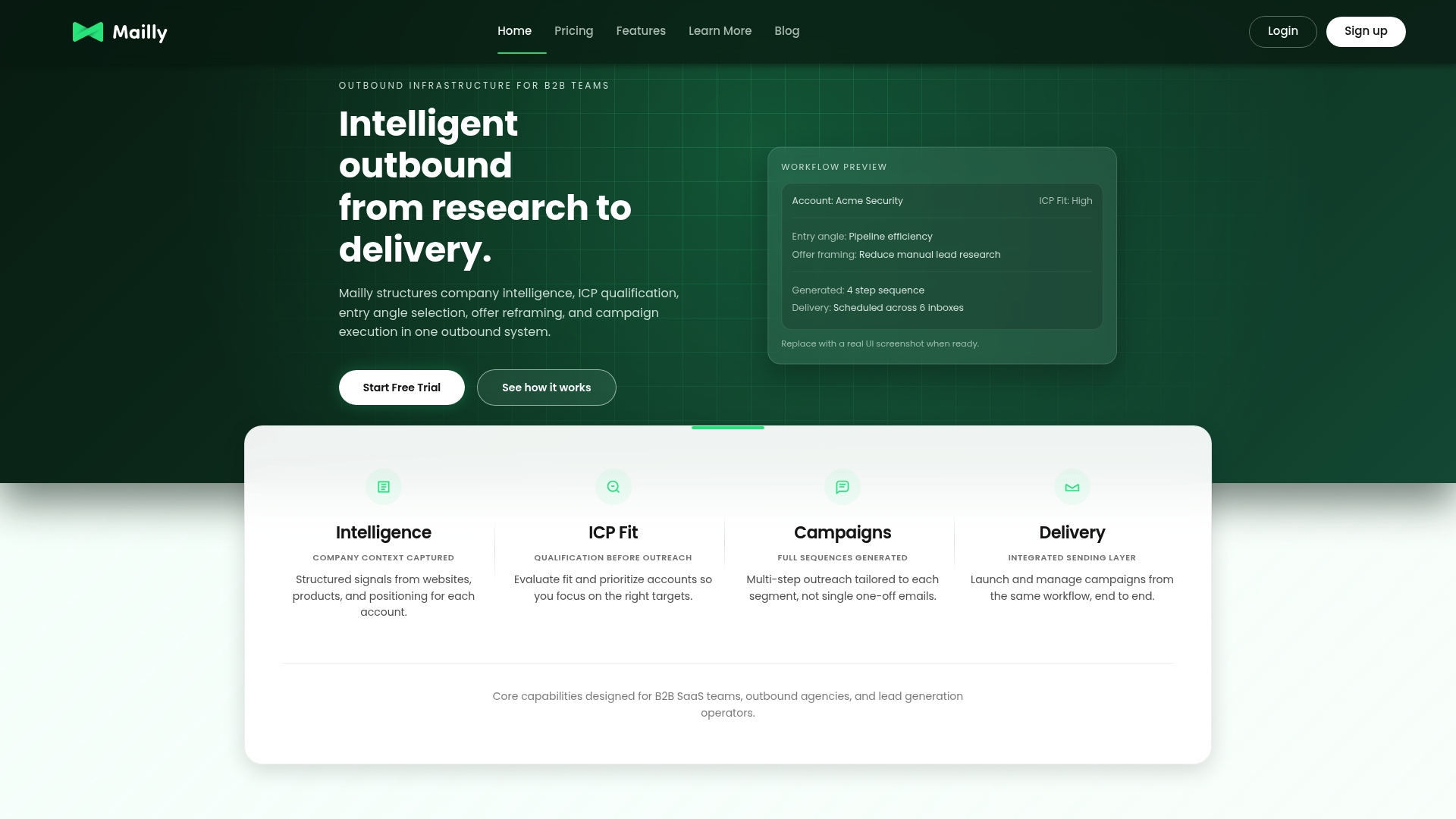
That is exactly where Mailly shines. As an AI-powered outbound strategy engine, Mailly goes beyond simple personalization by analyzing company positioning, product architecture, hiring signals, and more. It transforms cold email campaigns into carefully sequenced, psychologically relevant conversations designed for impact and engagement. This level of insight directly addresses the article’s call for meaningful, context-rich communication that respects recipient time and demonstrates genuine understanding.
Discover how Mailly can revolutionize your outreach and turn cold emails into powerful business dialogue. Visit Mailly to explore solutions that bring deep personalization to your campaigns. Learn more about our AI-powered outbound strategy that begins with research, not copy, ensuring your offers resonate where it counts.
Looking to break free from templated emails and increase your B2B engagement now
Start crafting intentional, relevant emails today with Mailly and see how advanced personalization drives better responses and meaningful connections.
Frequently Asked Questions
What is cold email personalization in B2B?
Cold email personalization in B2B involves tailoring outreach messages to reflect a deep understanding of each prospect’s unique business context, challenges, and needs, rather than relying on generic templates.
Why is deep contextual research important for cold email effectiveness?
Deep contextual research enhances cold email effectiveness by providing insights that allow for highly relevant and targeted messaging, ultimately leading to improved engagement and response rates.
What are some common myths about cold email personalization?
Common myths include the belief that simply using a recipient’s name or referencing a recent post makes an email feel personalized. True personalization requires deeper insights and understanding.
How can personalization improve engagement rates in cold outreach?
Personalization improves engagement rates by addressing specific pain points, showcasing genuine understanding, and creating a sense of relevance that makes recipients more receptive to the communication.
